
 E-Paper



Delhi to open neighbourhood shops outside Covid hot spots
Delhi’s salons, barber shops, liquor stores and restaurants will remain closed and e-commerce platforms will be allowed to sell only essentials.


Delhi decided to open all neighbourhood stores, even those selling non-essentials, in areas outside hot spots of the coronavirus disease (Covid-19) on Saturday, a day after the Union home ministry allowed the conditional operation of stand-alone retail outlets, even as Maharashtra and a few other regions chose not to relax restrictions over fears of the outbreak spiralling out of control.
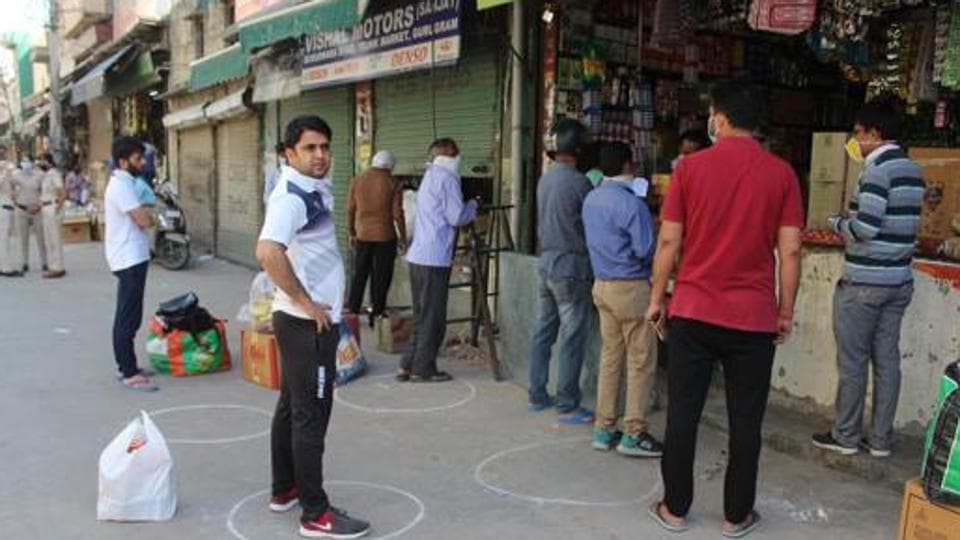
Delhi’s salons, barber shops, liquor stores and restaurants will remain closed and e-commerce platforms will be allowed to sell only essentials.
The tentative easing of restrictions under the national lockdown – in place till May 3 – did not include shopping malls, liquor and cigarette shops and sale of non-essential items through e-commerce platforms. Releasing the revised guidelines late on Friday, the home ministry said neighbourhood and stand-alone shops, including those located in residential complexes, were allowed to resume operations with immediate effect.
A Delhi government official said shops selling non-essential products too can open, but not in Covid-19 containment zones. “No activity will be allowed in containment zones,” the official said, adding that other restrictions on industries and private organisations remained in place.
The national capital currently has 92 containment zones, areas where clusters of the infection have prompted hard lockdowns. Residents in these hot spots are not allowed to step out of their homes, with the authorities home-delivering essentials to their doorstep.
India is among dozens of countries across the world that have been forced to take the tough decision of locking down their populations at home to halt the spread of the pathogen that has killed at least 200,000 people. While crucial to break the chain of infections, these measures gravely threaten economic activity, with many likely to lose their jobs or have their pay cut as nations brace for a recessionary period.
The central government said that while malls will remain shut, markets in rural areas can open. While allowing these shops to operate, a move seen as a relief to both traders and consumers , and seen as an important step towards reviving economic activity, the government said that the establishments will function with 50% workforce and after adhering strictly to precautions, including social distancing and wearing masks.
The home ministry clarified on Saturday that only shops engaged in “sale of items” were allowed, which meant barber shops, salons, liquor shops and restaurants (except delivery chains) were not allowed. E-commerce companies were told they could continue delivering only essential items.
Several stand-alone shops opened in Delhi early on Saturday after the late-night announcement of the home ministry. A senior official who attended a meeting at Delhi chief minister Arvind Kejriwal’s office to discuss the matter said that the Delhi Police faced law-and-order problems while trying to get some outlets to close in some areas.
“Actually, the Delhi government was left with no other option than to allow the shops to open because the news spread like wildfire across the city and many owners resumed their business. Altercations with the owners were reported in some parts of north and north-east Delhi. Others would show the MHA order on their WhatsApp,” the official said on condition of anonymity.
The police and the district magistrates informed the CM that it would be impossible to go to pockets of the city and get shops to stop operations now, a second official said. The government later decided to allow the shops to resume operations.
The Delhi government said that a decision to further relax some restrictions of the lockdown will be taken on Monday.
Several outlets such as stationery shops, electronic stores and hardware shops among others were open in different parts of the city on Saturday. Many of those shops, in areas such as Laxmi Nagar and Lajpat Nagar, were closed after police intervention.
The Delhi government’s decision to comply with the Centre’s directive prompted strong reactions from resident welfare associations (RWAs). “This will create crowd on the roads and social distancing will go for a toss. The government’s own projections show that the Covid-19 situation is not good. The CM had two days back said that the number of Covid-19 cases may increase if relaxations are given, then what changed in these two days?” said BS Vohra, president, federation of east Delhi RWAs.
The Centre has allowed states to take their own decisions on opening up shops.
Kerala, which was previously asked by the Centre to withdraw its order allowing restaurants and limited public transport, welcomed the order. “It will ease some pressure,” said chief minister Pinarayi Vijayan.
The state governments in Gujarat, Odisha, Haryana, Uttarakhand, Goa, Karnataka, Andhra Pradesh and Telangana also said they would follow the Centre’s new norms.
“We have to slowly revive economic activity but social distancing has to be maintained. If social distancing is not maintained around the shop, it will be closed by the police and will remain closed till May 3,” Goa chief minister Pramod Sawant said.
Maharashtra and Assam, however, said there would be no immediate let-up in the restrictions.
“We will get more clarity after a video conference with the Prime Minister on Monday,” Maharashtra health minister Rajesh Tope said. “We haven’t taken any decision on the order of the ministry of home affairs as yet. But there will be no further relaxation in lockdown rules till May 3,” he added.
The chief ministers of states are scheduled to have a video conference meeting with the Prime Minister on Monday.
Assam chief secretary Kumar Sanjay Krishna said a decision on opening shops or further activities will be taken only by April 27.
The number of Covid-19 cases in the country crossed 25,000, with the deaths surpassing 800, on Saturday. A month has passed since the lockdown was clamped across the country, and data shows that the sweeping measure has slowed the spread of the disease.
The latest order issued by Union home secretary Ajay Bhalla, which was an addendum to the April 15 guidelines, said: “All shops registered under the Shops and Establishment Act of the respective State/UT, including shops in residential complexes and market complexes, except shops in multi-brand and single-brand malls, outside the limits of municipal corporations and municipalities, with 50 per cent strength of workers with wearing of masks and social distancing being mandatory (will be allowed to function).”
“All shops, including neighbourhood shops and stand-alone shops, shops in residential complexes, within the limits of municipal corporations and municipalities, registered under the Shops and Establishment Act of the respective State and UT (will be allowed),” it added.
Later, the home ministry issued clarifications on its order. “In rural areas, all shops, except those in shopping malls are allowed to open. In urban areas, all standalone shops, neighbourhood shops and shops in residential complexes are allowed to open,” it said .
“Shops in markets/market complexes and shopping malls are not allowed to open,”the ministry said in a statement.
A senior home ministry official, who spoke on condition of anonymity, said that gyms, bars, sport complexes and theatres will not be allowed to function as they provide services, not the sale of items.
Dealers of electronics and electrical items and other shops in residential areas outside containment zones in urban centres can now open.
“The latest decision will reopen major economic activity in rural, semi-rural and even urban areas and concerns raised by people on social media about non-availability of certain items will now be addressed,” said a senior government official, asking not to be named. “However, everyone should observe complete safety measures as we are still in a critical phase of the Covid-19 spread,” the official added.
The latest order is likely to benefit rural areas the most, opening up commercial activities further as all non-essential items will now be available to the public through shops.


