
 E-Paper



Delhiwale: The portrait of a successful man
“Dilli and Majhiaon are both alike for me,” explains Daya Shankar Singh. In his early 40s, Mr Singh is referring to the city where he came into his own and to the village in Bihar where he was born.


Like most of us, he is staying at home — but he’s away from home at the same time.
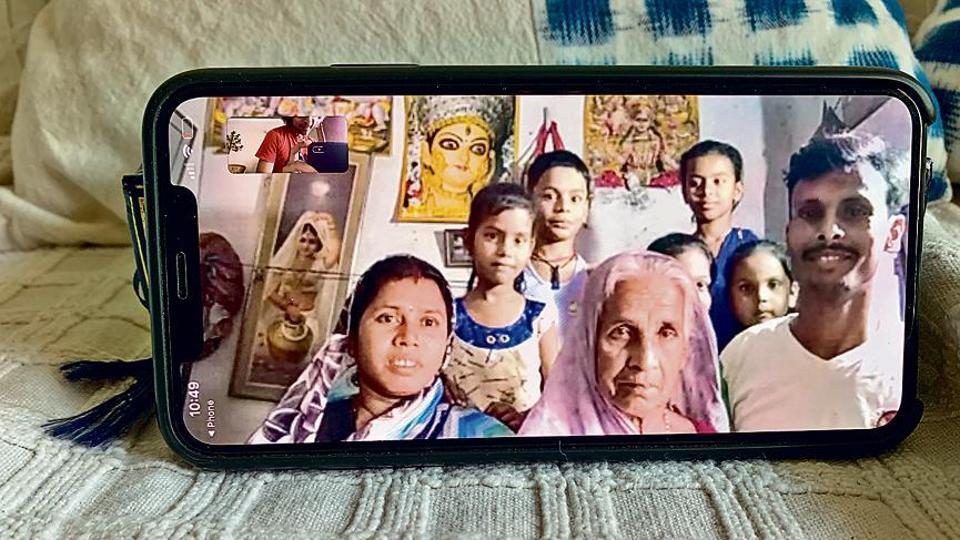
And this is because he has two homes.
“Dilli and Majhiaon are both alike for me,” explains Daya Shankar Singh. In his early 40s, Mr Singh is referring to the city where he came into his own and to the village in Bihar where he was born. And by “Dilli”, he doesn’t mean Delhi but Gurugram, in the National Capital Region, where he has been working as a bookstore assistant since 2005.
At the moment, Mr Singh is in his village house, where his family lives. He boarded a train from New Delhi railway station just before the announcement of the nationwide lockdown caused by the coronavirus pandemic. “Nobody has the virus in the village,” he says, talking on WhatsApp video. The gentleman’s voice is balmy and hearing him speak plunges one into soothing illusions, as if all wars had ended and the world was at peace. He shows his home through the phone screen that connects him to this reporter. There is his mother, Sukwaro Devi, wife, Lalita Devi, and five children—Anju, Sanju, Raj, Kajal and Usha. Playful Usha is constantly crashing into the screen by rushing behind her father’s back. The walls are decked with posters of gods and goddesses.
How can Mr Singh spend most of his time so far from his small children, one might wonder.
There is the matter of earning money, of course. “But I have a family in Dilli too.” He is talking of four friends with whom he shares a one-room dwelling in Gurugram’s Chakkarpur village. In fact, Mr Singh says that, to him, the whole of Gurugram looks like his village. “In Gurgaon, I keep bumping into people from my Bihar village or from the neighbouring villages.” Most of these acquaintances, he says, happen to work in the city as security guards, car park attendants and food delivery men. Two of Mr Singh’s roomies also work as guards. He is the only bookstore assistant he knows. “But I also started as a guard”, he says.
Years ago, a bookstore owner asked a security guard at duty in the Galleria Market if he could help her find some educated person for her shop. That night, the guard thought for a long time about his own potential. Next morning he went to her shop, still holding on to his lathi (wooden baton), and offered the shop owner his own services. The woman might have been surprised — and unsure. The man was a school drop-out. She took out a book from a shelf and asked him to read the title written in English. “It was Two Lives, by Vikram Seth... I read it immediately,” recalls Mr Singh. He was hired.
Now, holed up in his village, Mr Singh feels contended with his life, despite early adversities—“Father died, I couldn’t study beyond class 10th.”
He was 26 when he decided to move to Delhi. His wife pleaded him not to leave the village and to stay with her. “I said we have nothing... I have to go.”
He took the bus to the nearest railway station in Ara and from there he boarded the Delhi-bound Jan Sadharan Express, a train “that only has general compartment coaches, which are cheap and for which you don’t need previous booking.” It took him 16 hours to reach the Capital. On the way, the only thing he ate was the home-cooked litti that his wife had packed for him in a plastic bag.
Over the years, Mr Singh would regularly return home to visit the family “but Delhi too became home.”
These days, as the pandemic rages across the world, and as the bookstore in which he works stays closed, Mr Singh is busy growing channa and masoor dal on his little piece of land, which he would rent to other farmers while in Delhi. He has no plans to be a farmer though, he quickly clarifies. “I’m missing the bookshop, missing meeting the customers, talking to them, seeing new things...”
He is hopeful that the lockdown will soon be history so that he can return to Delhi. Now he gathers his family to pose for a formal portrait, and he stands among them with the quiet confidence of a successful man.


