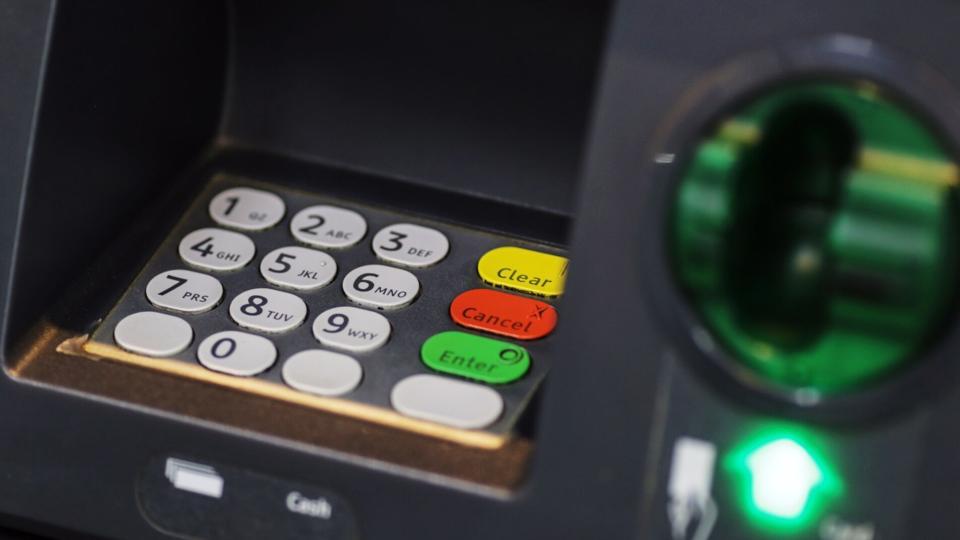
Discuss facial identification cameras at ATMS with banks, high court to Odisha
A bench of justices Sangam Kumar Sahoo and Chittaranjan Dash said people making transactions in ATMs conceal their identity by covering their faces
The Orissa high court has directed the state government to discuss with banks and the Reserve Bank of India a proposal to install ‘facial biometric identification systems’ at ATMs so that people who use the facility for illegal activities can be identified.

A bench of justices Sangam Kumar Sahoo and Chittaranjan Dash said in many cases, people making transactions in ATMs conceal their identity by covering their faces.
“We find that in many cases, a number of persons are making transactions in ATMs concealing their identity by covering their faces or by adopting some other methods. Therefore, if proper steps are taken by the bank authorities to install facial biometrics identification process at ATMs when the user approaches the ATM, the system would ask the user to show his face to the camera,” the Court said.
The court also observed that ATM security cameras can monitor and record potential ‘skimming operations’
Also, the bench added: “If somebody steals ATM PIN (Personal Identification Numbers) and uses the card for withdrawal of money or for making any transaction, the same can be recorded which would facilitate to ascertain the person’s identity, especially in cases where money is withdrawn illegally using ATM cards”.
The direction was passed in a habeas corpus case filed by a man about his minor daughter’s disappearance in the Bhadrak district. The investigator told the police that a man was spotted withdrawing money in Kendrapara district from his wife’s bank account but he could not be identified because he had covered his face.
ABOUT THE AUTHORDebabrata MohantyDebabrata Mohanty is a senior assistant editor of Hindustan Times who works as state correspondent from Odisha covering the state's politics, governance, public policy, natural disasters, environment and its society for close to three decades. With his long years of reporting from the state capital of Bhubaneswar, Mohanty has been known as one of the most experienced and credible journalists covering Odisha for the national English dailies. His reporting combines on-ground detail with deep institutional knowledge detailing the state's changing politics, governance issues, administrative reforms and the functioning of its public institutions. He has regularly reported on issues ranging from legislative developments and public policy implementation. Politics is his core areas of expertise as he closely tracks Odisha's political landscape, including the rise and transformation of the Bharatiya Janata Party (BJP), the Biju Janata Dal (BJD), the two principal political parties in Odisha. His long association with the state's political establishment enables him to write on contemporary developments in a larger political context. Mohanty takes a deep interest in writing human interest stories, environmental issues and documenting the impact of cyclones, floods, heatwaves, and other climate-related events in one of the most disaster-prone states. His coverage extends to public health, governance reforms and stories on accountability of government institutions. Before joining Hindustan Times, Mohanty worked with The Indian Express, Mail Today, and The Telegraph, where he covered at least six general elections and as many assembly elections. In 2007, he was selected for the prestigious Chevening Young Indian Print Journalist Programme at the University of Lincoln, United Kingdom, where he received advanced training in print journalism. In 2009 he won the Press Institute of India-International Committee of Red Cross award on conflict reporting for his on-ground reportage of 2008 Kandhamal riots.Read More

E-Paper