
 E-Paper



Southern shift puts NDA closer to ‘magic number’ required for delimitation bill in Parliament
If the bills pass, it will make the Lok Sabha the world’s largest directly elected national legislative chamber.


The National Democratic Alliance (NDA) inched closer to crossing the two-thirds mark in both Houses of Parliament as government managers expressed confidence they’ll push through two bills that expand the Lok Sabha to a maximum of 850, proportionally increase the seats in every state and Union Territory by 50%, and freeze the arrangement for the next 25 years.
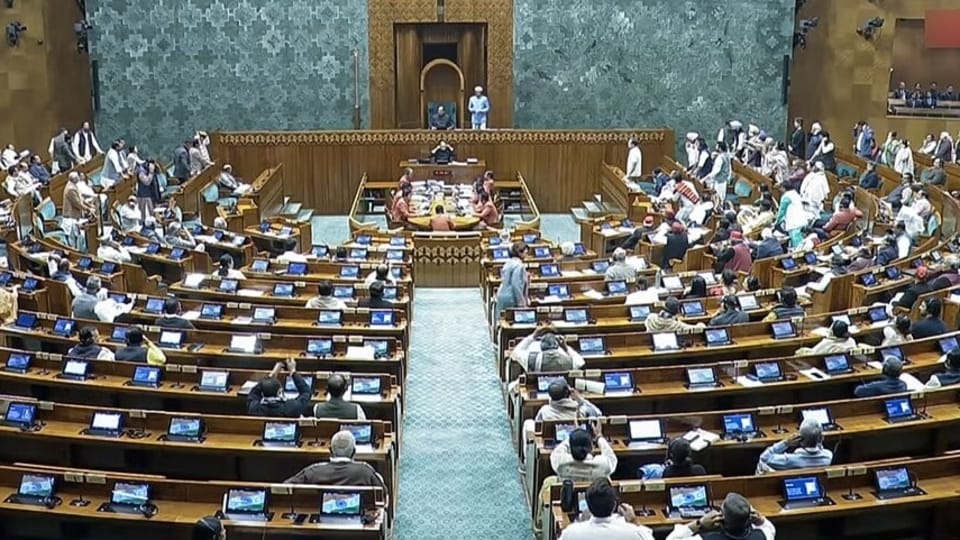
The NDA was buoyed by pledges of support from the Dravida Munnetra Kazhagam (DMK), the Bharat Rashtra Samithi and the YSR Congress Party, and signals of willingness to engage from the Nationalist Congress Party (Sharadchandra Pawar) and the Jharkhand Mukti Morcha.
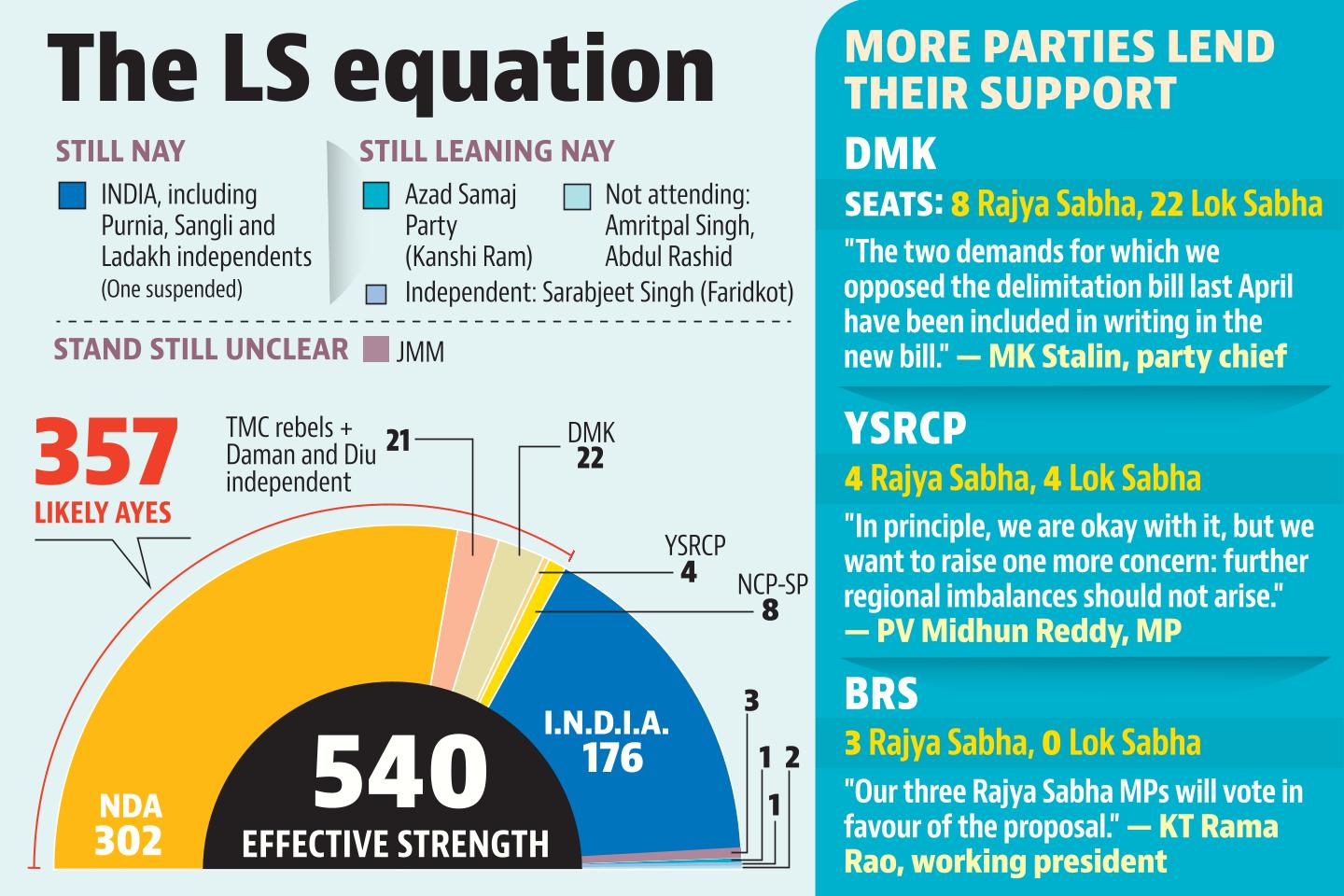
Together, the NDA appeared just a few seats short of the special majority mark in the Lok Sabha where three seats are vacant and three other parliamentarians – Engineer Rashid from Jammu and Kashmir and Amritpal Singh from Punjab are incarcerated, and Kalyan Banerjee from West Bengal is suspended – are unlikely to attend the special sitting beginning Monday. In the Rajya Sabha, with backing of the DMK and unaligned parties such as the YSR Congress, the NDA appeared set to cross the two-thirds mark.
Deep Dive

“With the Lok Sabha’s strength set to rise by 50%, from the existing 543 seats to 816, every state and Union Territory stands to witness an expansion in its parliamentary representation,” Union law minister Arjun Ram Meghwal said on X. Government managers said they were confident that more small parties from the INDIA bloc, especially those from southern India, will back the bills.
The developments came a day after Union Cabinet cleared the 132nd Constitution Amendment Bill and the Delimitation (Second) Bill, which also pave the way for implementing 33% reservation for women immediately after the delimitation exercise, set up delimitation commissions for the purpose, and effect a proportional rise of 50% in the strength of state assemblies, with a cap of 650 – relevant for Uttar Pradesh. The seats reserved for women will be rotated in accordance to the delimitation commission’s order and be in place for 15 years.
If the bills pass, it will make the Lok Sabha the world’s largest directly elected national legislative chamber. A constitution amendment bill will require two-thirds majority in the Lok Sabha and Rajya Sabha and 50% of all states to ratify.
“We had made a promise to our Nari Shakti and we remain committed to fulfilling it,” Prime Minister Narendra Modi said on X.
The DMK – whose two conditions of 50% proportional increase in the state’s share of Lok Sabha seats and a freeze on the arrangement till 2051 were met in the bills – announced its support, with senior leader A Raja saying the decision followed deliberations at a meeting of party parliamentarians chaired by president M K Stalin.
“DMK supports the bill incorporating the demands of fair delimitation. The two demands for which we opposed the delimitation bill last April have been included in writing in the new bill. This is a victory for the sustained struggles waged by the DMK since 2024! A victory for all the southern states, including Tamil Nadu!” Stalin posted on X.
“We must think calmly, without getting emotional, about what would happen if we missed this delimitation bill, which provides for a 50% increase in constituencies for all states based on the 1971 population. After thoroughly examining all these issues, the DMK has decided at today’s meeting of MPs to support delimitation in this form, which is feasible in practice and beneficial to us,” he added.
The DMK has 22 MPs in the Lok Sabha and eight in the Rajya Sabha.
The YSR Congress – which has four MPs in the Lok Sabha and four in the Rajya Sabha – also signalled its support.
“The reason was the 50% proportionate increase in seats. The Centre assured us of this. This time, they have included it in the bill. In principle, we are okay with it, but we want to raise one more concern: further regional imbalances should not arise,” party MP PV Midhun Reddy said.
The BRS – which has no MPs in the Lok Sabha and three in the Rajya Sabha – announced its support.
“Our stand on delimitation has always been clear: No reduction in South India’s parliamentary representation. No injustice to Telangana will be tolerated…Keeping Telangana’s interests paramount, our three Rajya Sabha MPs will vote in favour of the proposal. We have always supported women’s reservation and remain committed to its implementation,” party working president KT Rama Rao said on X.
With the backing of the DMK, BRS, YSRCP, TDP, Jana Sena and JD(S), almost 60% of all MPs from southern states are expected to support the delimitation exercise. The 50% increase in seats was the only formula that could have protected the interests of the southern states and implemented women’s reservation immediately, said people aware of the matter.
In April, the government introduced the 131st Constitution Amendment bill and two other linked legislation to operationalise women’s reservation and implement delimitation. But the bill failed to garner the required majority in the face of united Opposition. It was the first time a constitution amendment bill failed to get the required strength in the Lok Sabha since 2011, when a bill to give the Lokpal constitutional status was defeated.
But since then, unprecedented churn in the Opposition ranks – rebellion within the Trinamool Congress and Shiv Sena (Uddhav Balasaheb Thackeray) – as well as willingness from the Dravida Munnetra Kazhagam and the Nationalist Congress Party (Sharadchandra Pawar) have indicated that the NDA might be more successful this time.
Delimitation has been an explosive issue in India since the 1970s when zooming populations and demographic differences first started causing anxieties. The Constitution mandated regular delimitations after every census but the size of the Lok Sabha was frozen in 1971 in the face of protests from southern states, which argued that they shouldn’t be penalised for controlling their populations better than the northern states. The freeze was extended in 2021.
Government managers acknowledged the arrangement didn’t advantage north India but pointed out there are always compromises and push-pulls in a diverse democracy of India’s size.
Under the new constitutional amendment bill, the maximum strength of the Lok Sabha will rise to 815 members from states and 35 from Union territories (it is 530 and 20 now, respectively), while the maximum strength of state legislative assemblies will increase to 650. The proposed 50% expansion will apply to the existing allocation of seats in each state and Union territory, thereby preserving their relative share in the Lok Sabha rather than redistributing representation according to population differences. This will translate to women getting around 270 reserved seats in the Lower House if the bills are passed and the act comes into effect.


