E-Paper



‘Don’t sensationalise’: SC says no urgent listing of hijab case
A bench, headed by Chief Justice of India (CJI) NV Ramana, declined to put a date to hearing these cases for the second time after a batch of appeals lined up before the top court to assail the Karnataka high court’s March 15 verdict.

 Prefer HTon Google


Cases pertaining to the ban on hijab have nothing to do with school examinations and the matter should not be sensationalised, the Supreme Court remarked on Thursday as it refused to urgently list a clutch of petitions against the Karnataka high court’s ruling that wearing of the headscarf by Muslim women does not form a part of essential religious practice in Islam.
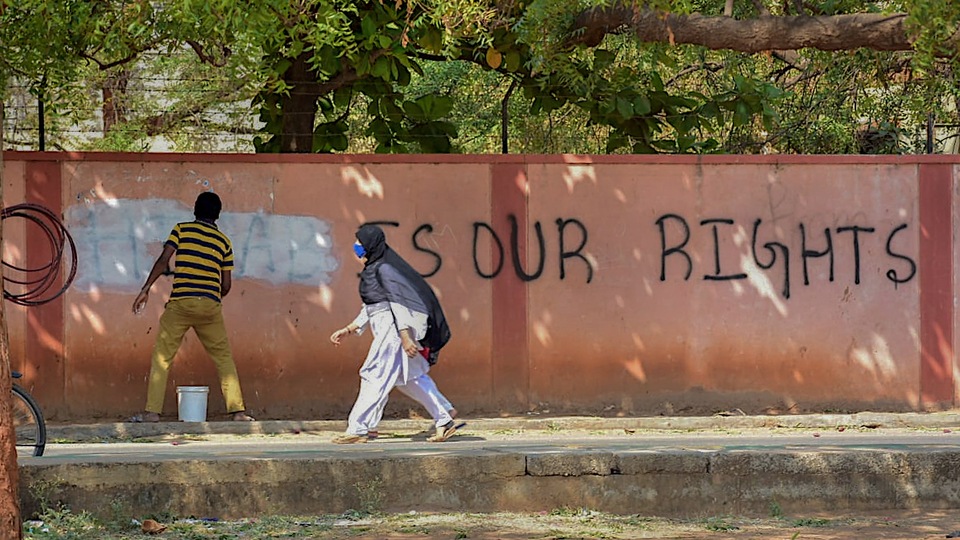
A bench, headed by Chief Justice of India (CJI) NV Ramana, declined to put a date to hearing these cases for the second time after a batch of appeals lined up before the top court to assail the Karnataka high court’s March 15 verdict.
On March 16, the CJI refrained from indicating any date of hearing after senior counsels Sanjay Hegde and Devadatt Kamat urged the court to urgently list the matter.
On Thursday, Kamat, appearing for girl student Aishat Shifa, made yet another attempt to obtain an early date of hearing on the ground that the girls wearing hijab would not be able to sit for the upcoming exams in Karnataka due to the high court judgment, which has affirmed the state government’s prohibitory orders against hijab.
“Exams are approaching. These girl students are not being allowed to enter schools and colleges. One year will go to waste,” Kamat rued.
But the bench, which also comprised justice Krishna Murari, remained unmoved. “This has nothing to do with exams… don’t sensationalise the issue,” the CJI retorted.
At this point, solicitor general Tushar Mehta also intervened on behalf of the Karnataka government. “What is this? What is so urgent that they are repeatedly mentioning this matter?” Mehta questioned. Justice Ramana, however, asked Mehta to refrain from arguing any further and simply went on to take up the next matter listed in the court’s business.
On March 15, a full bench of the Karnataka high court declared that wearing of hijab is not mandatory in Islam. It upheld the ban on the headscarf imposed by the state government in schools and colleges through a February 5 executive order which led to massive protests and counter-protests across the state and in several other cities across the country.
The high court’s three-judge bench, headed by chief justice Ritu Raj Awasthi, held that the Quran does not mandate wearing of hijab for Muslim women and that the attire “at the most is a means to gain access to public places” and a “measure of social security”, but “not a religious end in itself”.
The high court also favoured a “speedy and effective” investigation into the stoking of the hijab controversy in Karnataka, suspecting some “unseen hands at work to engineer social unrest and disharmony in the state”.
Dismissing a bunch of petitions filed by some girl students pressing wearing of hijab as their religious right protected under the Constitution, the high court upheld the state government’s authority to prescribe uniform in educational institutions under the Karnataka Education Act while declaring that “adherence to dress code is a mandatory for students”.
Hours later, one of the petitioners, Niba Naaz, filed an appeal in the Supreme Court challenging the high court verdict. Naaz’s petition, which was mentioned by senior counsel Hegde on March 15 before the CJI, argued that that the high court erred in creating a dichotomy of freedom of religion and freedom of conscience wherein the court has inferred that those who follow a religion cannot have the right to conscience.
“The Hon’ble High Court has failed to note that the right to wear a hijab comes under the ambit of ‘expression’ and is thus protected under Article 19(1)(a) of the Constitution. It is submitted that clothing and appearance fall within the ambit of the right of expression guaranteed under Article 19(1)(a) of the Constitution,” it added.
Aishat Shifa, another petitioner before the high court, also filed an appeal in the Supreme Court a day after the high court judgment. The petition by students of PU College in Udupi – the epicentre of the original protests seeking to wear the hijab – was mentioned by Kamat for an urgent hearing on March 16 when the court said it would look into the plea but did not set down the cases for hearing.
The high court verdict has drawn mixed reactions. While Karnataka chief minister Basavaraj Bommai-led Bharatiya Janata Party government commended the judgment, some of the petitioner girls expressed their dismay at the reasoning of the verdict and complained of its far-reaching repercussions on their religious rights.