E-Paper



In China, EAM urges SCO to take stand against terrorism
External Affairs Minister S. Jaishankar urged the SCO to adopt a firm stance against terrorism, stressing the need for cooperation amid global disorder.

 Prefer HTon Google


The Shanghai Cooperation Organisation (SCO) should adopt an “uncompromising” position on combating terrorism and extremism, external affairs minister S Jaishankar told a meeting of the bloc on Tuesday, hours after he met Chinese President Xi Jinping and apprised him about recent developments in bilateral ties.
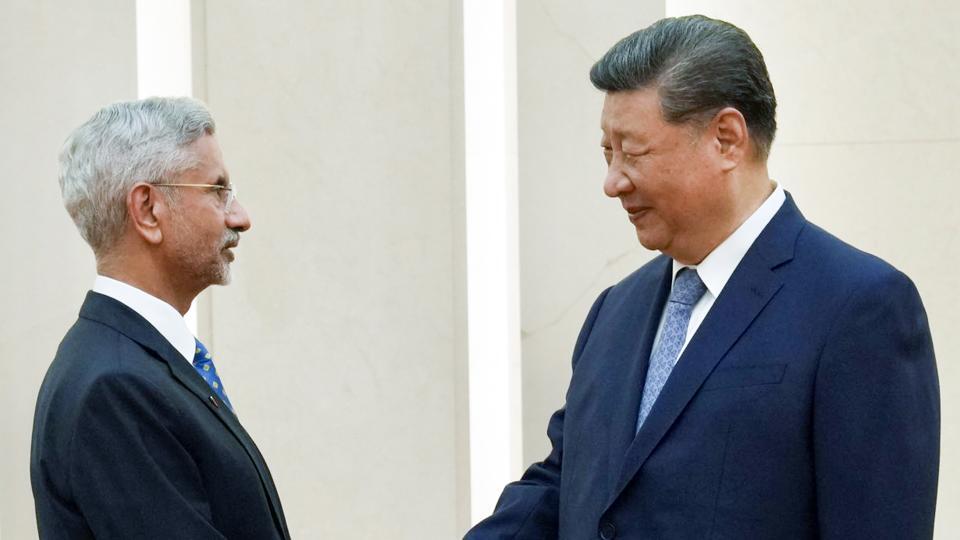
Jaishankar met Xi along with other foreign ministers of the member states of SCO. The meeting was held before the foreign ministers participated in a conclave in Tianjin.
“Apprised President Xi of the recent development of our bilateral ties. Value the guidance of our leaders in that regard,” Jaishankar said in a social media post, referring to his meeting with Chinese foreign minister Wang Yi on Monday. He also conveyed the greetings of President Droupadi Murmu and Prime Minister Narendra Modi to Xi.
Later in the day while addressing a gathering that included his Pakistani counterpart Ishaq Dar, Jaishankar said the April 22 Pahalgam terror attack was “deliberately conducted” to undermine the tourism-based economy of Jammu & Kashmir and to create a religious divide.
He also told the SCO Council of Foreign Ministers Meeting in Tianjin that the members of the grouping face the challenge of stabilising the global order and de-risking various dimensions of it amid considerable disorder, conflicts, competition and coercion.
Jaishankar noted that SCO was founded to combat the “three evils” of terrorism, separatism and extremism, which often occur together. “It is imperative that the SCO, to remain true to its founding objectives, take an uncompromising position on this challenge,” he said in a lengthy social media post on his speech.
He described the Pahalgam terror attack as a graphic example of terrorism, separatism and extremism. “It was deliberately conducted to undermine the tourism economy of Jammu and Kashmir, while sowing a religious divide,” he said.
“The UN Security Council, of which some of us are currently members, issued a statement that condemned it in the strongest terms and ‘underlined the need to hold perpetrators, organisers, financiers and sponsors of this reprehensible act of terrorism accountable and bring them to justice’. We have since done exactly that and will continue doing so,” he added.
India launched Operation Sindoor on May 7 to target terror infrastructure in territories controlled by Pakistan in retaliation for the Pahalgam attack. This triggered four days of hostilities with Pakistan, which is currently a member of the UN Security Council, before the two countries reached an understanding on May 10.
Jaishankar’s remarks urging SCO to take on an “uncompromising” position towards terrorism came against the backdrop of disquiet in India over China’s support for Pakistan during the recent hostilities. In the past, China has blocked efforts by India and its partners to sanction Pakistan-based terrorists at the UN Security Council. Last month, a meeting of SCO defence ministers couldn’t adopt a joint communique after Pakistan objected to a reference to the Pahalgam terror attack in the document. Indian defence minister Rajnath Singh refused to endorse the communique.
During his address, Jaishankar said the SCO foreign ministers were meeting amid “considerable disorder in the international system”, with more conflicts, competition and coercion occurring in the last few years.
“Economic instability is also visibly on the rise. The challenge before us is to stabilise the global order, de-risk various dimensions and through it all, address longstanding challenges that threaten our collective interests,” he said.
Jaishankar raised the situation in Afghanistan, which has been on the SCO agenda for long. “The compulsions of regional stability are buttressed by our longstanding concern for the well-being of the Afghan people. The international community, particularly SCO members, must therefore step up with development assistance. India, for its part, will certainly do so,” he said.
India will continue to positively approach new ideas and proposals at SCO and has also taken several initiatives of its own in areas ranging from start-ups and innovation to digital public infrastructure. However, it is essential that such cooperation is “based on mutual respect, sovereign equality and in accordance with territorial integrity and sovereignty of member states”, he said.
His remarks were apparently a reference to China’s connectivity project, the Belt and Road Initiative (BRI), a key part of which passes through Pakistan-Occupied Kashmir.
Deepening collaboration within SCO requires more trade, investment and exchanges, Jaishankar said. “For that to move to the next level, it is imperative that we address some current issues. One of them is the lack of assured transit within the SCO space,” he said.
This absence of transit arrangements “undermines the seriousness of advocating cooperation in economic areas”, he argued. The SCO members should also promote the International North South Transport Corridor (INSTC), which Jaishankar said will continue to gather momentum.
The INSTC is a 7,200-km multi-mode transport project for moving freight among India, Iran, Afghanistan, Armenia, Azerbaijan, Russia, Central Asia and Europe. India has been supporting the project and has pushed for linking the INSTC to Iran’s Chabahar port, where an Indian state-run firm operates a terminal.
Jaishankar contended that SCO’s ability to contribute to shaping world affairs will depend on the member states coming together on a shared agenda. “That means taking everybody on board,” he said.
“The world is today moving towards greater multipolarity. This is not just in terms of redistribution of national capacities, but also the emergence of effective groupings like SCO,” he said.
On Monday, Jaishankar had told his Chinese counterpart Wang Yi that India and China must build on “good progress” in normalising their relations by addressing issues related to the border, including de-escalation, and avoid “restrictive trade measures and roadblocks” to economic cooperation. He had also reiterated that stable bilateral ties can be built only on the basis of mutual respect, mutual interest and mutual sensitivity.
This is Jaishankar’s first visit to China since ties were hit by border skirmishes in April-May 2020, though he has met Wang on the margins of multilateral events several times since the two sides reached an understanding on ending a face-off along the Line of Actual Control (LAC) last October.