E-Paper



Economy versus ecology: Tourism quandary vexes Lakshadweep
HT, in a series supported by the Pulitzer Center, looks at the changes that have hit Lakshadweep, the archipelago off India’s southwest coast.

 Prefer HTon Google


Agatti/Kavaratti: Everyone in Agatti knows about the tent city coming up along the lagoon. Ask any auto driver and he will zoom past the coconut groves to a stretch of the white beach where construction material including pre-fabricated aluminium columns, steel meshes, and mounds of concrete can be found.
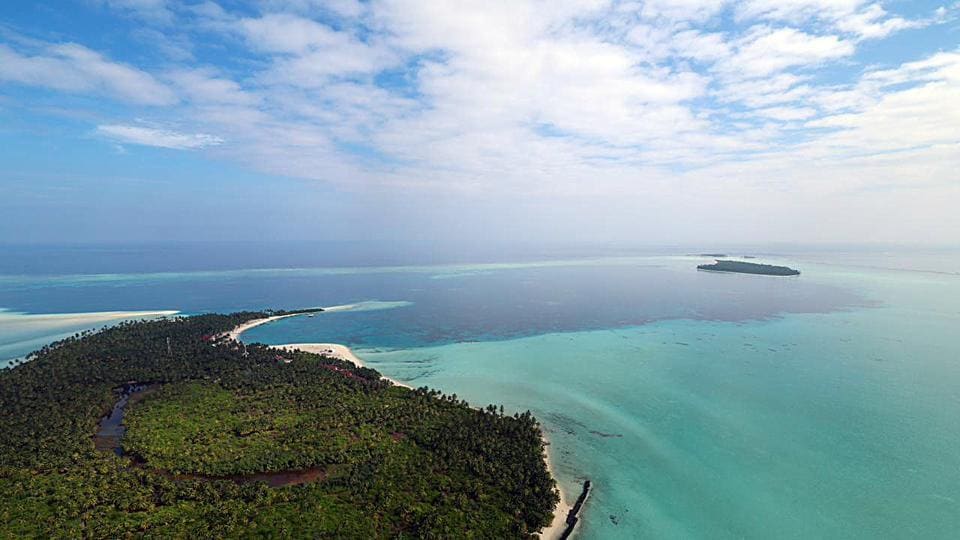
Similar tent cities are coming up in Bangaram and Thinnakara — these are among the latest efforts to build luxury tourist infrastructure in Lakshadweep. HT filed an RTI (right to information) application seeking information on the projects planned in Lakshadweep islands to boost tourism. In response, the tourism ministry said the UT had been identified as a destination for development under the government’s Swadesh Darshan 2.0.
Separately, a Niti Aayog document titled: “Transforming the Islands through Creativity and Innovation” from 2019 said a Strengths, Weaknesses, Opportunities and Challenges (SWOC) analysis found strong justification for water villas in Lakshadweep. Since, according to the analysis, Lakshadweep has a lagoon area of 4,000sq km, a strategy for water villas at suitable sites was formulated.
For promotion of tourism, water villas were also planned.
While the projects have been envisioned to provide a glimpse of Lakshadweep’s lagoons up close, their impact on corals, lagoon water and fishers remains a huge concern. Most experts agree that a boost in tourism could help generate revenue for islanders.
But, locals are anxious. They have three main worries: how will fishermen access lagoons if they are taken over for beach villas/tent cities/lagoon villas? How will a sudden spike in tourism impact fragile coral ecosystems underwater? Why are locals not part of the decision-making process or beneficiaries in this tourism boom?
According to documents on the environment ministry’s Parivesh website, M/S Praveg Limited, a Gujarat-based tourism company has sought island clearance regulation zone (ICRZ) approval for building “a resort facility, encompassing accommodation, dining, recreational amenities, and associated infrastructure”, in Agatti, with a built-up area of 2001.5 m2.
The firm advertises it thus on its website: “Discover the breathtaking Agatti, Thinnakara, and Bangaram Islands… Experience serenity and opulence with our cocoon-shaped, well-appointed tents, taking tented accommodation to the next level. Make your special day even more memorable with our exceptional destination weddings, corporate events, and private gathering spaces.”
The company is yet to respond to HT’s queries on the capacity of these tent cities, when they start functioning, and the nightly charges, apart from details of compliance with the Island Coastal Regulation Zone Regulation 2019.
A delicate balance
Experts have also said that the way certain checks were bypassed to make way for these projects may set an unhealthy precedent for projects in other coastal areas.
In 2020, the Union environment ministry granted CRZ clearance for the construction of water villas in Suheli, Minicoy, and Kadmat, documents on the Parivesh website show. Work on these, however, has not started yet, according to islanders.
Until the clearance, water villas on the islands were prohibited as they fall in the no-development zone (NDZ).
A Supreme Court-appointed committee led by former judge RV Raveendran, in July 2014, recommended that the NDZ be a uniform 20m area from the high tide line (HTL) all along the coast of Lakshadweep islands. The remaining portions will be developed according to the Integrated Island Management Plans (IIMPs), it added.
“Considering the fragile ecosystem”, the report also underlined that all development plans under IIMPs should be implemented in consultation with elected self-governing bodies.
But documents accessed by HT indicate that these recommendations were not followed. To begin with, the IIMPs formulated according to the recommendations of the committee were amended.
According to the minutes of Lakshadweep Coastal Zone Management Authority dated February 18, 2020, the director of the National Centre for Sustainable Coastal Management presented the revised IIMP maps for Minicoy, Suheli, and Kadmat, with areas earmarked for lagoon villas in the conservation zone.
“MoEFC has already conveyed its approval July 7, 2019 for the revision of IIMPs of Minicoy, Suheli and Kadmat to provide for establishment of lagoon villas as a regulated activity in lieu of it being a prohibited activity,” it said.
The minutes further state that expert members of the authority pointed out that it was imperative to inform the Supreme Court about the impending changes to IIMPs by way of an affidavit.
But, members were informed about the legal opinion of an additional solicitor general who had opined: “…as there are no directions to file any further affidavit regarding the status of how promotion of the eco-friendly tourism in uninhabited island would be determined, the administration may not file.”
Mohideen Wafar, a former scientist with the National Institute for Oceanography, coral reef expert, and one of the expert members of LCZMA mentioned that EIA (environmental impact assessment) reports did not address the impacts of water sports on corals, lagoons, environment, and the reefs, as per the minutes.
In addition, the EIAs were not clear on the nature or degree of restriction of access for the islanders to the project zone.
“The situation in Maldives is very different. It has over 1,000 islands… We have only 10 inhabited islands in Lakshadweep. The corals are precarious due to repeated bleaching. We should consider as much precaution as possible in view of the very fragile ecology and very small atolls with high population density,” said M Wafar, whose term with the LCZMA ended two years ago.
“The rich want exclusive private space. They do not want fishermen to be near the lagoon villas. When most of the population is dependent on the lagoons, why should we deprive them of access?” he asked.
On August 6, new drafts of IIMP for Kadmat, Suheli, and Minicoy were circulated for public comments, and have been reviewed by HT.
The plans mention lagoon villas and yacht tourism as “regulated” activities in the conservation zones which include the lagoons, inter-tidal zones, etc.
Lack of local involvement
“One of the main concerns that we are flagging is that there is no scope for consultation with the panchayat on these developments,” said Misbah Ashiyoda, president of Lakshadweep ST welfare association, Kavaratti.
“If lagoons are given to private corporations, how will fishers access these areas? In a way we are being told that these areas are beyond our reach now. Fishers are already suffering because they cannot go to the Bangaram lagoon,” said BA Jaleel (75), former deputy collector, Agatti.
Others are certain that lagoon villas are impractical and will not last. “The monsoon has become unpredictable. These villas will not last in the monsoon. One big wave can demolish everything,” said P Abu Salem (72), a retired government school teacher.
Their concerns have grown since the administration advertised plans to promote Maldives-like tourism in Lakshadweep.
These concerns began when in 2021, the Administration issued the draft Lakshadweep Development Authority Regulation (LDAR) 2021 to change land ownership in the Union territory to facilitate development and tourism. It empowered the administration to constitute planning and development authorities for the development of any area identified as having “bad layout or obsolete development”.
In response to an RTI application by HT, the home ministry said that LDAR 2021 was not presently under consideration. It said that the Lakshadweep Town and Country Planning, 2024, is under consultation with stakeholder departments and ministries.
Separately, the issue of the takeover of Pandaram Lands — land parcels owned by the government but leased out to islanders against payment of token taxes — has also become contentious.
Calls for intervention
Several scientists and retired civil servants have flagged the impact the projects would have on the islanders and ecology.
“Lakshadweep has experienced catastrophic climate change-related coral mass mortality events, straining the accretion and buffer capacity of the reefs… the reefs of the capital Kavaratti are already eroding more than they are growing. Lakshadweep is not just ecologically fragile but also socially progressive, and it needs a sustainable development framework,” the Lakshadweep Research Collective, a team of ecologists and marine biologists, said in 2021 in a letter to then President Ram Nath Kovind.
“Lakshadweep is home to ecological marvels that are unique to India and the world. By dismantling customary resource use patterns, especially around uninhabited atolls like Suheli and Cheriyam, now earmarked for tourism development, the LDAR threatens biodiversity and has negative implications for human well-being,” Rucha Karkarey, Royal Society Newton International Research Fellow, Lancaster Environment Centre, said in 2021.
Experts believe the people of Lakshadweep are best placed to decide what kind of tourism and development they wish to see on the islands. “By most meaningful well-being indices, Lakshadweep does better than most parts of India. So it is important to ask what development seeks to achieve in the islands. It would be useful, before answering this question, to speak to the people of Lakshadweep, so that they can wrest back some agency in their own futures,” said Rohan Arthur, Scientist, Oceans and Coasts, Nature Conservation Foundation.
There have been objections to the new IIMPs as well.
“I have seen the revised Integrated Island Management plan issued on August 6 and submitted our objections to it,” said Muhammed Hamdullah Sayeed, Congress leader and MP from Lakshadweep.
HT reached out to Lakshadweep administrator Praful Patel Khoda for a comment. His office expressed an inability to respond to the questions immediately.
Some also believe that “the tourism industry can be used for conservation”. “I do not think the tourism industry will destroy itself by doing anything that adversely impacts the coral reefs. On the contrary, I believe the tourism industry can be used for conservation because they have a stake. Instead of marine protected areas, there is now a concept called Other Effective Area-Based Conservation Measures (OECM). Moreover, Maldives is managing well, and no harm in understanding how. We need balance,” said P Krishnan, director, the Bay of Bengal Programme, and marine scientist.