
 E-Paper



‘End terror first’: India's response to Pakistan PM Shehbaz Sharif's ‘peace talks’ desire
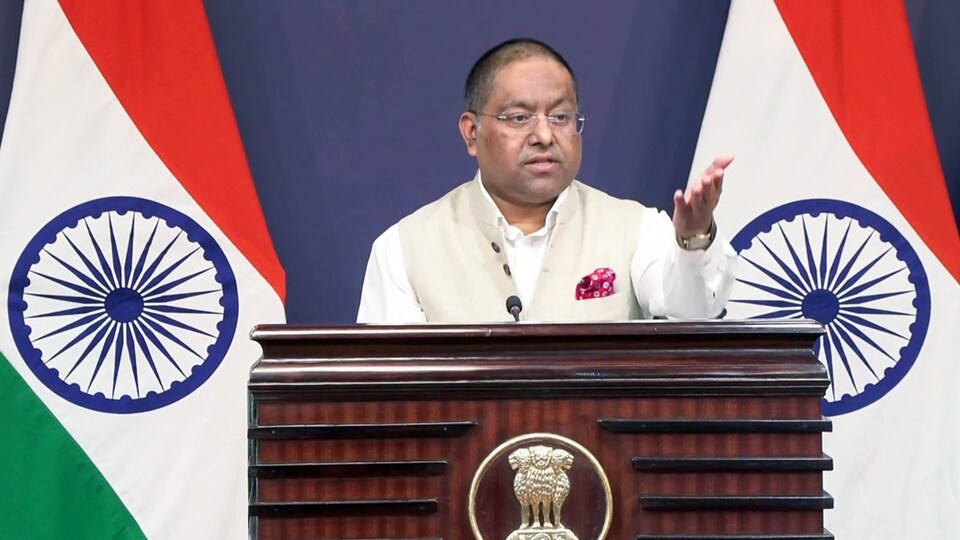
EAM spokesperson Randhir Jaiswal also emphasised that India will only hold talks with Pakistan on the issues of handing over PoK and on terrorism.

 Prefer HTon Google


In a firm message to Islamabad after the deadly Pahalgam attack, India on Thursday reiterated that dialogue with Pakistan will only be possible when it takes robust steps to stop cross-border terrorism.
New Delhi's response came after Pakistan Prime Minister Shehbaz Sharif expressed his state's willingness to hold peace talks with India to resolve all outstanding issues, including Kashmir, terrorism, water and trade.
"We would like to reiterate that terrorism and talks cannot go together," External Affairs Ministry Spokesperson Randhir Jaiswal said at his weekly media briefing on Thursday.
Also Read | ‘Pakistan pleaded with world to stop India’: Rajnath Singh in Goa commends forces' on Op Sindoor
Jaiswal made the assertion when asked about Sharif's recent comments in Tehran regarding securing a peaceful understanding with India.
For the unversed, Pakistan Prime Minister Sharif, during a visit to Tehran earlier this week, said he would like to resume talks with India on a range of contentious issues, including Kashmir, terrorism, water, and trade.
Watch | Shehbaz Sharif explains how BrahMos blew up Pakistan's planned offensive
However, New Delhi wasted no time in pushing back and clarified its stance on terrorism.
India firm on its stance
Jaiswal also emphasised that India will only hold talks with Pakistan on the issues of handing over Pakistan-occupied-Kashmir (PoK) and on terrorism.
Pakistan needs to hand over to India the terrorists, whose list we submitted to them some years ago, he said.
Also Read | Asim Munir's fresh warning over Indus Waters Treaty: 'Water is Pakistan's red line'
On being asked about the status of the Indus Waters Treaty, Jaiswal said, "As far as the Indus Water Treaty is concerned, it will remain in abeyance till the time Pakistan credibly and irrevocably abjures its support to cross-border terrorism just like Prime Minister Narendra Modi said: 'terror and talks cannot go together, terror and trade cannot go together, and water and blood cannot flow together."
India acts against Pakistan-sponsored terrorism
After the deadly April 22 attack, which claimed 26 innocent lives, India announced a raft of punitive measures against Pakistan, including the suspension of the Indus Waters Treaty.
India also carried out precision military strikes on nine terror infrastructures early on May 7 under Operation Sindoor.
Also Read | Shashi Tharoor 'disappointed' over Colombia's stand on Operation Sindoor, slams Pakistan
Following the Indian action, Pakistan attempted to attack Indian military bases on May 8, 9 and 10.
The Pakistani attempts were strongly responded to by the Indian side by inflicting heavy damage to several key Pakistani military installations ,including air bases, air defence systems, command and control centres and radar sites.
Later, Foreign Secretary Vikram Misri on May 10 announced that India and Pakistan reached an understanding to stop all firings and military actions on land, air and sea, with immediate effect.
(with PTI inputs)


