
 E-Paper



EVM-VVPAT case: Supreme Court verdict on pleas seeking 100% verification today
On Wednesday, Supreme Court said it could not “control the elections” or issue any directions solely based on doubts about reliability of EVMs.

 Prefer HTon Google


The Supreme Court is set to deliver its judgment on a series of petitions seeking a comprehensive cross-verification of votes cast through Electronic Voting Machines (EVMs) with Voter Verifiable Paper Audit Trail (VVPAT). The Supreme Court decision is expected to be announced by a bench comprising Justices Sanjiv Khanna and Dipankar Datta.
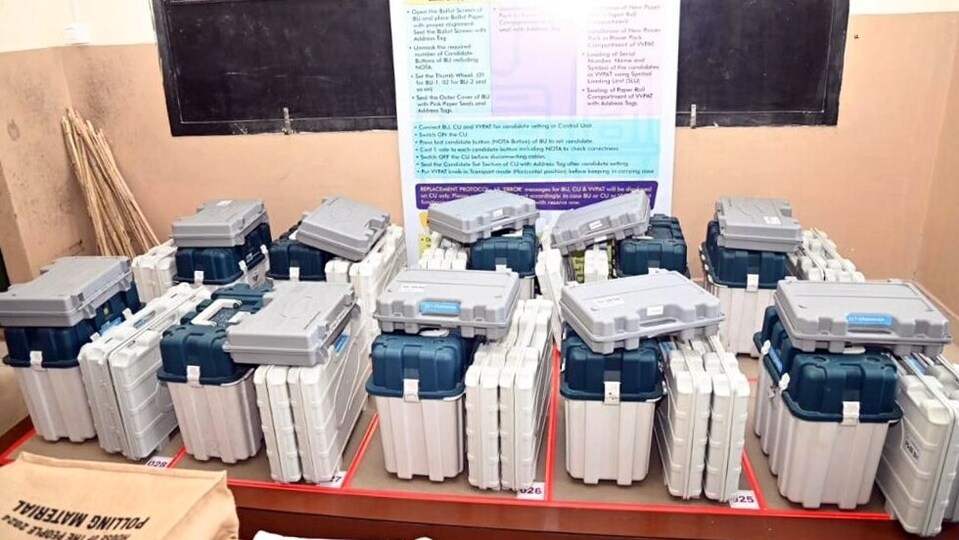
On Wednesday, the Supreme Court said it could not “control the elections” or issue any directions solely based on doubts about the reliability of EVMs. The court reserved its decision on a set of petitions alleging that EVMs could be tampered with to influence election outcomes.
“We went through the FAQs. We just wanted three-four clarifications. We don’t want to be factually wrong but doubly sure in our findings and hence we thought of seeking clarification,” the bench told additional solicitor general Aishwarya Bhati, who appeared for the Election Commission of India (ECI).
Additionally, it acknowledged the responses provided by the ECI to its queries. The bench specifically sought clarification from an official regarding five questions concerning the operation of EVMs, including whether the microcontrollers embedded in them are reprogrammable.
Read Here | Why stop a system that is working well: Supreme Court on EVMs
The bench added, “First clarification needed is with regard to microcontroller. Whether it is installed in the controlling unit or in the VVPAT. We were under the impression that the microcontroller is the memory installed in the control unit (CU). One of the questions in the FAQs indicates that it is also installed in the VVPAT.”
The NGO 'Association for Democratic Reforms', one of the petitioners, has requested the reversal of the poll panel's 2017 decision to substitute the transparent glass on VVPAT machines with an opaque one, allowing voters to view the slip only when illuminated for seven seconds.
The court said it could not alter the mindset of those questioning the benefits of voting machines and advocating a return to ballot papers.
Read Here | How EVMs came into being: A brief history
Senior advocate Santosh Paul, representing one of the petitioners, emphasised the necessity to disclose the source code of EVMs to ensure transparency. “No, the source code cannot be disclosed as there is a chance of it to be misused,” the court said.
Additionally, the petitioners have urged the court to instruct a return to the previous method of using ballot papers.
Despite reserving its verdict on April 18 after a two-day hearing, the matter was revisited on Wednesday for further clarifications from the EC.
The ongoing seven-phase Lok Sabha elections commenced on April 19 and are set to conclude with the declaration of results on June 4.


