E-Paper



Experts prepare to drain lake in Uttarakhand after chopper delivers special gear
Two Navy divers who were winched down from a helicopter close to the lake's surface used hand-held echolocation devices to measure its depth which was found to be around 8 to 9 metres.


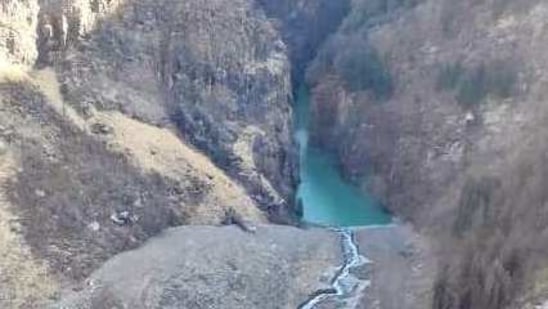
A helicopter on Sunday delivered special communication equipment to an expert team to analyse a lake formed upstream in the Rishiganga in Uttarakhand and communicate from the remote area about their findings and how to drain the lake, the State Disaster Response Force (SDRF) said.
The special equipment - quick deployable antenna (QDA) - which is based on satellite communication, helps authorities to reach out to people or officials in areas where there are no signals and send and receive voice and video data and hold video conferencing. Under this technology, 1.2-metre QDA (V Sat) and 1.2-metre V-SAT very small aperture terminal is used.
The expert team was formed by Uttarakhand’s chief secretary Om Prakash and includes scientists from Uttarakhand Space Application Centre, Geological Survey of India and others apart from officers from the Indo Tibetan Border Police (ITBP) and the SDRF.
The team reached the lake area on Saturday and are now analysing the lake to find out ways to drain it so that it doesn’t breach in future and lead to another tragedy like the one in Chamoli on February 7 when a glacier broke off to trigger a devastating that killed dozens. Many others are still missing.
“The experts will analyse the lake and direct the SDRF and ITBP men to drain it out by widening its mouth,” SDRP spokesperson Praveen Alok said.
Ridhim Agarwal, DIG SDRF Uttarakhand said an Indian Air Force (IAF) helicopter took two Navy divers to the lake on Saturday to measure its depth.
“The chopper hovered over the lake and Navy divers descended close to the lake surface and used their hand-held echolocation devices for measuring the depth of the lake. The lake depth has been found to be around 8 to 9 metres”.
Agarwal said they knew the other dimensions of the lake and to understand the quantum of water, they needed to know the depth of the lake. “Now as we know the depth, we are roughly aware of the quantum of water there. Our experts are looking into how this water can be drained out by widening its mouth”, she said.
In October last year the Uttarakhand SDRF had acquired the QDA technology to effectively tackle the challenges from disasters and reach out to affected people in the remote areas of the Himalayan state at the earliest.
The state government has already distributed 248 satellite phones in the remote areas of the state so that timely communication is possible between authorities involved in dealing with disasters and emergencies and the people living in remote areas with poor or no mobile phone connectivity. To further strengthen the communication, the SDRF has now acquired QDA technology.
“SDRF has procured six QDA systems including three static and three mobile ones. The static QDA will be set up at SDRF headquarters in Dehradun while mobile QDAs can be sent to the affected area by a helicopter so that communication regarding the disaster, rescue and search and other emergencies could be established quickly. This will help in effectively managing rescue and search operations in real time and will help the authorities here in reducing casualties due to various disasters”, Agarwal said.
In October last year, a trial of QDA systems was conducted by establishing communication between SDRF control room in Dehradun and Gunji area in Pithoragarh, Malari area in Chamoli and Tiuni area in Dehradun district. After the successful trial, the QDA technology was inaugurated by chief minister Trivendra Singh Rawat, who interacted with the village heads and others in these areas through QDA and discussed the main problems facing them.