Severe cyclone Mocha has intensified further into an extremely severe cyclonic storm over east-central Bay of Bengal, and is forecast to move north-northeastwards and cross southeast Bangladesh and north Myanmar coasts on Sunday, the India Meteorological Department (IMD) said on Saturday. IMD has issued rain and storm warnings for Andaman and Nicobar Islands, parts of Tripura, Mizoram, Manipur, Nagaland and Assam on Saturday and Sunday.
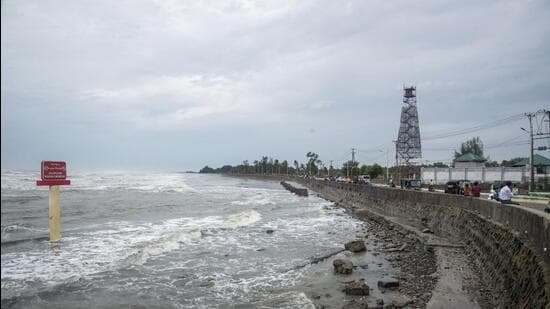
“The extremely severe cyclonic storm, Mocha over east-central Bay of Bengal moved nearly north-eastwards with a speed of 19kmph on Saturday, about 590km north-northwest of Port Blair, 580 km south-southwest of Cox’s Bazar (Bangladesh) and 490 km south-southwest of Sittwe, Myanmar,” the Met forecast said.
“It is very likely to move north-northeastwards and cross southeast Bangladesh and north Myanmar coasts between Cox’s Bazar, Bangladesh, and Kyaukpyu, Myanmar, close to Sittwe, Myanmar, around noon of May 14 as an extremely severe cyclonic storm with maximum sustained wind speed of 170-180 kmph gusting to 200 kmph,” it added.
IMD warned of minor damage to loose/unsecured structures, uprooting of small trees and breaking of tree branches, the possibility of landslides in vulnerable areas, and damage to small trees such as bananas in Mizoram, Tripura, and south Manipur.
Mocha was about 520km west-northwest of Port Blair on Friday morning. An IMD official said the tropical heat potential, which provides energy to the cyclone, is high near the Myanmar coast. “Bay of Bengal is considerably warm with sea surface temperatures of over 30 degrees Celsius over most parts of the ocean,” the official said.
{{/usCountry}}Mocha was about 520km west-northwest of Port Blair on Friday morning. An IMD official said the tropical heat potential, which provides energy to the cyclone, is high near the Myanmar coast. “Bay of Bengal is considerably warm with sea surface temperatures of over 30 degrees Celsius over most parts of the ocean,” the official said.
{{/usCountry}}Experts said that there has been an increase in the number and intensity of cyclonic storms impacting the Indian sub-continent and the role of climate change in this phenomenon cannot be ignored.
“Sea surface temperatures are increasing. The mechanism behind the formation of cyclones does not change but weather conditions are changing. Cyclones have been intensifying at a faster pace in the recent past. The reason behind this is not just an increase in the sea-surface temperatures but also rising ocean heat content. Earlier the system used to take 2-3 days before forming into a tropical storm but nowadays it changes from a depression into a cyclonic storm in just a day,” said M M Ali, meteorologist and oceanologist, Andhra Pradesh State Disaster Management Authority and emeritus scientist-G and group director (atmosphere), Indian Space Research Organisation (ISRO).
“Atmosphere not only interacts with sea surface temperatures, but also with the entire ocean. It is evident from research that ocean heat content is changing because of climate change,” he added.