E-Paper



Fear, uncertainty haunt Afghan students in India
They are two thousand kilometres away from home, spread out across India, looking to study, to build for the future, for themselves, their families, their country


They are two thousand kilometres away from home, spread out across India, looking to study, to build for the future, for themselves, their families, their country. But in the course of one dramatic week, the futures of Afghan students in India, has become one of uncertainty and fear, and worry for what lies ahead.
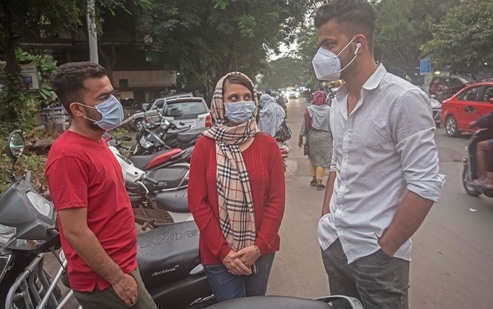
On Monday, 28-year-old Diana Farzan, a student in Bengaluru spoke to her family in Herat for all of five minutes. She wanted to check on her parents and her family, but had another question at the top of her mind, if she would be allowed to work. “I’m doing my masters in journalism because I want to pursue a career as a journalist or get back to teaching journalism. I don’t know what will happen now and what I will I do when I got back home. Sit at home as they (Taliban) wants, in a country where I don’t have the right to vote? I don’t want to do that,” said Farzan.
But if Farzan has two more semesters left in India, for another student at Bangalore University, the concern is more immediate. An Afghan student, who ordinarily would have to return at the end of the academic session said that under the Taliban, Afghanistan would move backwards in time. “I don’t know what I must do...From what we have heard, Taliban rule was a time when a woman didn’t matter. I don’t want that. I will see how things are by the time my course is over,” said the Bangalore University student, who didn’t want to be named.
Ever since the Taliban marched to Kabul, in Odisha’s Rourkela, a 23 year-old civil engineering student has been making frantic calls to his family, but despite a short conversation, has had no solace. His father, who works with the Afghan Election Commission and the family have locked themselves inside their home, despite a food shortage. “Our house is in the sururbs of Kabul. But no one is sure what is going to happen as we have seen how Taliban have tortured people over last two decades,” said the student who did not want to be named.
The 23-year-old is among the 14 Afghanistan students sponsored by ICCR for scholarships in Odisha, and hoped that once he finished his degree, he would join the “reconstruction” of his country. “But now returning home seems to be dangerous forget working in Afghanistan.”
Another 23 year-old student, Ehsanullah, who joined Utkal University in Bhubaneswar earlier this year, said that the Taliban had actually entered and searched his home, but thus far had done no harm. “My father retired from government job earlier this year and all my five brothers were employed in various wings of the Afghanistan government. Last week, my father’s pension and retirement benefits were cancelled, and brothers lost their jobs,” he said.
For many, the worry is that the very act of choosing to study abroad, or what they are studying, may be enough for them to be considered a “traitor” under the Taliban regime. Ibrahim Akbari, a student at Goa University said. “Things may be okay now but they will soon be coming door to door. My family’s life is in danger if they know that I am studying here. If I go back I will definitely be killed especially if they know that I am studying political science,” Akbari told HT.
Akbari said that a pressing concern now is the need for funds, particularly for those students that aren’t on scholarships. “Many have been funded by their parents back home who are now unsure of their financial situation and therefore cannot send more money here. Others have rent to pay.”
In Uttarakhand, Hashmi, a PHD student from Kabul, one of the four Afghans studying at Pantnagar University under the Indo-Afghan joint fellowship programme, has a visa that expires in two weeks. “My visa terminates on August 30 and I wanted to return to Afghanistan as my research here is done. But the present turmoil makes that very uncertain. But here, I will face the problem of how I will remain without a visa if it is not extended”, he said.
Brijesh Singh, Dean, student welfare in Pant varsity said that the University would stand with its Afghan students and take care of them on “humanitarian grounds.” “The matter is in the notice of the vice-chancellor. Since it is a policy matter, we will follow the instructions of the Central government in this regard.”
With inputs from Gerard D Souza in Panaji and Mohan Raj in Dehradun