
 E-Paper



Focus on vaccinating all, don’t lower guard: Modi to states
At a virtual meeting with chief ministers to review the Covid-19 situation across the country, Modi said the Centre’s priority is also to vaccinate all eligible children at the earliest with special campaigns needed in schools.


While India has managed the coronavirus pandemic well so far, a surge in cases in some states recently has manifested the need to stay alert and ensure all eligible persons, are vaccinated, Prime Minister Narendra Modi said on Wednesday.
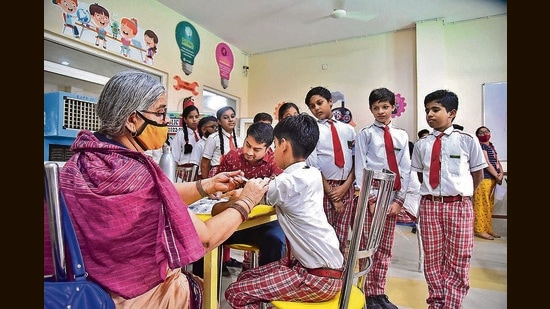
At a virtual meeting with chief ministers to review the Covid-19 situation across the country, Modi said the Centre’s priority is also to vaccinate all eligible children at the earliest with special campaigns needed in schools. On Tuesday, India’s drugs regulator cleared two vaccines for use in children -- one for those between the ages of 5 and 12 and the other for those in the 6-12 age group.
“It is clear that the Covid challenge is not fully over yet. Omicron and its sub variants can create problems as evident by the experience of many countries in Europe. Sub-variants are causing surges in many countries. India has been able to deal with the situation better than most. Still, in the last two weeks, increasing cases in some of the states show that we need to stay alert,” Modi said.
After falling to a 24-month of low of 996 new cases a day for the week ended April 15, the seven-day average of daily cases has inched up again and was 2,614 on Tuesday.
Maharashtra, Uttar Pradesh, Mizoram, Delhi and Haryana are among states and Union territories that have shown an increase in cases. The Centre had written to these states and Union territories, asking them to take measures to contain the spread.
Referring to the Omicron-driven third wave, Modi said that even as India witnessed up to three lakh cases per day, all states handled the situation while also allowing social and economic activity to continue. This balance should be maintained in our future strategy also, he said. While the highly infectious variant caused a surge in cases, it did not overwhelm India’s health system with most cases not requiring hospitalisation. India has also full vaccinated almost its entire adult population.
Onlt 5-10% of active Covid cases have needed hospitalisation in the third Covid-19 wave as compared to 20-23% in the devastating second wave, data shared by the Union ministry of health and family welfare in January this year showed.
The Omicron (third) wave was handled with determination and without panic, and in the last two years, all aspects of the coronavirus fight, whether related to health infrastructure, oxygen supply or vaccination, have been strengthened to fight the pandemic, Modi .
“In the third wave, none of the states saw the situation go out of control. This should be seen in the context of the massive vaccination drive. Covid vaccines have reached each and every person and it is a matter of pride that 96% of the adult population is vaccinated with at least one dose and about 84% people above 15 years of age have received both the doses. Vaccines, as per experts, are the biggest safeguard against corona,” Modi said.
Bharat Biotech’s Covaxin and Serum Institute of India’s Covishield are the two vaccines that have been the mainstay of India’s national Covid immunization programme for adults. Children aged 12-15 are being administered Biological E’s Corbevax while adolescents have been receiving Covaxin under the government programme.
The third shot of Covid-19 vaccines was rolled out for certain categories of citizens from January 10. People above the age of 60 with certain illnesses and those working in high-risk healthcare and front-line jobs were allowed to take what the government classified as precaution doses, as long as their second shots were taken more than nine months ago. The government also made the third dose available to all adults at private vaccination centres from April 10.
On Tuesday, India’s drug regulator approved the emergency use of Corbevax and Covaxin for children under the age of 12 years. While Corbevax was approved by the Drugs Controller General of India (DCGI) for administration in children aged 5-12 years, Covaxin was cleared for use in those aged 6-12 years.
The decision assumes significance as it sets up the stage to protect young children from the coronavirus disease, particularly at a time when schools have opened after nearly two years of closure, which, experts say have caused considerable learning and social adjustment gaps.
“It is satisfying to see that more and more children are getting the vaccine. The campaign to vaccinate 12-15 year-olds began in March and only yesterday, permission was granted for Covaxin vaccine for 6-12 year-old children. Our priority is to vaccinate all eligible children at the earliest. For this, as before, special campaigns will also be needed in schools. Teachers and parents should be aware about this,” the PM said.
Speaking on the booster shots (what India calls precautionary doses), Modi said they are available for all adults in the country to strengthen the vaccine “protective shield”.
The Prime Minister, who was meeting state chief ministers for the 24th time in the past two years to discuss the Covid situation, stressed on the importance of implementing the ‘test, track and treat’ methodology with the same efficacy was done during previous Covid-19 waves in the country.
“Preventing infections at the very beginning was our priority and should remain so even now. We have to implement our strategy of test, track and treat with the same efficacy”, he said, adding that all serious influenza cases will be tested for Covid, all positive samples sequenced, and , Covid-appropriate behaviour, followed in public places.
The Prime Minister also stressed on the need for continued upgradation of health infrastructure and medical manpower to tackle any surge in cases.
During the virtual meeting, Union health secretary Rajesh Bhushan made a presentation where he discussed the rise in cases across several countries in the world and in some states in India. He spoke about the need for states to regularly monitor and report data, maintain effective surveillance, upgrade infrastructure and utilise funds given by the Centre.
Union home minister Amit Shah, who was also present at the meeting, spoke about the recent increase in Covid cases in some states and on the need to follow the ‘test, track, treat, vaccinate’ strategy and ensure Covid-appropriate behaviour, a statement from the Prime Minister’s Office (PMO) said.
Delhi chief minister Arvind Kejriwal said that in recent days, the national capital has witnessed a high positivity rate. He also spoke about masks having been made mandatory again.
Surveillance and precautionary measures have been stepped up in NCR districts to avoid any surge in fresh cases, Uttar Pradesh chief minister Yogi Adityanath said at the meeting.
Punjab chief minister Bhagwant Mann said the state is fully prepared to tackle any surge in the cases.


