
 E-Paper



Zero visibility in Delhi
Delhi on Thursday recorded an Air Quality Index of 318


People across the National Capital Region (NCR) woke up to a thick blanket of fog on Thursday, as visibility dropped to zero in the morning, severely disrupting flights, trains as well as vehicular traffic across the region, marking one of the most challenging mornings of the season.
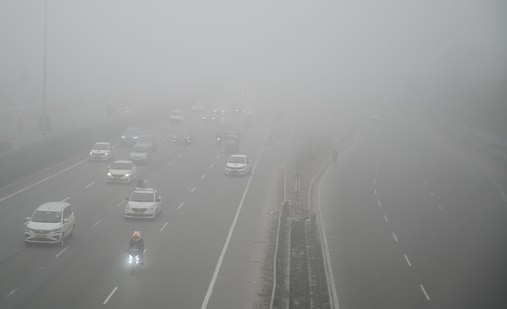
More than 300 flights coming in and out of Delhi’s Indira Gandhi International (IGI) Airport were delayed on account of the “very dense” fog engulfed the area around the airport for two hours between 6am to 8am.
Officials, however, said that no diversion or cancellation of flights was reported as the fog cleared up by early afternoon. The average delay for a flight was reported around 18 minutes, according to flight tracking website FlightRadar24.
The sharp drop in visibility also impacted trains coming into Delhi. Northern Railways said at least 43 trains were delayed by over 30 minutes due to poor visibility.
On the roads, drivers faced challenging conditions as visibility dropped sharply, impacting traffic flow in the early hours of the across NCR.
Scientists at India Meteorological Department (IMD) recorded visibility at Palam plummeting below 200 metres by 5.30am. In the next half-an-hour, it dropped even further, touching zero by 6am, where it remained for two hours. It finally started improving around 8am, IMD officials said.
Under IMD’s classification, visibility below 200 metres is considered as “dense” fog, and below 50 metres is considered “very dense” fog.
Jenamani added that at the airport, CAT 2 and CAT 3 procedures were initiated, allowing planes to operate during low visibility.
Delhi had experienced dense fog on Wednesday as well, with visibility dropping to 100 meters. The IMD issued a yellow alert for Friday and Saturday, forecasting moderate fog during early mornings and late evenings.
Explaining the phenomenon, IMD scientist said that the fog was a result of cold morning temperatures mixing with high moisture and pollutants in the air. During winter, moisture from sources such as nearby water bodies and overnight dew condenses into tiny water droplets. Combined with plummeting early-morning temperatures and calm winds, these droplets create a thick layer of fog, which is worsened even further by the pollution in the air.
AQI back online after 24 hours
Delhi on Thursday recorded an Air Quality Index of 318 (“very poor”), as the Central Pollution Control Board resumed sharing data after a day’s break.
CPCB did not share air quality data on Wednesday and the first half of Thursday due to server issues. When it resumed in the evening, Delhi clocked a “very poor” AQI of 318 at 4pm.
Forecasts by the Early Warning System for Delhi (EWS) said the AQI is likely to remain “very poor” till January 5 as conditions remain adverse for the dispersal of pollutants.
An official with the Commission for Air Quality Management (CAQM) said the problem was fixed on Thursday evening, with both the Sameer app and its website sharing real-time data from 6pm. “The day’s bulletin was also updated and all data will be collated and shared in real-time from now on,” the official said.


