E-Paper



Former CJI Chandrachud in favour of all India judicial service
Former CJI Chandrachud said India should have one common examination for judicial recruitment all over the country.

 Prefer HTon Google


Bhubaneswar: Former chief justice of India (CJI) DY Chandrachud on Wednesday batted for a national-level judicial recruitment process to strengthen India’s judicial system and said an All India judicial service, which also addresses the federal concerns over the issue, was necessary.
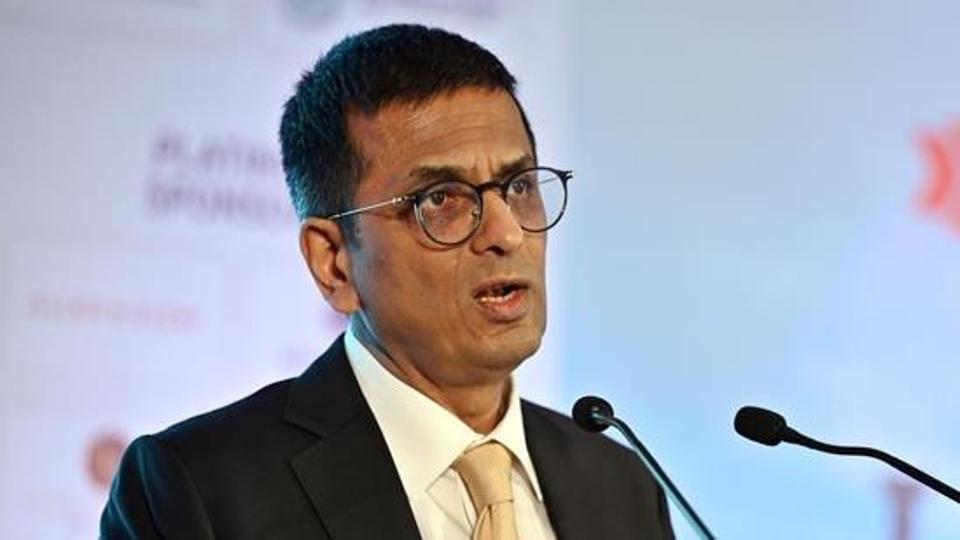
“Can we bring All India Judicial Service? I think it is important in the present context. Today, State governments say that we have a federal structure and they are concerned with the fact that an Indian Judicial Service can dilute Indian Federalism,” he said while speaking at the annual convention of OTV, an Odisha-based television channel, in Bhubaneswar.
He said though district judiciary recruitment is a state subject a balanced approach is necessary to address the federal concerns.
“You should have one common examination for recruitment all over the country so that you get the best from across the country. Someone from Tamil Nadu can go to Odisha and someone from Odisha can go to Meghalaya and so on and sub-serve the purpose of integrating India into one country. There can be one common entrance examination and recruitment on the basis of merit list in that examination and applying reservation in each particular state,” he said.
“We are now moving towards a highly developed economy, and India is completely different to what it was in 1960s or 70s as far as the judicial reforms are concerned. If we have to take our nation to the next level, judicial reforms will be crucial as the existence of rule of law and efficient judicial system is critical for the realisation of rights of citizen and critical to the prospering of business. From both perspectives, an investor wants transparency, objectivity and certainty of outcomes. The judge to population ratio is very low and we need more judges; secondly, we need enhancement of infrastructure from district court to high courts across India and all vacant posts in Indian judiciary are fulfilled,” he added.
Speaking about the reluctance of the lower courts in granting bail, Chandrachud said he is deeply concerned about it. “The district judiciary is the first point of interface with common citizens, and it is important that they apply to two principles- principles of presumption of innocence that every accused is presumed to innocence until proved guilty and secondly, bail should be the normal rule, and jail should be the exception. But in case of serious offences, you have to deny bail. A judge has to look not only at the interest of the accused but also the society. “If someone is accused of rape and murder, will you want to grant bail to such a person when you have to protect the interest of the society too? But there are cases where there are hundreds of witnesses and the trial will take 7 to 8 years. So, how long can you keep a person in jail,” he asked.
He said the district judiciary is reluctant to grant bail as we live in a culture of distrust today. “We do not trust our public officials, and judges are no exception. If a district judge grants bail and if the bail is cancelled, we should not pass moral strictures on the district judge. If a wrong grant of bail has been made, it can be reversed by higher court,” he said.
Speaking on the Ayodhya verdict, he said, “Whenever we hear such cases, we need to understand that it was the first appeal in Supreme Court as first judgement was given by Allahabad high court. Be it the first appeal of Ayodhya or any other case, you as a judge apply the common principles to hear the first appeal. The principle of Judiciary is to apply the common principles. “In Ayodhya case, a lot of interesting things came before us including records of 30,000 pages, 300 to 400 years old documents in several languages including Sanskrit, Urdu, Gurumukhi and others and examination of lot of witnesses. There was time constraint as well as CJI Justice Gogoi was to retire,” he said.