
 E-Paper



Forest tales: Missing tigers and low tech support hamper conservation
There’s hardly any mechanism to monitor tigers that have strayed out of their designated habitat.

 Prefer HTon Google


The Royal Bengal is the most protected animal in India and its population is booming, but missing tigers are the weakest link in the conservation success story.

There’s hardly any mechanism to monitor tigers that have strayed out of their designated habitat. The flaw keeps drifters out of the loop and the forest officials have no clue about them.
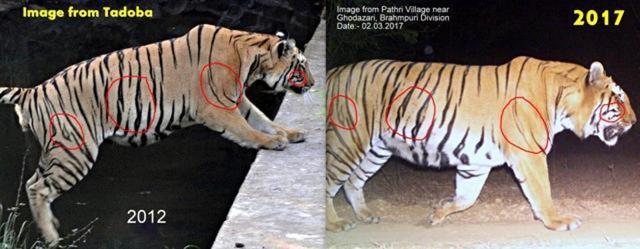
Among the missing tigers in recent times was Ookhan of Tadoba-Andhari in Maharashtra. He was found this March at a place about 100km away from where he was spotted last almost four years ago.
The photograph taken in 2013 helped track the seven-year-old male. Stripe patterns are unique to every tiger and that is their identity marker.
Ookhan is a lucky break on a long list of tigers that went missing and never found.
The Maharashtra forest department has yet to trace Jai, the iconic tiger of Nagpur’s Umred Karhandla wildlife sanctuary, who went missing on April 18, 2016.
A year later, and after searches across Maharashtra, Andhra Pradesh and Telangana, forest officials have no clue if the animal with a radio collar around its neck is alive or dead.
Ookhan or Jai are not stray cases. It is quite common in the wild for dominant tigers occupying the rich prey base to push out the weaker ones to the hinterland.
A tiger’s territory range from 10 to 12 square km, and the number of tigers moving out to different zones for food and water has increased recently with their population rising on the back of conservation efforts.
Scientists report 20% “turnover” in tiger population, meaning the older getting replaced by the younger generation every year. In that scenario, tracking them becomes important both for research and understanding the animal outside their protected core areas.
The most common and time-tested monitoring device is the radio collar, which weighs over a kilo and emits signals through a transmitter linked to a satellite.
But Jai’s collar is on the blink, triggering fears that either the device is buried or thrown into a no-signal zone. That was the last word on Jai from the forest department. Rest has been rumours — from his death to being spotted in Telangana.
Jai, who reached Umred after losing a territorial war in Pench, went missing despite the radio collar.
Less than 5% of tigers in India are monitored round-the-clock through such collars, which is an expensive technology.
The low use of imported collars is primarily because of its high cost — about Rs 4 lakh apiece — and high maintenance. Just a battery, which needs to be replaced every year, has a price tag of about Rs 50,000.
“Radio collars are expensive as the equipment is imported from the US and Germany. Nowhere in the world the entire population is collared; only a sample is done for research purpose,” said VB Mathur, the director of the Dehradun-based Wildlife Institute of India (WII).
Independent tiger expert Raghu Chandawat agreed that collars are not effective because of their “high rate of failure” and poor “frequency of intercepts”.
Mathur countered that the fail rate was less than 1% as the signal is transmitted through two modes: transmitter or satellite. But he admitted that intercepts were an issue.
Another monitoring system is a camera trap. The National Tiger Conservation Authority (NTCA) has prescribed a protocol that includes collecting as many camera trap pictures of tigers, regular updating of albums, sharing it with divisional forest officials and matching them with the feline found in new areas to track from where they have come.
Of the 2,226 tigers in India, the WII has shared pictures of about 1,650 with forest departments of states. That’s done to ensure the WII can help track a tiger spotted at a place for the first time.
But the database has not been effective as most departments have failed to update records on tiger movements. Officials cite poorly trained staff for the flaw.
Inadequate monitoring has put Jai, Gabbar of Todaba, Sundari of Ranthambore and Corbett’s Khalli out of the radar in the past several years.
Sundari, daughter of Ranthambore’s late queen Machhli, went missing from the core area in March 2013 as she was dislodged by a more powerful tiger; a reason that applies to Ookhan’s disappearance as well.
More than 100 foresters searched for the camera-friendly Sundari. But no one cared for Indu — Sundari’s not-so-popular sister, who went missing around the same time.
Ranthambore reserve director YK Sahu presumed Indu to be dead, though her body was not found. Since 2010, there is no trace of 10 tigers that went missing from Ranthambore.
Half-a-dozen strays were, however, spotted in far-off Kuno Palpur and Bandhavgarh in Madhya Pradesh, their new homes, almost two years after they went missing.
Tigers travel up to 500 km looking for new homes. That brings them into direct confrontation with humans — villagers keen to protect their livestock and poachers looking for their skin and bones.
Deaths are violent and those who fall to poachers’ guns and poison never get noticed.
Rajesh Gopal, secretary general of Global Tiger Forum secretariat, said it was not difficult to monitor most tigers provided the NTCA protocol is followed. “We need tiger reserves to share information about the animals moving to the periphery to divisional forest officials to help monitor their movement,” said the former head of NTCA.
For 2018, the next round of tiger estimation, the NTCA has set a target of having a picture database of 90% of tigers counted. If that happens, tracking missing tigers would become easier.
Mathur said they were working with forest departments to improve monitoring at all levels. The fourth phase of tiger estimation, starting this October, will strengthen this effort, he hoped.
(With Inputs from Nihi Sharma in Dehradun)


