Freebies or empowerment: How BJP walks the tight rope to promise sops for women
After criticising opposition parties for allegedly putting a strain on the exchequer by promisisng waivers on amenities, the saffron party has promised a range of welfare measure which it claims are actually "empowerment tools".
New Delhi: Amid a raging political debate over the feasibility of parties announcing freebies ahead of elections, the Bharatiya Janata Party (BJP) – which has targeted its opponents for putting a strain on the exchequer by promising waivers on amenities and other services – has framed its welfare measures as empowerment tools, particularly for women.
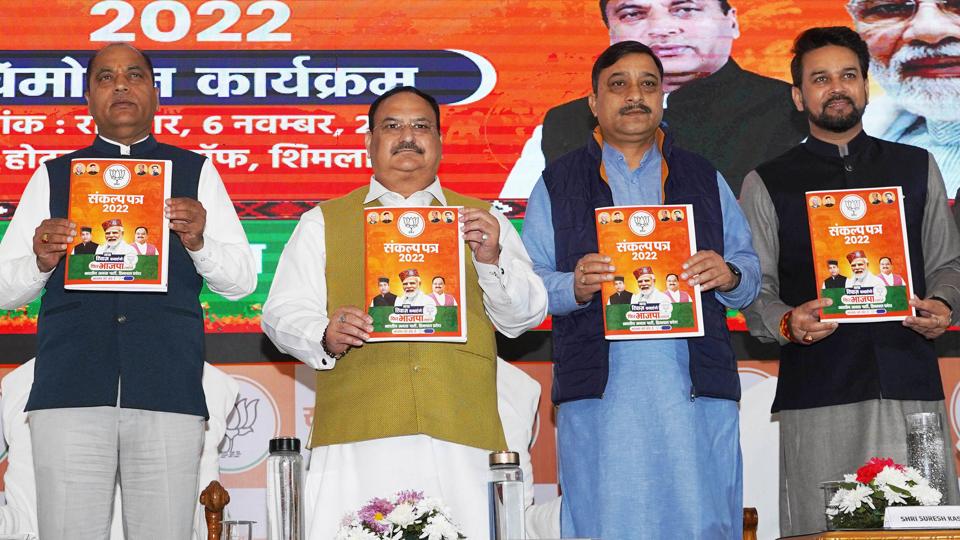
BJP president JP Nadda defended the separate election manifesto for women in Himachal Pradesh that promises sops such as free cooking gas cylinders and money under various heads as a tool for empowerment. (ANI)
Senior party leaders assert that there is a fine line that demarcates freebies from empowerment and that it has identified the template that empowers the poor and the marginalised without resorting to “avoidable expenditure”. However, as parties compete against each other in announcing sops and freebies, the BJP has had to think out of the box to stay in the game.
“There are interventions that are necessary that can uplift the community at large and there are avoidable expenditures such as free units of electricity and transport services that eventually put a strain on the exchequer,” said a senior party functionary in response to a question on how the BJP’s announcements could be seen differently from those made by opponents such as the Aam Admi Party (AAP) and the Congress. Both these parties have made a slew of promises – including free power up to a certain consumption level and other pecuniary benefits – in poll-bound Gujarat and Himachal Pradesh.
On Monday, while announcing a separate manifesto for women ahead of the November 12 polls in Himachal Prades, party president JP Nadda defended the document that promises sops such as free cooking gas cylinders and money under various heads as a tool for empowerment.
“There is a fine distinction between empowerment and allotment... we are for empowerment and this is what we have told the Election Commission (EC) as well,” Nadda said.
In a letter to the EC last month, the party said it seeks to empower voters and enhance their capacity for their overall development, not merely focus on short-term measures such as freebies to allure voters ahead of elections. The letter was in response to the poll panel seeking suggestions for the proposal to amend the Model Code of Conduct (MCC) that will require parties to furnish details of the “financial implications” of promises made in election manifestos.
Reiterating the empowerment aspect of the poll promises, Nadda said the party firmly believes that if society has to move forward, then women have to be empowered. “Prime Minister [Narendra] Modi brought policies to empower women and improve their condition. About 11-12 crore families had no toilets, which means women in these families had no dignity. In the kitchen, there is a gas cylinder instead of wood now, there is dignity... law and order has improved and there are avenues for their education,” he said.
In the manifesto that broadly makes 11 promises for women’s empowerment, the party has promised 33% reservation in government jobs and educational institutions; scooties for girls pursuing higher education; three free LPG cylinders to women from poor families and ₹51,000 towards marriage of girls from such families; and interest-free loans to women entrepreneurs.
In recent elections, issues related to women have been given significant weightage in the manifestos released by the party, but with the issue of freebies and their financial ramifications dominating the poll narrative, the party has had to modify its poll promises by focussing on women who have emerged as a crucial vote bank.
Earlier this year, the party in its manifesto for Goa promised to provide three free LPG cylinders to every household, 33%reservation for women in all future recruitments in the public sector and woman-only police stations in every taluka. In Uttarakhand, it promised to give ₹500 per month to women heads of every poor family, a corpus of ₹500 crore for Women Self Help Groups and an amendment to the law against so-called ‘love jihad’ with an eye on securing women’s safety.
The party is hopeful that women-centric promises will help it coast to victory and also withstand the allurement of government jobs and the old pension scheme promised by its opponents. However, there is a section of leaders who admit that taking a stance against populist policies can have an adverse impact on the electoral outcome.
“The prime minister is unambiguous that he is against the culture of revdis (freebies), but in the sphere of competitive politics, the BJP has two challenges. The first is to identify what is a freebie and the second is to counter the announcements of the opponents,” said a former minister and a senior functionary.
The second senior functionary cited the example of the Congress winning the Chhattisgarh assembly polls in 2018 by promising financial benefits. “When the Congress announced loan waivers and bonuses on paddy procurements, the BJP did not anticipate the impact it would have, and ended up paying a heavy price. So, until there is a consensus on freebies, there is no option but to find ways of matching announcements,” the leader said.
The opposition has, however, accused the BJP of doublespeak. Former minister and Congress leader P Chidambaram recently criticised the BJP for announcing a waiver of penalties for traffic offences in Gujarat and announcing additional free LPG cylinders.
Responding to the criticism, a third leader said the party is committed to a pro-poor welfare state but does not want to make promises that will hurt the economic structure.
“Our government gave free vaccines, but in doing so did not collapse the economic structure. Look at Punjab (ruled by AAP). They have trouble paying salaries today. That is a model we need to be wary of,” the third leader said.
Smriti covers an intersection of politics and governance. Having spent over a decade in journalism, she combines old fashioned leg work with modern story telling tools.
Get the latest India News, breaking headlines and real-time updates from across the country. Stay informed about politics, government policies, crime, weather and major national developments.
Home/India News/Freebies Or Empowerment: How BJP Walks The Tight Rope To Promise Sops For Women

 E-Paper