
 E-Paper



Global collaboration key to cross-border justice delivery challenges: CJI
The Chief Justice of India said that the judiciary and executive must cultivate a shared commitment to justice and the law officers should remain impervious to the politics of the day

 Prefer HTon Google


Global collaboration and trust building is key to address diverse cross-border challenges to justice delivery, said Chief Justice of India (CJI) Dhananjaya Y Chandrachud on Saturday while addressing an international conference of Commonwealth law officers in Delhi.
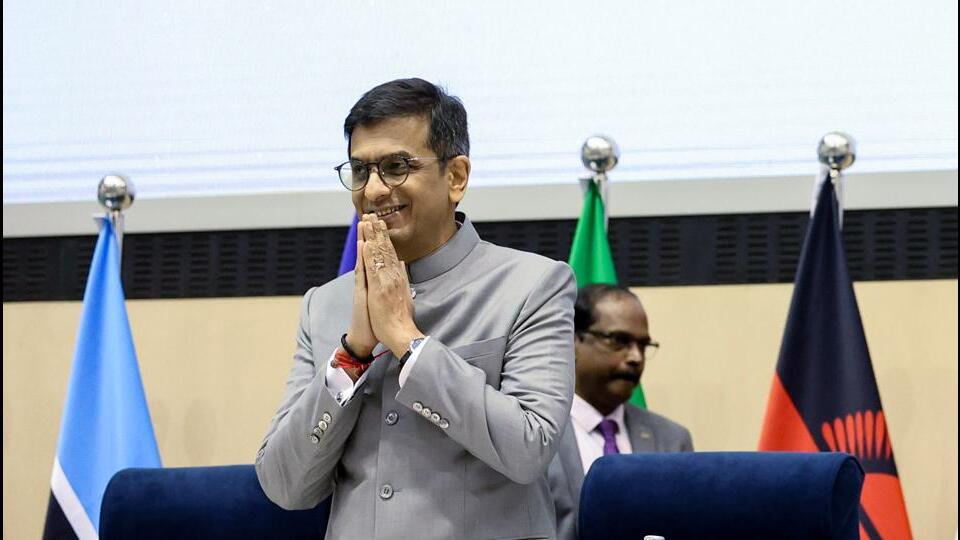
Stating that the sustainable development goals resonate deeply with India’s core constitutional principles of justice, equality and human rights, CJI said, “The legal community plays a crucial role in translating these goals into action by utilising its expertise to navigate the complexities of law and governance and ensuring that justice and sustainability go hand in hand.”
CJI was speaking at the Commonwealth Attorney and Solicitors Generals Conference 2024 organised by the Commonwealth Legal Education Association (CLEA) and the ministry of law and justice. The inaugural event was presided over by Prime Minister Narendra Modi.
“I am compelled to underscore the significance of global collaboration and trust-building in addressing the diverse cross-border challenges to justice delivery...by fostering partnerships and sharing best practices, we can amplify our impact and pave the way for a more sustainable future,” said CJI addressing the law officers of 30 countries who assembled for the two-day conference at Vigyan Bhawan.
CJI said that the judiciary and executive must cultivate a shared commitment to justice and the law officers, who serve as the primary point of contact between courts and the government, should remain “impervious to the politics of the day”.
“Law officers bear a greater responsibility in upholding ethical standards compared to private practitioners, given their role as guardians of the rule of law,” CJI said, sharing the example of late Soli Sorabjee, a former Attorney General, who, during his tenure demonstrated a commitment to justice by advising the then National Democratic Alliance (NDA) government headed by Bharatiya Janata Party (BJP) when it lacked a valid legal case.
“It is imperative that law officers remain impervious to the politics of the day and conduct themselves with dignity in court, ensuring the integrity of legal proceedings,” said justice Chandrachud, while adding, “A crucial aspect of executive accountability rests on the ethical conduct and responsibility of law officers, who function not only as representatives of the government but also as officers of the court.”
Supreme Court judge and CLEA chief patron, justice Surya Kant, spoke on the theme of the conference – Cross border challenges in justice delivery. There were speeches also by Attorney General R Venkataramani, Union law minister Arjun Ram Meghwal and solicitor general Tushar Mehta.
“This collaborative approach involving legal officers, government officials, and the judiciary reinforces the ethical underpinnings of executive accountability while fostering a culture of mutual respect and cooperation within the justice system,” CJI said.
Advocating technology being a “powerful force” to enhance the speed and accessibility of justice, the head of the Indian judiciary sounded a note of caution too. He said, “Modernising courtrooms and facilities is as crucial as bolstering overall infrastructure. Ensuring that technology serves to enhance transparency and accountability and not to perpetuate opacity and inequality.”
While technology promises to enhance the speed and accessibility of justice, CJI said, “We must navigate carefully. The deep-seated structural and financial hierarchies within Indian society demand consideration to ensure that technology does not inadvertently exacerbate existing problems...we must ensure that technological solutions are designed keeping in mind equity and inclusivity, taking into account the diverse needs and capabilities of all our stakeholders.”
His speech also focused on the emerging trends in legal education, such as the integration of technology and interdisciplinary studies, providing exciting opportunities for innovation and collaboration.
In the recent past, fostering collaboration among nations on the judicial front, India hosted chief justices, judges and law ministers of Global South nations in November last year and formulated the “New Delhi Principles on the Role of Judiciary in Ensuring Equal Access to Justice for All in the Global South”. Early last year, the Supreme Court of India hosted members of the e-committee of the UK Courts and judges of the countries belonging to the Shanghai Cooperation Organization and discussed the best practices for the administration of justice.
“In today’s rapidly evolving world, characterised by an array of pressing issues, the need to fortify institutional capacity is more urgent than ever before...Courts not only refer to the jurisprudence evolved by courts of other jurisdictions while deciding questions of constitutional importance but also refer to the best practices on the administrative side,” CJI said.
He also spoke about recent initiatives introduced by the Supreme Court, which among many things included a Standard Operating Procedure (SOP) guiding courts in summoning government officials. The SOP, that was part of a judicial order laid down uniform standards to be adopted by high courts and Supreme Court for treating government officials with dignity and respect, discouraging disparaging remarks based on appearance or attire unless there is a violation of the dress code.
“The SOP cautions against leveraging the power to summon officials as a tool to pressure the government, emphasising that such actions should be reserved for circumstances crucial to the administration of justice,” said CJI, while adding, “We need to recognise the significance of cultivating a shared commitment to justice.”


