A government order issued discreetly earlier this month, removing the bar on its employees from associating with the Rashtriya Swayamsevak Sangh (RSS), the ideological mentor of the Bharatiya Janata Party (BJP), is an indication of ties between the Sangh Parivaar and the party being recalibrated following a period when some chill had set in. There have been reports of a strain between the two even before the summer’s Lok Sabha polls, which saw the BJP emerge as the single largest party, but without the mandate to form the government on its own.
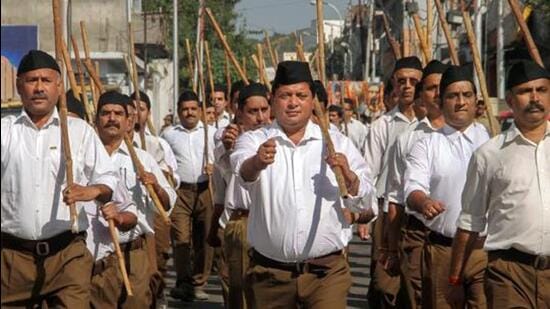
RSS disassociates itself from electoral politics, but its cadre is known to drum up support for BJP on ideological issues. (PTI)
“It will not be wrong to call it the BJP government’s olive branch to its ideological mentor,” said a senior functionary associated with an RSS offshoot.
In its July 9 order, the Department of Personnel and Training (DoPT), said the instructions issued in 1966, 1970 and 1980 regarding the participation of government servants in the activities of the RSS “have been reviewed and it has been decided to remove the mention of Rashtriya Swayamsewak Sangh (RSS) from the impugned OMs (Official Memorandums)”.
The order was made public on Sunday, after the Congress put out a post on social media. RSS functionaries declined to comment on whether they were aware of the fresh instruction having been issued on July 9.
Although RSS and the BJP functionaries did not air grievances publicly, there have been reports of disengagement between the workers of the Sangh and the party and the absence of the RSS cadre from campaigning was reported from several states including Uttar Pradesh, where the party’s performance in the Lok Sabha polls was dismal. The party’s tally in the state fell from 62 to 33 and the overall numbers came down from 303 in 2019 to 240.
The RSS officially disassociates itself from electoral politics, but its cadre is known to drum up support for the BJP on ideological issues.
“Over the past few years there was a strain that crept in...while, the party is ideologically bound to the Sangh, there were differences on how the BJP government approached some of the suggestions and demands from the Sangh,” said the functionary, speaking on condition of anonymity.
The differences escalated when Sangh’s suggestions on some candidates and the messaging in some states was ignored and its advice on tighter filters for new inductees was overlooked. “There were specific instances where the Sangh did not approve of the BJP taking on board leaders who had criminal cases or complaints of financial irregularities against them. The Sangh also felt that anti-incumbency against some candidates and complaints about MPs and ministers being arrogant and aloof were not addressed,” said the functionary.
A second functionary said statements by several leaders including party chief JP Nadda, which seemed to convey that the party does not rely on the Sangh and that the personality of a leader outweighs the importance of the organisation exacerbated the strain.
“This is not the first time that a leader of the BJP suggested that a person is more important than the Sangathan (organisation). It happened in 1999 as well, when LK Advani , in closed-door meetings suggested that Atal Bihari Vajpayee was the face of the party and therefore more important than the sangathan; similar views were expressed this time as well (by Nadda) and it did not go down well with the cadre,” the second functionary said. Nadda in an interview to a newspaper said that BJP, having expanded its footprint and presence, does not depend on the Sangh.
RSS chief Mohan Bhagwat too has reiterated on several occasions that the organisation does not believe in “glorifying personalities”, said the second functionary.
While both the functionaries referred to the order as a move to “placate the Sangh”, Sunil Ambekar, all India head of the Sangh’s communication wing only said that the decision of the government is “appropriate and will strengthen the democratic system of Bharat”.
“The RSS has been continuously engaged in the reconstruction of the nation and the service of society for the past 99 years. Due to the RSS’s contributions in times of national security, unity-integrity, and natural disasters, the various types of leadership in the country have, from time to time, praised the role of the RSS. Due to their political self-interests, the then-government unjustly prohibited government employees from participating in the activities of a constructive organisation like the RSS,” he said in a statement.
The Sangh too is doing its bit for resetting of ties, according to the first functionary, and the cadre has been instructed not to speak out of turn or publicly criticise the government.
“At the recent meeting of the RSS in Ranchi, it was conveyed that swayamsevaks (volunteers) should focus on the work allocated to them instead of commenting on government business and policy. The senior leadership did not approve of critical statements and write-ups that appeared post Lok Sabha polls and said only the Sangh chief or the Prachar Pramukhs statements will convey the Sangh’s message,” the first functionary said.
The second functionary said the government order would boost participation in the organisation’s programmes. , “We have been working with people from a cross section of society and government servants too are part of society...it is good that the government has removed the bar, and this will help increase the footfalls in shakhas and more participation in our social service programmes.”
To be sure, as part of the Sangh’s outreach, Bhagwat and other senior Sangh functionaries are known to hold closed-door interactions with people including bureaucrats, technocrats, academicians and eminent persons from various fields. One such meeting was held in the Capital IGNCA in 2017, when Bhagwat met several individuals including government officials.
Smriti covers an intersection of politics and governance. Having spent over a decade in journalism, she combines old fashioned leg work with modern story telling tools.
Follow India news real-time updates and the latest news covered on Hindustan Times, featuring today's critical updates on Sonam Wangchuk LIVE and more across India.
Home/India News/Govt Order Allowing Staff To Join Sangh Hints At Resetting RSS-BJP Ties

 E-Paper