
 E-Paper



Covid-19: Govt faces House heat on lockdown, migrants, cases
The opposition parties were responding to Union health minister Harsh Vardhan’s statement to Parliament on the pandemic, in which he outlined the government’s achievements in managing the disease, defended the lockdown, spoke of the low fatality rate in India in comparison to the world, and highlighted the improvement in the health care infrastructure.

 Prefer HTon Google


In the first substantive discussion on the coronavirus disease (Covid-19) in Parliament on Wednesday, the Opposition questioned the government on its handling of the pandemic, the manner in which the lockdown was announced and managed, the slide in the economy, the suffering of migrant workers, and the Centre’s approach towards states in the battle against the disease.
The opposition parties were responding to Union health minister Harsh Vardhan’s statement to Parliament on the pandemic, in which he outlined the government’s achievements in managing the disease, defended the lockdown, spoke of the low fatality rate in India in comparison to the world, and highlighted the improvement in the health care infrastructure.
In a debate marked by almost all leaders seeking more time to express their views, Congress deputy leader in the Rajya Sabha, Anand Sharma, who initiated the discussion, acknowledged that the pandemic was unprecedented and that scientific understanding of the disease was still evolving. The opposition leaders also hailed the role of the front line warriors against Covid-19.
However, differences between the government and the Opposition on almost every element of the management of the pandemic was apparent.
On the Centre’s preparation in the first few months of 2020 and the subsequent lockdown, Sharma said that the announcement was sudden – there was only a four-hour notice – leaving people stunned. He said there must be an examination of whether the government was prepared or not, and the costs and benefits of the exercise.
Responding to the health minister’s remark that the lockdown prevented almost 1.4 to 2.9 million cases and 37,000-78,000 deaths, Sharma said: “This is a wide margin. What is the scientific basis for this conclusion? The day the lockdown was imposed, India had 600 cases. Today, as we speak, there are over 5 million cases and over 82,000 deaths. This is the true picture.”
Derek O’Brien of the Trinamool Congress alleged that through February and March, the government did not prepare adequately and got its guidelines on wearing masks wrong. Other opposition leaders, too, accused the government of squandering precious time in February — even though the first case in India was discovered on January 30 — and alleged that this was the case because the government was busy hosting US President Donald Trump. O’Brien called the lockdown announcement “Demonetisation 2.0”, while the Rashtriya Janata Dal’s Manoj Jha said: “Was the lockdown an individual decision or a collective decision? If it was a collective decision of the Cabinet, what were the preparations?” 
In his intervention, the Bharatiya Janata Party’s Vinay Sahasrabuddhe, however, defended the lockdown as well as the manner of the decision-making. He said that the Prime Minister, home minister, home secretary and cabinet secretary held 15 conversations with the states. “No chief minister said the lockdown should not have happened. During discussions on the Goods and Services Tax (GST), many parties used to agree internally based on consensus and then go out and do politics. This is the same hypocrisy at play. The Opposition shouldn’t do it. Many decisions were taken on the basis of inputs from the states.”
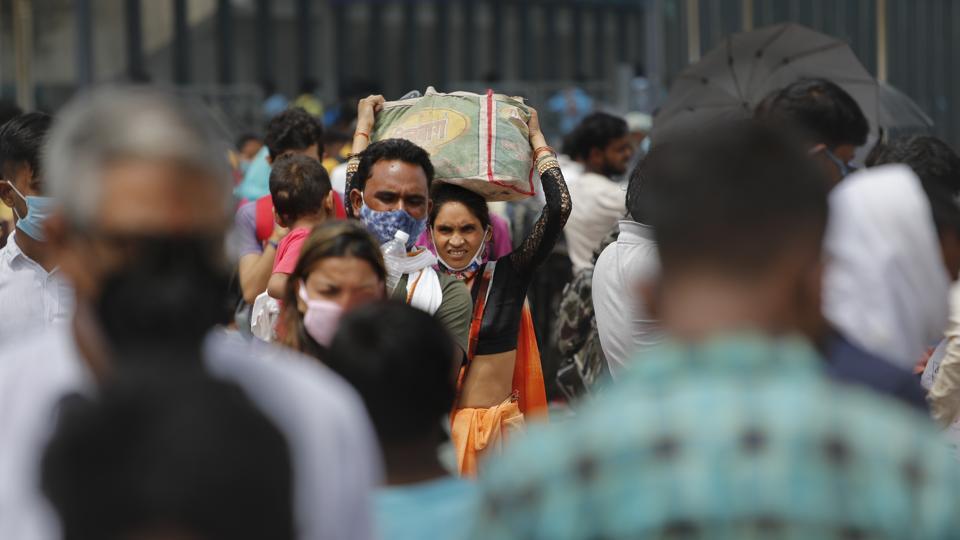
On the subsequent impact of the lockdown, the Opposition centred its critique on the suffering of migrant workers. Sharma said that if the government had consulted states and told them to prepare down to the district and tehsil level, implement standard protocols, and track camps with migrant workers, the situation would have been different. He spoke of the images of Indian migrant workers walking home, published internationally, and called for a national database on migrant workers.
Jha, who represents Bihar in the Upper House, a state which saw a high number of migrants returning home, said that while the upper middle class and middle class of the country thought they were fine, no one spared a thought for the poor and migrant workers. “Workers are not statistics. They are someone’s father, mother, daughter, son. I propose that we should all apologise to workers about whom we did not think, who we did not even talk about in the first two lockdowns and only woke up to their fate during the third lockdown.”
RCP Singh of the Janata Dal (United) said that during the pandemic, workers from Bihar, who have been working and contributing to the development of other states, were “deserted”.
The BJP’s Sahasrabuddhe strongly defended the government’s handling of the economic and humanitarian situation and said that its “integrated approach” was based on public participation; there was constant dialogue; there were a range of welfare programmes, including the extension of the distribution of free ration and cited examples from BJP-ruled states of efforts to assist migrant workers. An MP from Maharashtra, Sahasrabuddhe, however, spoke at length about the alleged mismanagement of the pandemic in that state.
On the economy front, Tiruchi Siva of the Dravida Munnetra Kazhagam (DMK) said: “The strictest lockdown was India’s. The lowest fiscal stimulus is India’s. The greatest GDP hit is India’s. The post-lockdown result is worse in India than anywhere else in the world.”
On Centre-state relations, O’Brien pointed out that out of a public expenditure of ₹100 on health, ₹63 was spent by states and ₹37 by the Centre. “When things are going good, you want to take the credit. When things are tough, you talk about chief ministers... what was needed was picking up the best practices from all states... you need humility to know that we don’t know everything. You need humility to work with states.” O’ Brien, along with other opposition leaders, also criticised the government on the “opaqueness” of the PM-Cares fine.
Also read| Can’t reserve 80% ICU beds for Covid-19 patients: Private hospitals
On data, Swapan Dasgupta — a nominated member who is aligned with the BJP — said that an element of confusion had crept in, and while it was agreed that India had a large number of infected people, there was a story that had gone out to the world about how Indian figures were underestimated.
“Now, I do not know whether this is true or false but a lot of the mathematical model this is based on would suggest that the tally in India would go up to 700 to 800 million, which seems an absurd proposition.” He said that the reticence of the government on the basis of the statistics had created confusion. “I urge the government to give a clarification on the statistical robustness of the figures.”
The debate will continue on Thursday.


