E-Paper



Govt plans to unveil social security plan for gig workers
The Indian government plans to launch a social safety net for 7.7 million gig workers, requiring aggregators to contribute 1-2% of revenue for benefits.

 Prefer HTon Google


The Union government may soon announce a social safety net for the country’s estimated 7.7 million gig economy workers, people familiar with the thinking in the highest echelons of government said, with aggregators likely to be asked to pay 1-2% of their revenue to create a social security fund that can provide health insurance and other benefits to the workers.
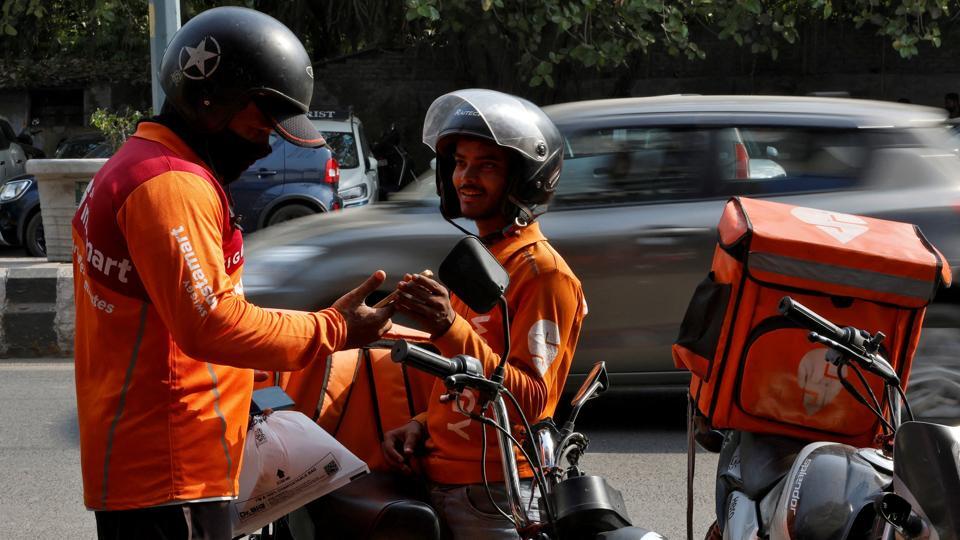
The plan, HT learns, may be unveiled on September 17, when the third Narendra Modi government completes 100 days of its term. The day also coincides with the Prime Minister’s 74th birthday.
Given all talk of the 100-day plan before and soon after the national elections this summer, it is no surprise that all ministries are keen to showcase their achievements, and suggest special 100-day schemes.
Among those pitches lying with the Prime Minister’s Office (PMO), HT learns, is the blueprint of a social security plan for gig workers. Union labour minister Mansukh Mandaviya is understood to have met with officials on September 7 to put final touches to the plan.
“We have one final meeting with the platforms and aggregators that remains to be done. Otherwise, we are ready with our plan to be sent to the cabinet,” said one of the people, a senior government official who asked not to be named.
While the details are still mostly unknown, the scheme is in line with the Social Security Code passed by Parliament in 2020 but which hasn’t been implemented yet because the rules are yet to be framed by all states. Four labour codes passed during 2019-2020 consolidated 29 labour laws to boost jobs and extend ease of doing business.
“We have already asked all the big aggregators to register with e-Shram, the national database of informal workers. The outlay for this hasn’t been worked out yet because it will be from the fund that the aggregators create,” said the official cited above.
Zomato, one of the largest gig economy companies in the country, did not respond immediately to a request for comment. Neither did Amazaon, Uber or Urban company when contacted by HT.
This newspaper reported on September 1 that the labour ministry was working on a social security plan for gig workers, quoting Mandaviya, who did not share further details. The minister, however, said the government was going to launch an online window for gig platforms to help enrol workers on the e-Shram portal, a state-run database of informal workers.
Workers registered on the portal, currently numbering around 300 million, qualify for federal social welfare schemes, such as free ration at their place of work and publicly funded social insurance.
“States have already had a very positive reaction to this scheme. The only state which raised some concerns was West Bengal but it was of a technical nature and we will work it out,” said the official cited above.
The government has also planned to meet with trade unions to ensure that their concerns are also taken on board. “The welfare of gig workers is a major concern internationally. It was also a major part of the Brics meeting on international labour initiatives,” said the official.
Some states already have laws or are working on ones for gig workers although their enforcement is patchy.
On July 24, 2023, Rajasthan passed the Rajasthan Platform-Based Gig Workers (Registration and Welfare) Act, becoming the first state to regulate gig work. “In Rajasthan, there are still issues about contribution of aggregators towards social security,” said Rikta Krishnaswamy, the Delhi-NCR coordinator for the All-India Gig Workers’ Union.
On June 29 this year, the Karnataka government published a draft of the Karnataka Platform-based Gig Workers (Social Security and Welfare) Bill to regulate social security benefits of gig wage earners.
The issue is also one that the opposition and especially the Congress Party has been highlighting frequently. Leader of the Opposition Rahul Gandhi, in the last few weeks, has met Uber drivers to get their inputs for legislation aimed at gig wage earners in Congress-ruled states.
“I wanted to meet you so that I know what kind of laws we need. We are bringing this in Telengana and Karnataka,” Rahul Gandhi tells one Uber driver in a recent video.
The government however is clear that it is not a political issue, but a policy initiative that is the need of the hour.
“Any social benefits are welcome, but we have not been consulted yet,” said Sunand, who goes by one name, who is associated with the All-India Gig Workers’ Union and is a leader of the Centre for Indian Trade Unions.
Sunand said the main concerns, aside from social security, are the legal definition of employee-employer relationships in the gig sector, wages and working hours, which he said aren’t addressed by the labour codes.
Globally, gig platforms tend to not view themselves as traditional employers. These app-driven service providers describe workers as partners, which then has implications for what kind of labour regulations they are required to follow.
“Even existing laws and legal frameworks, say like the Delhi Shops and Establishment Act, have enough provisions to provide protection needed for gig workers. They key thing is to understand the nature of gig work,” said Krishnaswamy.
Labour falls in the Concurrent List of the Constitution, meaning both the Centre and states have jurisdiction over the sector. India’s gig economy is rapidly expanding but most workers are undocumented and not covered by any welfare programme.
According to the Economic Survey 2023-24, the gig workforce in Asia’s third-largest economy will reach 23.5 million workers by 2029-39, roughly three times the estimated 7.7 million workers in 2020-21.