
 E-Paper



Covid-19: Govt strengthens community check protocols to check spread
Community surveillance is one of the mainstays of the government’s strategy to fight coronavirus disease (Covid-19) transmission in the country.


A little over 4 million people, mostly in containment zones, and comprising asymptomatic high risk groups, such as the elderly (above 60 years of age), children under the age of 10 , and pregnant women are now routinely being monitored on a daily basis as part of the government’s strengthened community surveillance strategy.
In zones where population density is high such as slums, these high risk groups are moved to a quarantine centre to be kept under observation, according to Union health ministry’s containment and surveillance plan that was revised earlier this month.
“The phase of pandemic that we are in currently demands robust surveillance mechanism in place so that infected individuals are identified and isolated in time before they further spread the disease within the community. About 80% of contacts are successfully traced within 72 hours of the process having started,” said an official familiar with the matter and who works at the National Centre for Disease Control (NCDC).
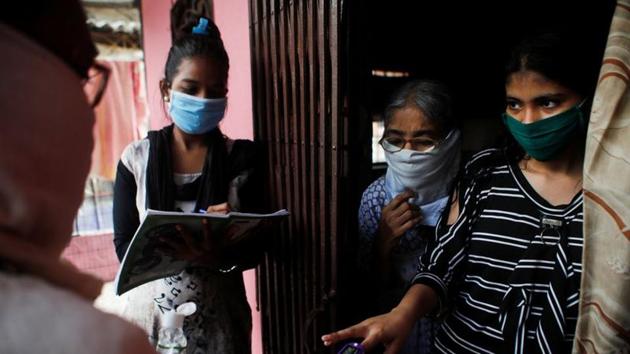
A list of 100 households is assigned to each team that screens everyone in the household, and takes readings of their temperature and oxygen saturation; those found with fever or low oxygen saturation levels are isolated for testing and further necessary action.
Any temperature of 100.4 F or greater is considered as fever, and oxygen saturation level below 95% will warrant monitoring under medical supervision.
The surveillance teams are formed by state authorities based on the requirement.
Community surveillance is one of the mainstays of the government’s strategy to fight coronavirus disease (Covid-19) transmission in the country. The Union health ministry is focusing on strengthening surveillance further by way of contact tracing and testing in collaboration with State governments.
The 4.2 million people currently under community surveillance, have been identified as high risk contacts of confirmed cases, according to the government data.
The plan is active at the district and block level to ensure no infected individual is missed.
Contacts put under surveillance are individuals who have been exposed to an infected person (confirmed by a laboratory) from 2 days before to 14 days after the onset of illness.
According to the plan, high risk contacts include those who live in the same household as the patient; were in close proximity (within 1 meter) of the confirmed case without precautions (mask) for more than 15 minutes; had direct physical contact with the body of the patient including physical examination without personal protection equipment; or shook hands or hgged or kissed an infected person.
Contacts that need special focus are largely family members, visiting relatives and domestic help among household contacts; neighbours, friends, milk and vegetable vendors etc. among contacts within community; co-travelers and drivers in flights, trains, buses, taxis and auto rickshaws etc. in the travel category; and those who attended a marriage, party, funeral , religious meeting, conferencs etc. among social gatherings.
“There is a large section of workers who have been adequately trained to execute community surveillance measures. The plan has been broken down to the block level and there are dedicated supervisors who are trained in monitoring and handholding the workers wherever required,”added the official.
The integrated disease surveillance programme (IDSP) network in states is a dedicated unit that is responsible for executing surveillance measures, in collaboration with other state health bodies that have been pressed into action.
As a result of strong monitoring mechanisms and improved awareness levels the infections reported per positive case have dropped significantly. From 81-130 in May this year, the number has come down to 26-32 in August, according to the data shared by the Indian Council of Medical Research (ICMR).
“It highlights the importance of effective testing, tracking and treating strategy in fighting the pandemic, and that we need to strengthen it further to keep the momentum going,” said Dr Balram Bhargava, director general, ICMR.
Experts in the field of community medicine say that for effective community surveillance workers need to be trained adequately in interpersonal and communication skills.
“It is not only about what is communicated to members of the community but also about how it is communicated that makes the difference,” said Jugal Kishore, head, community medicine department, Safdarjung Hospital.


