E-Paper



Goyal defends global south at CII summit
Goyal says India is for environment protection and sustainable development, which is the shared global responsibility

 Prefer HTon Google


New Delhi: All countries must contribute towards sustainable development with assigned responsibilities based on their contribution to the problem in the first place, Union commerce minister Piyush Goyal said on Monday, underscoring “polluter pays” principle at a time when 27 European countries forcing carbon tax on imports from developing countries like India.
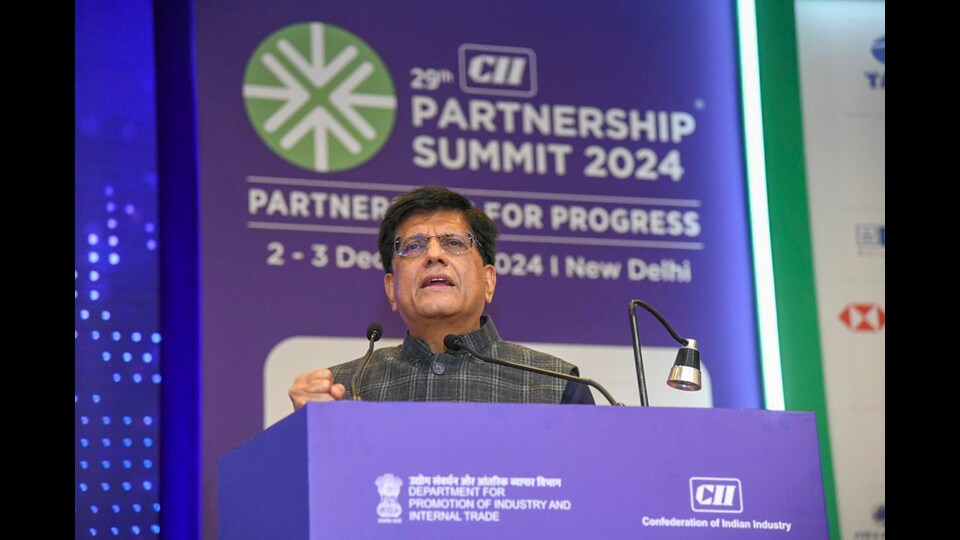
Addressing ministers from 11 countries at the 29th CII Partnership Summit in New Delhi, Goyal said: “When we look at the shared future, very clearly, we all have responsibilities towards the environment, towards sustainability. But most of the countries on this platform are countries which are not the reason for the problem in the very first place.”
The 11 countries included Algeria, Bahrain, Bhutan, Israel, Italy, Nepal, Senegal, South Africa, Cambodia and Qatar.
“The damage to the environment was not caused by the Global South or by the less developed or developing countries, but more by the developed countries, which enjoyed the fruits of low-cost energy to develop their economies into large per capita economies,” he added. The summit, themed ‘Partnerships for Progress’, is organised by CII in collaboration with the department for promotion of industry and internal trade (DPIIT).
India is for environment protection and sustainable development, which is the shared global responsibility, he said, adding that responsibilities must, however, be equitable. “This shared responsibility towards sustainability, towards better supply chains, towards stable policies, will all have to be done with the recognition of a common but differentiated responsibility. While we are all part of the solution, we will all have to work together. Everybody will have to be given a responsibility based on their contribution to the problem in the very first place,” the Union minister said.
Goyal’s statement came days after a controversial decision at the UN climate conference in Baku adopting a meagre $300 billion climate-finance package by undermining priorities of the Global South. India expressed disappointment at the shifting of focus from enablement of adequate climate finance to emphasis only on mitigation at the plenary session of at the CoP29 in Baku, Azerbaijan.
Even as India’s per capita carbon emission is only one-third of the global average, the European Union — a block of 27 countries — is thrusting sustainability measures such as the Carbon Border Adjustment Mechanism (CBAM) and EU deforestation regulation (EUDR) on Indian manufacturers.
Measures like CBAM could spike tariffs up to 35% on carbon-intensive Indian exports such as steel, cement, aluminium, fertilisers and chemicals and make Indian products unviable in the European market. The tax, being implemented in phases from October 2023, becomes fully effective from January 2026. Meanwhile, EUDR’s implementation deadline for deforestation-free certification of products like cattle, wood, cocoa and derived goods has been extended by a year to December 30, 2025.
Speaking at the summit, Israel’s minister of economy and industry MK Nir Barkat said that Israeli technology could help in mitigating several climate risks. He also focused on Israeli start-up ecosystem and the strengths of the west Asian country in desert tech and climate change technology leading to desalination and wastewater treatment, among others.
Italian minister of enterprises Adolfo Urso said Italy is interested in developing a strategic corridor that not only promotes trade but also sustainability and regional security. Qatari minister of state of foreign trade affairs Ahmed Mohammed Al Sayed said the partnership between Qatar and India represents a long-term strategic alliance that they are committed to increase, advance, and strengthen together. According to CII director general Chandrajit Banerjee, the one-and-a-half-day summit is represented by delegates from 61 countries and 30 global speakers. It is deliberating on a range of issues including, sustainability, green technologies and gender equality.