E-Paper



GST council raises prosecution limit, hikes cess on SUVs
The 48th GST Council that deliberated eight of 15 agenda items on Saturday reduced GST on a couple of items, benefiting farmers and petroleum refiners, and provided rate-related clarifications on several items such as rab (semi-solid form of jaggery), fryums and sports utility vehicles (SUVs) to have nationwide uniformity.

 Prefer HTon Google


The Goods and Services Tax (GST) Council on Saturday removed GST on some types of animal feed, reduced tax on ethanol supplied to refineries for blending with petrol, clarified that SUVs having certain features would attract 22% cess, decided to keep no-claim bonus on insurance products outside the tax ambit, and decriminalised various offences barring crimes for faking invoices.
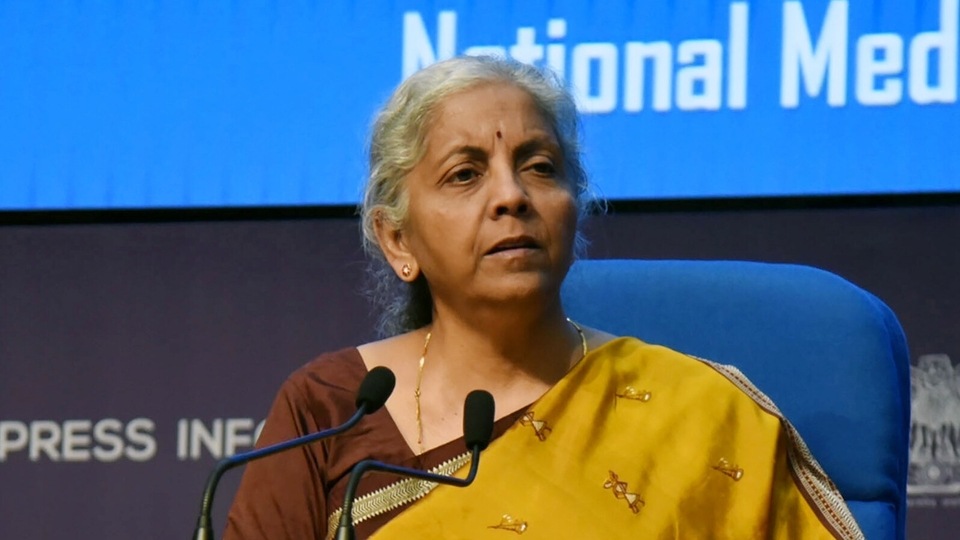
The 48th GST Council that deliberated eight of 15 agenda items on Saturday reduced GST on a couple of items, benefiting farmers and petroleum refiners, and provided rate-related clarifications on several items such as rab (semi-solid form of jaggery), fryums and sports utility vehicles (SUVs) to have nationwide uniformity.
“In this council meeting there has not been any tax increase on any item. Everything that is being done is to issue clarifications where ambiguity of interpretations prevailed,” Union finance minister Nirmala Sitharaman told reporters after the meeting that took place virtually. Sitharaman is the chairperson of the council, which has representations of states through their respective finance ministers. The council is the apex decision-making body on GST matters.
Also Read | India's forex reserves up for 5th consecutive week
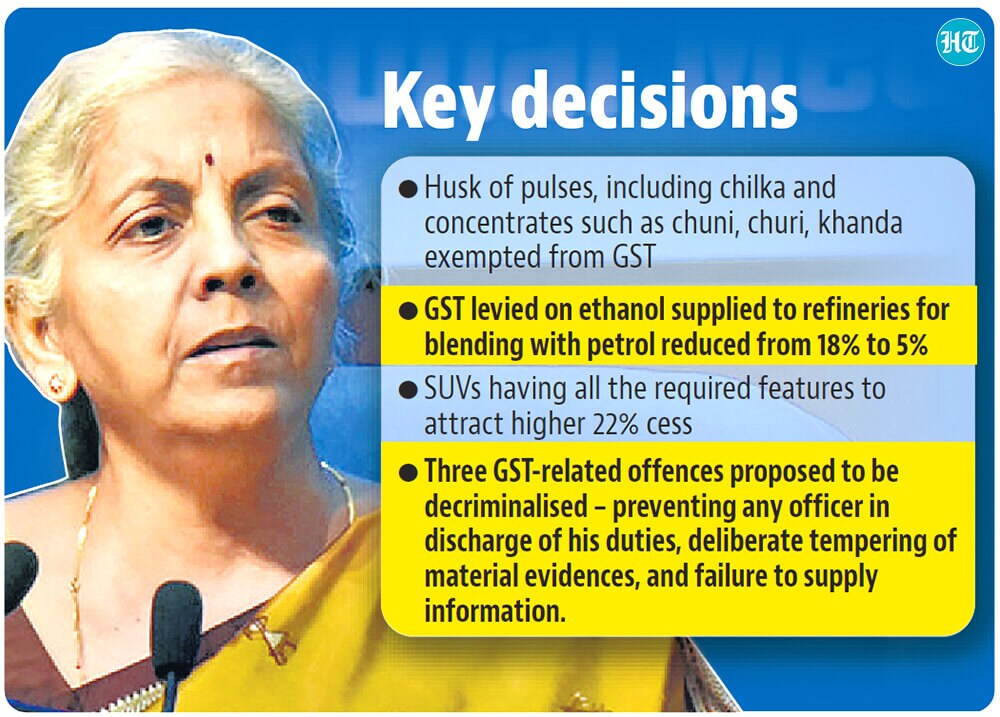
At its Saturday meeting, the council decided to exempt husk of pulses, including chilka and concentrates such as chuni, churi, and khanda from GST. Earlier, these fodder materials attracted 5% tax when used as a cattle feed ingredient.
It also reduced GST on ethyl alcohol (ethanol) supplied to refineries for blending with petrol from 18% to 5%. Explaining decisions of the 48th GST Council, revenue secretary Sanjay Malhotra said the move to bring refineries on par with oil marketing companies that already enjoyed a 5% tax on ethyl alcohol will boost blending of ethanol with petrol to reduce the country’s dependence on imported fuel and “thereby, save precious foreign exchange”.
Also Read | Work out strategies to draw global manufacturers to India: FM to industry
The council also rectified ambiguities related to applicability of GST rates and cess on several items, including SUVs, rab, and fryums. It was clarified that rab attracts GST at the rate of 18%, while fryums manufactured using the process of extrusion attract 18% GST.
The council decided that a motor vehicle will attract “higher rate of compensation cess of 22%” if they fulfil “all four conditions” — it must be popularly known as an SUV, have engine capacity exceeding 1,500cc, length exceeding 4,000mm and a ground clearance of 170mm or above.
Also Read | More steps in works to cool prices: Nirmala Sitharaman
Sitharaman clarified that there is no new taxation on any item and the council has only clarified rates as per the fitment committee’s recommendations. “But even as we brought in this clarification, there was a request to bring in or add to this, MUVs [multi-utility vehicles]… So what has been agreed by the council is that this goes ahead, this clarification goes ahead, but if there is anything else which has to be added on to this 22% rate, the fitment [committee] will look into it..,” she added.
Speaking about changes in GST laws for greater ease of doing business, Malhotra said the council took some “path-breaking” decisions to decriminalise GST-related offences and raised limits to initiate prosecutions. He said three types of offences have been proposed to be decriminalised — preventing any officer in discharge of his duties, deliberate tampering with material evidence, and failure to supply information.
“Moreover, the threshold limit of tax amount for launching prosecution in any criminal offence [as] defined under the GST laws, the limit has been increased from ₹1 crore to ₹2 crore for all offences other than those involving fake invoices,” he said. The council also decided to reduce the compounding amount for various offences from the current level of 50% to 200% of the tax amount to 25% to 100%, he added. The implementation of changes in GST laws is expected after the Budget as both the Centre and states requires legislative approvals for the same.
Experts said the GST regime was increasingly becoming simpler and effective. Saurabh Agarwal, tax partner at EY India, said: “The overall focus of the GST Council again appeared to be on resolving the uncertainties for industry on multiple issues viz levy of compensation cess on SUVs (including MUVs), taxability of residential dwelling for personal use…”
“Today’s GST Council meet was predominantly characterised by various clarifications being issued and trade/compliance facilitation measure such as conditions applicable for levy of higher rate of compensation cess for SUVs, decriminalisation under GST, etc. As such, the industry players will have to wait a little more on decisions on other pressing issues such as setting up of an appellate tribunal, rate rationalisation, online gaming taxation, etc,” said Abhishek Jain, partner – indirect tax at KPMG in India.
He said the issue of applicable rate of compensation cess for SUVs and MUVs has been in talks for a while. “This issue seems to have been put to rest with the GST council specifying the four conditions for the 22% GST compensation cess levy,” he added.
While the 48th GST Council meeting had about 15 agenda items, only eight could be taken up on Saturday and the rest were postponed for discussion in the next meeting as many states wanted to finish this meeting by 1.30pm due to other preoccupations. The seven agenda items that could not be taken up on Saturday included reports of two GoMs — one related to capacity-based taxation on tobacco and gutka, and the other pertaining to setting up of GST tribunals, according to Sitharaman.
The council on Saturday took decisions related to eight agenda items that included data sharing, she said, adding that matters pertaining to online gaming and casinos were not part of Saturday’s meeting agenda.