
 E-Paper



GST hike to make premium air travel costlier
Economy fares remain unchanged to keep travel affordable, but higher GST on premium classes has raised concerns among airlines and online travel agents.

 Prefer HTon Google


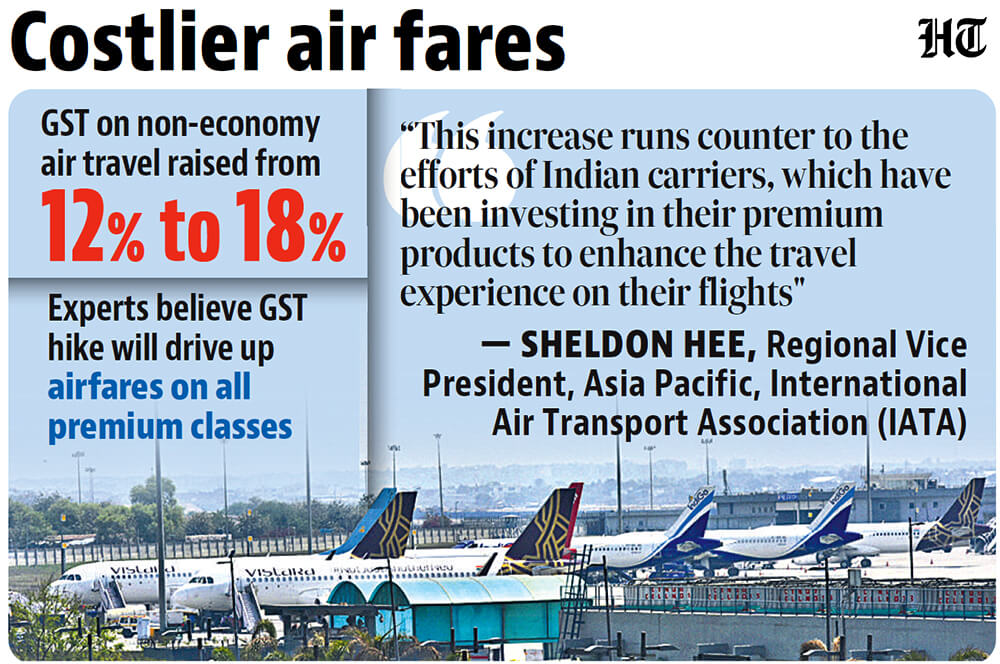
The Goods and Services Tax Council has raised the levy on non-economy air travel from 12% to 18%, a move experts believe will drive up fares for passengers travelling in premium economy (PE), business and first class.
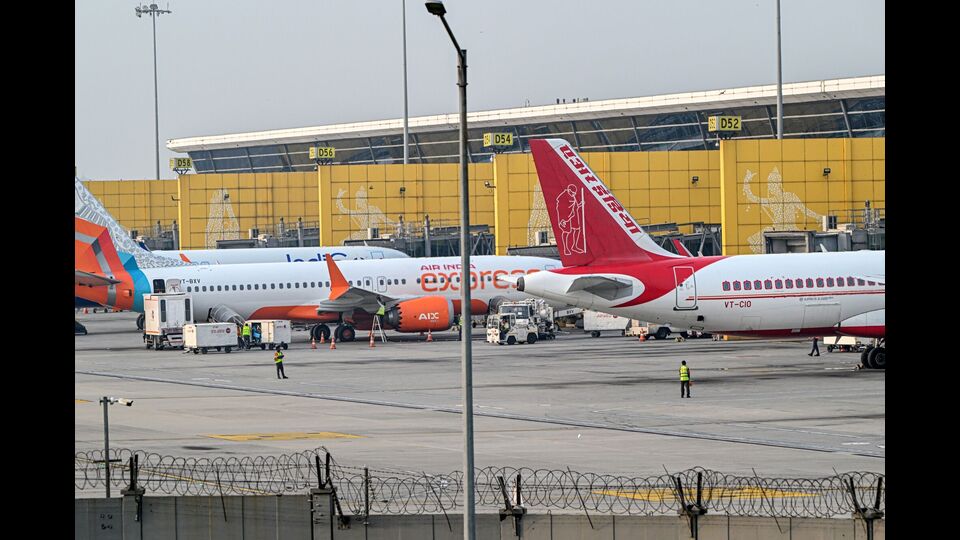
While the rate for economy travel stays unchanged to keep airfares affordable for mass travellers, the steeper GST on upper classes has triggered concern among airlines and online travel agents. Prior to the Council announcing the new tax regime on Wednesday, two major airlines requested for GST on all classes to be brought to 5%, three government officials confirmed to HT.
Former president of Travel Agents Federation of India (TAFI) Ajay Prakash said the new GST rate has come at a time when the Indian aviation market is going through a “very sensitive phase”.
“Increasing the GST for upper class fliers directly means airfares for all the three classes will shoot up,” he said. “While the government claims to promote Indian aviation by bringing in big aircraft, etc., levying higher GST is only going to discourage individual fliers to book on non-economy classes.”
Jitin Makkar, senior vice president and group head of corporate sector ratings in ICRA Limited, noted the additional levy will be passed on to the consumers.
An airline insider requesting anonymity said that the increase is no revolution but it is enough to make airlines rethink budgets and booking strategies. “Let alone the Air India crash (June 12 disaster that claimed 260 lives) that shook passenger confidence, Indian airlines are facing major troubles due to the ongoing Pakistan airspace closure leading to more flying time and increased airfares. At such a time, it was needed that the sector be allowed to remain untouched,” the official said.
A former airline official echoed similar views, saying, “India has only two major airlines now –– while one is trying to regain passenger trust while facing a loss of ₹5,000 crore due to Pakistan closing its airspace, the other (IndiGo) has just entered into the segment and launched its business product.”
Sheldon Hee, regional vice president, Asia Pacific, International Air Transport Association (IATA) termed the move “disappointing”. IATA is a global trade association of airlines, representing around 300 airlines or about 80% of worldwide air traffic and acts as a global voice of the airlines.
“In many ways, India has been an amazing aviation story with its impressive growth, record aircraft orders, and world class infrastructure. Aviation has tremendous potential to contribute to India’s economic growth, both directly as Indian airlines grow, and indirectly through increased connectivity for travellers and businesses alike. It is, therefore, disappointing to hear of a decision to increase the GST on non-economy travel with no clear justification,” Hee said.
“This increase runs counter to the efforts of Indian carriers, which have been investing in their premium products to enhance the travel experience on their flights. Tax on non-economy air travel has risen dramatically –– GST is at 18% after yesterday’s announcement, compared to the 8.6% rate in 2017 under the service tax regime.”
Hee also said that for its aviation industry to thrive, India needs to take a whole of government approach in considering broader policy and consider the risks of such policies on dampening demand and undermining profitability in order for its aviation industry to thrive.
“Asia Pacific airlines are forecast to only earn $2.60 per passenger in 2025. Taxing premium travellers, where these customers often make a difference to a route’s viability, is counterproductive,” he added.
Makkar, however, said that the increase should not have a significant impact on the business class segment considering this segment’s low price elasticity, though there could be some amount of downtrading to the economy segment.
“By keeping rates stable for economy travellers, this measure is likely to ensure continued affordability, thus making air travel more accessible,” he concluded.
The updated GST framework introduces much-needed transparency and stability for air passengers, particularly those flying economy. Travelers who complete their bookings and payments before the new rates take effect will continue under the earlier structure, ensuring both fairness and consistency. This consumer-centric step not only aligns government revenue priorities with passenger ease but is also expected to spur travel demand. A stronger flow of travelers will, in turn, benefit hotels, restaurants, and allied services, giving a significant boost to the broader hospitality and tourism ecosystem," said Liberatha Kalath, CMD, DreamFolks.


