
 E-Paper



Hasty passage of bills not unique to NDA govt
In the 14th Lok Sabha, the UPA’s first term between 2004 and 2009, 33 bills were approved with each one taking less than 5 minutes. This amounts to 18% of 182 bills approved in the Lok Sabha during the entire five-year term.


6, 6, 8, 5, 5, 9, 5, 5, 9, 7—these are not digits of a cellphone number but minutes are taken to pass proposed laws in the Lok Sabha during the monsoon session of Parliament. The laws passed amidst the din and without debate, triggered controversy as the Opposition alleged the government avoided parliamentary scrutiny and debate.
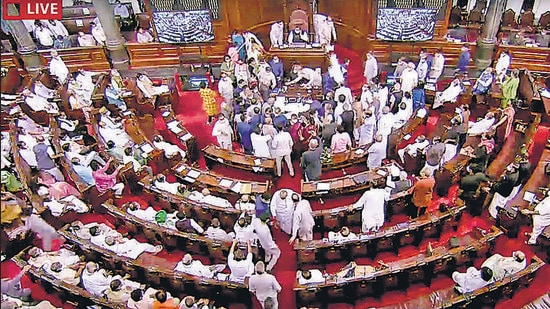
But data available with PRS Legislative Research shows that during the UPA1 and UPA2 governments too, a large number of bills were passed with little debate in the Lok Sabha.
In the 14th Lok Sabha, the UPA’s first term between 2004 and 2009, 33 bills were approved with each one taking less than 5 minutes. This amounts to 18% of 182 bills approved in the Lok Sabha during the entire five-year term.
Of these 33 bills, eight were passed on December 24, 2008, in 17 minutes, setting a record for hasty passage of bills as the BJP, then in the Opposition, disrupted the House over then minority affairs minister AR Antuley’s remarks that ATS chief Hemant Karkare’s death during the terror attack in Mumbai should be probed.
The 15th Lok Sabha—the second term of the Manmohan Singh government—saw 20 bills or 17% of the total laws passed during the five-year term approved in five minutes or less. And 11 other bills were cleared swiftly with each one taking less than 30 minutes, according to PRS data.
A bill, after introduction, is usually referred to a standing committee for review. Once the House panel submits its report, the bill is scheduled for “consideration and passing”. The Business Advisory Committee of each House—a multi-party panel headed by the Chair—allows time for its discussion. Normally, one to three hours are allotted for discussion for a bill.
Congress leaders, however, pointed out that during the Modi regime, very few bills have been sent to House panels for review. In an interview with HT, the Congress’s Rajya Sabha chief whip Jairam Ramesh said, “The Opposition’s agitation is justified. Just 12% of the bills in the second term of the Modi government (were sent to the panels). It was 27% in the first term of Modi and in the UPA 1 and 2, 71% and 60% bills were referred to panels for review.”
The monsoon session of Parliament witnessed as many as 19 bills passed without any debate as the government decided to push important bills amid the Opposition-led deadlock over the Pegasus spyware issue and the farm laws. The only bill to go through a proper debate was the 127th Constitution Amendment bill. Lawmakers spoke on the bill for 7.54 hours in the Lok Sabha—the longest debate on any bill during the Narendra Modi government.
To be sure, laws were cleared after extensive debates in the first term of the Modi government (2014-19), and just one bill was passed in less than 5 minutes. Another eight took half an hour each to be decided in the Lok Sabha. But other laws saw extensive discussion lasting from an hour to a marathon of 7.28 hours. The last was a discussion of the bills on the bifurcation of Jammu and Kashmir into Union territories.


