
 E-Paper



HC scraps Andhra’s three-capital plan
A three-judge bench, headed by chief justice Prashant Kumar Mishra, declared that the Reddy-led YSRCP government’s proposal for multiple capitals for the state was bereft of any legal authority.

 Prefer HTon Google


The Andhra Pradesh high court on Thursday ruled that Amaravati shall be the only capital city of the state which will be developed within six months,scrapping chief minister Jagan Mohan Reddy’s ambitious “three-capital” plan on the ground of legislative incompetence, abuse of power and arbitrariness.
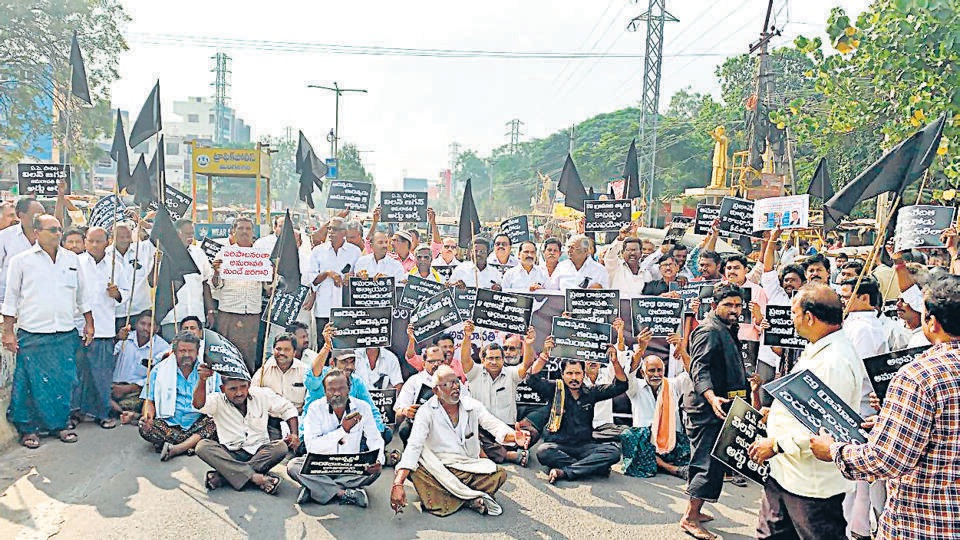
A three-judge bench, headed by chief justice Prashant Kumar Mishra, declared that the Reddy-led YSRCP government’s proposal for multiple capitals for the state was bereft of any legal authority and smacked of “malafides”, depriving 30,000 unsuspecting farmers of their livelihood and the right to live a dignified life after they voluntarily surrendered their land for development of the capital city.
The bench, which also included justices M Satyanarayana Murthy and DVSS Somayajulu, held that the state government’s failure to discharge its duties and obligations, stoppage of development work and the failure to complete the land pooling scheme process in Amaravati despite a statutory contract with the farmers is a “fraud on power”.
Through a 2020 law, the Jagan government proposed Amaravati as the legislative capital, Visakhapatnam as the executive capital and Kurnool as the judicial capital. This law was withdrawn in 2021 when the matter reached the high court, but with a rider that the government would re-legislate on establishing multiple capitals after further deliberation.
Extinguishing any possibility of a future legislation on multiple capitals for the south eastern coastal state, the high court ruled: “The state legislature has no legislative competence to pass any resolution or law for change of capital or bifurcating or trifurcating the capital city.”
State municipal administration and urban development minister Botsa Satyanarayana said the state government would take a call after studying the judgement copy. “Our policy is very clear. We want to create three capital cities for decentralised development of all regiions,” he said.
He made it clear that the state legislature was meant for enacting laws as was the case with Parliament.
“It is for the state to implement the project for which the land is acquired and (it) cannot use the land for any other purpose. The state cannot shift its capital when the large parcels of land already pooled for sole purpose of construction of capital city,” underlined the court.
The bench directed the state government to hand over developed plots to the land owners within three months while asking it to not alienate or create any third-party interest on the land pooled for Amaravati, except for the construction of capital city or development of capital region. It also ordered the development of infrastructure in Amaravati, roads, drinking water, drainage and electricity within one month.
“Once the state agreed to take up a particular project and made the farmers part with huge parcels of the land, it is the duty of the state to complete the development as it is not only constitutional obligation, but also statutory obligation...the state or APCRDA (Andhra Pradesh Capital Region Development Act) cannot abandon the partly completed projects, development and infrastructure in the capital city on the ground of financial difficulties or any other ground,” held the bench as it allowed a clutch of petitions filed by Amaravati farmers’ joint action committee and other individuals.
APCRDA was constituted by the previous Telugu Desam Party government to develop Amaravati as the capital city under the agreement that the capital city would be constructed within the notified area.
The high court noted that a change of government cannot be a valid ground to change the policy. “... it is the duty of the State to continue the project, unless those decisions were taken to implement those projects contrary to the constitutional or statutory provisions... If the state and APCRDA failed to construct capital city within the pooled land, it directly violates the constitutional trust and the people will lose the confidence on their elected representatives,” the court said.
Pointing out that the previous government spent nearly ₹15,000 crore on development and another ₹32,000 crore on ground work in Amaravati, the bench said the present government shall account for the money spent on the work undertaken by the earlier government to the public.
“Sudden stoppage of the developmental activities due to an alleged financial crisis or otherwise is impermissible and the state government is held responsible for the total amount spent on the capital so far... When more than ₹15,000 crore of the tax payers’ money are spent on the project, the State shall continue to complete the projects for the benefit of the public,” emphasised the bench.
It further noted in its 307-page judgment: “For the reason that the project is not supposedly financially viable, they disbanded or abandoned the projects on the lame excuse, without taking care of amount already spent on the project and being spent by way of payment of annuity to the farmers, who surrendered their land voluntarily in the land pooling scheme... The works were stalled immediately after the present government came into power, by taking a decision and consequently, the court can infer malafides.”
The high court lent credence to the development agreement-cum- irrevocable general power of attorney that the state government secured from the land owners in Amaravati to hold the state government to its promise.
“Once the government made a promise in terms of the agreement, it is the obligation of APCDRA to complete the land pooling scheme and development as agreed...they cannot resile from their promise in view of the principle of promissory estoppel...the inaction of the state, APCRDA in development of capital region is to the detriment of the farmers who surrendered their lands, and the failure to keep up the promise would amount to improper abuse of power. Thereby such inaction is arbitrary and unreasonable,” it said.
The court further held that the notified master plan of Amaravati cannot be modified It directed that the government should pay ₹50,000 to each of 100-odd petitioners towards court expenses.
On December 17, 2019, chief minister Y S Jagan Mohan Reddy announced in the state assembly that the state government would create three capitals for Andhra Pradesh – executive capital at Visakhapatnam, judicial capital at Kurnool and legislative capital at Amaravati.
After several hurdles in the state legislature in the subsequent months, the government enacted the legislation in June 2020 creating three capitals for the state and doing away with Andhra Pradesh Capital Region Authority created by the previous Telugu Desam Party government for developing Amaravati as the state capital. The bills were later given the assent by Governor Biswabhushan Harichandan.
Amaravati farmers and several other individuals challenged these bills in the high court.
In November 2021, the Jagan government repealed the legislation on three capitals stating that it would bring in a fresh fool-proof legislation, so that there would be no legal hurdles. It told the court that the earlier laws had been repealed, but the court continued to hear the arguments on the Amaravati issue.


