
 E-Paper



Heavy rain forecast, another weather record likely to fall
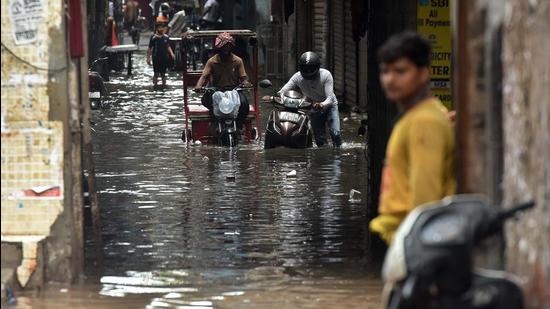
Halfway into the month, the city has recorded 390mm rain, making it the second rainiest September ever recorded since records begun to be kept in 1901. The highest this month has ever received is 417.3mm in September 1944.


The India Meteorological Department (IMD) issued an orange alert for Delhi, predicting heavy rain in parts of the national capital on Thursday, which could break the city’s all-time record for amount of rainfall in the month of September.
Halfway into the month, the city has recorded 390mm rain, making it the second rainiest September ever recorded since records begun to be kept in 1901. The highest this month has ever received is 417.3mm in September 1944.
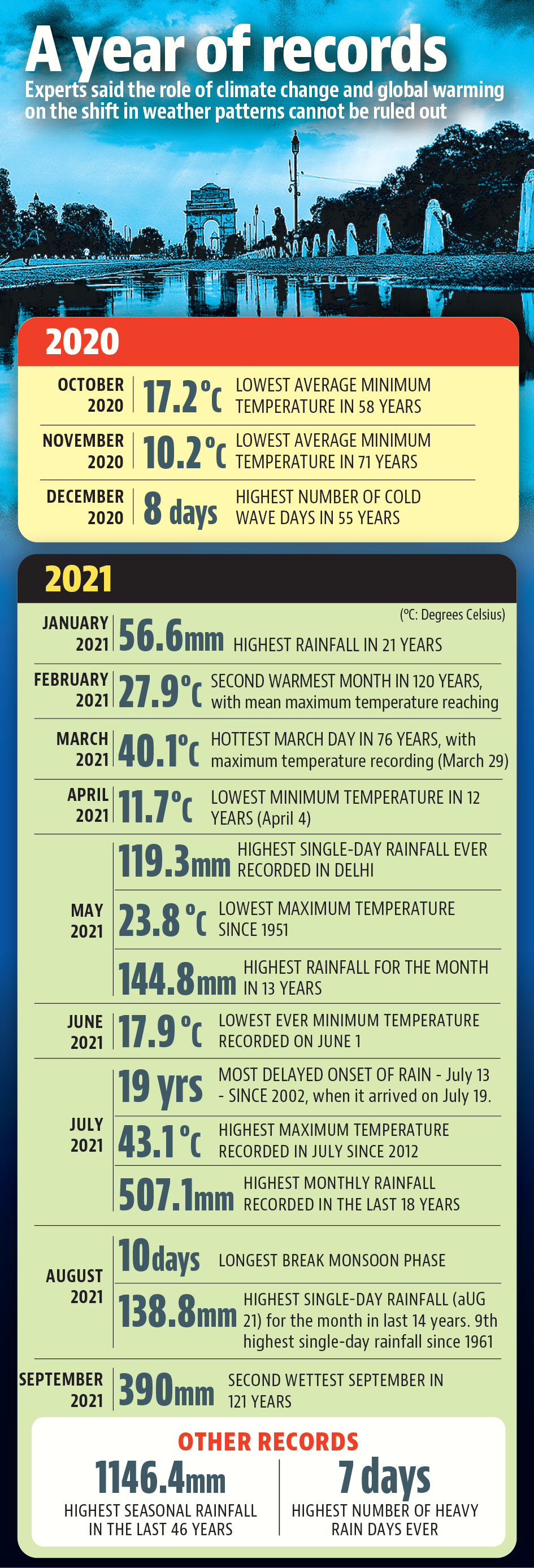
If this number is exceeded, this would be the 13th month a weather record would be broken in the Capital. Forecasters and scientists have attributed this largely to temporary factors, including global and local weather impacts, but they also said that the shift reflects the impact of global climate change.
IMD data shows that despite a late-onset, Delhi has had one of the most erratic monsoons ever. It started off with an unusually delayed arrival -- instead of arriving on its normal date of June 27, monsoon this year entered the Capital only on July 13, sixteen days behind schedule. This was the most-delayed arrival in 19 years. In 2002, monsoon hit Delhi on July 19.
The wait for rains resulted in spiking temperatures and Delhi went on to record a maximum temperature of 43.1 degrees Celsius on July 1, the highest for the month of July since 2012. According to IMD records, the maximum temperature in Delhi touched 43.5°C on July 2, both in 2012 and 1987.
However, despite a sweltering start and a long wait for monsoon, Delhi was quickly able to cover-up the rainfall shortage, setting another record. July ended up receiving a cumulative rainfall of 507.1 mm (141% above normal), breaking the record of the wettest July in 18 years, according to Met records.
The weather conditions took a turn again, and August began with one of the longest dry spells or subdued monsoon spells (break monsoon phase) that the city had ever witnessed.
Starting August 9, Delhi went on to record a 10-day dry spell. Break phases tend to last for around six to seven days in Delhi, Met officials said.
The trend of aberrant weather patterns continued through the month, and the city broke the record for the highest single-day rainfall for August in the last 14 years on August 21.
IMD recordings showed that day, Delhi received 138.8 mm rainfall, which was the highest single-day recording for August in 14 years and ninth highest since 1961.
Previously, Delhi received such a heavy 24-hour spell during the month on August 2, 2007, when the city got 166.6mm rainfall. The highest-ever single-day rainfall recorded during this month was on August 2, 1961 with184mm.
Just a fortnight into September and two historic records have already been broken. According to IMD data, September this year has already become second rainiest Septembers in the last 121 years (since 1901, when record keeping began).
RK Jenamani, senior scientist at IMD, said that not monthly records, but Delhi this year has also broken several seasonal monsoon trends. This season, from June 1 to September 14, Delhi has recorded 1,146.4 mm rainfall, highest seasonal recording since 1975 when the total monsoon rainfall count was 1,155.6 mm.
“Apart from the seasonal count, this year Delhi has recorded seven heavy rainfall days (64.4 mm and above), which is the highest since 1901, when record keeping began. The earlier record was of six heavy rainfall days, which was on 1964,” Jenamani said.
The record-breaking streak began in August 2020, when Delhi recorded 236.5mm rainfall -- the highest for the month since 2013. In September last year, Delhi went on to record the warmest month in over two decades with the average maximum temperature clocking in at 36.2 degrees Celsius, breaking the previous record of 36.1 degrees Celsius in 2015.
In October, Delhi broke a 58-year-old record, clocking a mean minimum temperature of just 17.2 degrees Celsius. November broke an even older record, with the month’s mean minimum temperature dropping to 10.2 degrees Celsius, last seen in 1949. In December and January, as coldwave continued in the Capital, record-breaking weather trends continued. December recorded eight coldwave days, highest since 1965, and January this year broke the record for the highest rainfall for the month in 21 years (56.6mm), it also recorded the highest number of cold wave days since 2008.
Met data shows that from February to June this year, extreme weather events continued. February this year was the second warmest in 120 years, with the mean maximum temperature in the month touching 27.9 degrees Celsius.
March again recorded the hottest day in 76 years, with the mercury levels touching 40.1 degrees Celsius on March 29. In April the conditions changed and the lowest minimum temperature in over a decade was recorded on April 4, at 11.7 degrees Celsius.
Under the impact of two unprecedented cyclonic storms, Tauktae and Yaas, Delhi on May 19-20 broke the record for the highest single-day rainfall for the month ever, with 119.3mm rains. This also pushed the overall monthly rainfall for the city to increase to 144.8—the second highest in the month since 2008. The gusty winds and the intense showers also brought the temperatures down, breaking the record of the lowest maximum temperature since 1951.
Experts said that while this year was unique, owing to several local and global weather phenomenon at play, which also impacted Delhi’s weather patterns, but said that the larger role of climate change was also at play.
“These extreme weather events are something which we have been observing in Delhi and its neighbouring states over the last three-four years. In many parts, all-time weather records are now being broken. Increase in extreme weather events is a major sign of climate change and such events will only increase in the future and cities will have to prepare for such events,” said Mahesh Palawat, vice-president Skymet weather services.
A report released in 2019 by Climate Impact Lab in collaboration with the Tata Centre for Development at UChicago estimated around 1.5 million additional deaths in India each year due to climate change by 2100. The findings showed that Delhi will likely see 23,000 climate-related deaths annually by 2100.
It also said that Delhi is expected to face about 22 times more extremely hot days. Nationally, an eight-fold increase in really hot days of above 35 degrees Celsius is estimated.


Stay updated with all top Cities including, Bengaluru, Delhi, Mumbai and more across India. Stay informed on the latest happenings in World News along with Delhi Election 2025 and Delhi Election Result 2025 Live, New Delhi Election Result Live, Kalkaji Election Result Live at Hindustan Times.


