In a first, India has exported around 500 metric tonnes of roe-filled Hilsas from Gujarat to Bangladesh in the last two months and another 150 MT of the fish is likely to be exported in the coming weeks, people aware of the developments said.
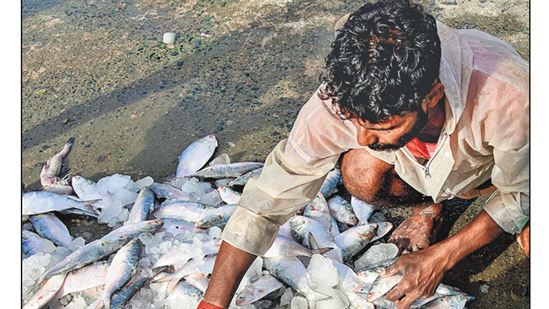
“Usually, it is the other way round. Hilsa from Bangladesh, which is considered the best for its taste, is imported around the Durga Puja time. But this is for the first time that Hilsa is being exported to Bangladesh. It is primarily the roe-filled Hilsa from Gujarat,” said SA Maqsood, secretary of the Fish Importers’ Association in West Bengal.
Also read: Hilsa spotted in Ganga near Ghazipur in UP, decades after barrage cut off migration route
Bangladeshi Hilsa prized for taste and demand
Hilsa is often tagged as the “Queen of Fish” for its taste . The Bangladeshi-hilsa found in the Padma River, is considered to be tastier than its Indian counterpart, which is found in the Hooghly River in West Bengal. Outside West Bengal, the Bangladeshi Hilsa is in great demand in Assam and Tripura.
{{/usCountry}}Hilsa is often tagged as the “Queen of Fish” for its taste . The Bangladeshi-hilsa found in the Padma River, is considered to be tastier than its Indian counterpart, which is found in the Hooghly River in West Bengal. Outside West Bengal, the Bangladeshi Hilsa is in great demand in Assam and Tripura.
{{/usCountry}}“The prime reason behind the export is the huge production of jilsa in Gujarat. Only the roe-filled fishes are being exported. In Bangladesh the fish-eggs would be processed separately and exported to other countries, while the fish would be dried for future consumption as dried fish in Cox Bazar, Chittagong, Sylhet and other areas,” said Maqsood.
Also read: India gets continued market access for agri, marine products to EU beyond Sept
Hilsa breeds in Gujarat’s reservoirs and rivers
“In Gujarat, while a residential population of the hilsa is found in the Ukai reservoir, shoals of the fish migrate from the Arabian Sea to river Narmada and Tapi for spawning,” Basanta Kumar Das, director of Central Inland Fisheries Research Institute, said.
Fish traders in West Bengal said that as the consumption of the fish is very little in Gujarat, most of the catch is sent to West Bengal. The consignments reach Howrah and Kolkata from where they are sent to other parts of the state including north Bengal.
Meanwhile, with the festive season round the corner and Durga Puja scheduled in mid-October, fish importers in West Bengal have already approached the Bangladesh authorities like every year requesting to allow export of the silver delicacy to West Bengal, where it is in high demand.
Also read: CMFRI drafts national guidelines for marine ecolabelling to boost seafood exports
Bangladesh resumed limited Hilsa exports to India in 2019
While the former Sheikh Hasina-government imposed a ban on the export of hilsa in 2012, every year since 2019 a few thousand metric tonnes of the fish were allowed to be exported to India during this time of the year. It was considered as a Durga Puja gift.
In 2024 the Bangladesh government allowed around 49 companies to export 2420 MT of the fish to India through the Petrapole border.
“This year we have already written to the Bangladesh Prime Minister Tarique Rahman and other ministers and officials,” said Maqsood.
In 2025, West Bengal procured around 5000 MT of Hilsa from Gujarat, ten times more that what is usually procured annually.
The surge
Gujarat’s Hilsa production rose to 14,587.72 metric tonnes in 2025–26, the highest in four years, according to Vijay Kharadi, Commissioner of Fisheries, Gujarat government.
The state had landed 14,198.98 tonnes in 2022–23 before the catch slipped to 8,209.48 tonnes in 2023–24 and 8,535.75 tonnes in 2024–25. Marine Hilsa still accounts for most of the fish. Inland landings, however, jumped from 123.62 tonnes last year to 4,645.99 tonnes in 2025–26, according to figures shared by the department.
That inland surge is almost entirely from the Narmada River in Bharuch. In 2024–25 the district recorded only 59.14 tonnes of marine Hilsa and 6.84 tonnes inland, under one per cent of the state total, while Porbandar (2,417.83 tonnes), Valsad (2,398.82 tonnes), Gir Somnath (1,324.35 tonnes) and Devbhumi Dwarka (901.80 tonnes) led the marine catch.
“In 2025-26 the position changed. Bharuch landed 2,949.76 tonnes marine and 4,460.33 tonnes inland, 7,410.09 tonnes in all, or about 51% of Gujarat’s Hilsa,” according to Kharadi.
The river run had almost vanished in the years just before this. Bharuch’s riverine Hilsa was 449.25 tonnes in 2019–20, then between four tonnes and 13 tonnes each year from 2020–21 to 2024–25, before the 4,460.33-tonne inland landing in 2025–26.
“Attribution to rainfall, estuarine conditions, altered migration or landings elsewhere requires a scientific stock and migration assessment, which has not been carried out for Gujarat’s Hilsa fishery.” Kharadi said.
Fisheries Commissioner Kharadi said it was too soon to treat the rebound as a lasting change. Rainfall, estuarine conditions, a change in migration, or weaker landings elsewhere could all be in play, he said, but attributing the rise to any of these would require a scientific stock and migration study.