E-Paper



How a brand new airport will aim to match Goa’s buzz
On October 17, frequent fliers of Oman Air were sent the following message on their mobile phones. “Beginning January 2023, all Oman Air flights arriving to and departing from Goa will operate out of the new Mopa International Airport (GOX). Oman Air flights will no longer operate from Goa International Airport (GOI) in Dabolim,” the communication read.

 Prefer HTon Google


On October 17, frequent fliers of Oman Air were sent the following message on their mobile phones. “Beginning January 2023, all Oman Air flights arriving to and departing from Goa will operate out of the new Mopa International Airport (GOX). Oman Air flights will no longer operate from Goa International Airport (GOI) in Dabolim,” the communication read.
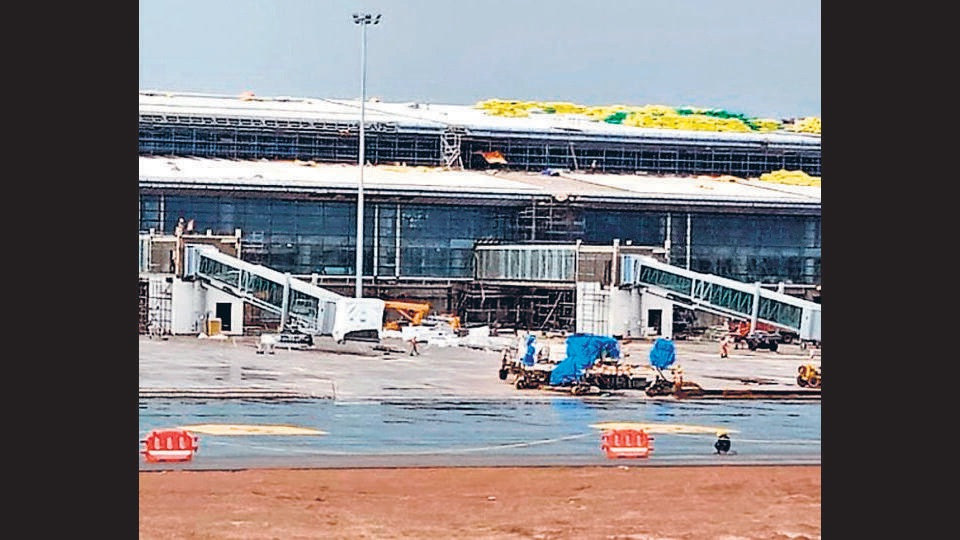
Ten days later, on Thursday, the Director General of Civil Aviation (DGCA) gave the new Mopa airport an aerodrome licence, paving the way for the imminent operation of commercial flights. That Goa would be getting a second full-fledged airport has been known for a while, but such have been the delays – it was first announced that it would be ready in 2017; then August 2019, August 2022, and now slated to begin in early 2023 – that many in the state had begun to wonder if the day would ever come to be.
This time, though, with messages from airlines, and the DGCA clearance, feels different.
In a state that has emerged as a major tourism hub in India, and has long grappled with the undeniable need for capacity expansion, hamstrung by an existing airport stretched beyond capacity, there is some sense of relief. “This will be a game-changer as far as tourism is concerned. Dabolim has its own limitations because of naval operations. If we are to look at new markets, in terms of international inflow or outflow, this was needed. I am of the view that tourism needs to change in Goa and better connectivity can bring in better tourists,” tourism minister Rohan Khaunte said.
Dabolim airport
The existing airport, Dabolim, close to the port town of Vasco da Gama and 30km away south of the state capital Panjim, was set up as a civilian airport by the erstwhile Portuguese colonial regime in 1955. It served as the headquarters of TAIP (Transportes Aéreos da Índia Portuguesa), a state-run airline of the Portuguese enclaves in India, and primarily ran flights between Goa and Portugal via Karachi, helping connectivity with Lisbon, as well as Daman and Diu – also Portuguese-held territories.
However, during the military operation to liberate Goa that lasted for two days between December 18 and December 20, 1961, it was taken over by the Indian Navy, and continues to be India’s biggest Naval airfield; home to two MiG 29K Squadrons assigned to the aircraft carrier INS Vikramaditya.
In 1966, the airport was reopened for civilian use, and it was Dabolim’s presence that aided in Goa’s explosion into the tourist hub that it is today; servicing a steady stream of domestic passengers, and foreign tourists that arrived every winter in chartered flights since the mid-1980s.
Since then, according to DGCA figures, the airport has grown to be India’s eight largest in terms of passengers handled – after the four metros, and Bengaluru, Hyderabad and Ahmedabad.
The problem, however, is that there is simply not enough room at the airport. The current terminal in use, the third since 1966, and operationalised in 2013, is designed to handle 2,750 passengers per hour and around 5 million passengers annually, state government data shows. The statistics, however, reveal that the airport handled 7.6 million passengers in 2017-18, and 8.36 million in 2019-20 before Covid-19 set in. From April to September in 2022, the airport has already handled 5.24 million passengers.
There is also the problem of the navy restricting civilian operations every morning between 9am and 12.30pm for practice sorties, senior government officials said.
It is not as if Dabolim airport has not been cognisant of this congestion. In 2019, a parallel taxiway, which helps free up the runways when a plane lands or takes off, was built. The navy, which controls traffic at the airport, said that they have “always been accommodating civil/ charter flights during military slots in case of delays and other contingencies”.
But the rise in numbers has tipped the scales. Long-time tourism operator Gaurish Dhond, who earns a living taking people to and fro the Dabolim airport, said, “The Goa airport has always been crowded. There are always queues, especially during rush hours, not enough waiting room and constant chaos.”
The Travel and Tourism Association of Goa, a lobby group, has often raised concerns as well. “We have noticed a blame game between AAI and Immigration authorities regarding the infrastructure provided at the airport, while the queues get bigger. During charter operations last season, we have noticed that wide-bodied aircraft have to wait without a parking bay for more than 1 hour, with engines running due to non-availability of parking bays,” the Association said in a memorandum earlier this month.
The new Mopa airport
Enter Mopa – a greenfield airport being built on a Public Private Partnership (PPP) model in the state’s far north. The new airport has an expanse of nearly 10 million square metres, that once comprised the villages of Mopa, Uguem, Dhadachivada, Poroscodem and Dhargal in Goa’s northernmost taluka of Pernem.
First proposed in the late 1990s by the then Congress government led by chief minister Luizinho Faleiro, the project ran into opposition from politicians, hoteliers, and taxi operators from south Goa, who said it was too far north. They argued that going ahead with the project would harm the development of south Goa, and there were persistent protests from villagers whose land was being acquired. Close to 2,131 acres of land was acquired for the airport in 2012. Government officials say only 15 families were displaced by the acquisition process, all of whom have been provided alternate accommodation.
The first land acquisition proceedings were launched in 2007, but were only taken forward in 2012 after written assurances from the Union government in 2010 that the existing Dabolim airport would continue to operate as a civilian airport, to assuage concerns from the south. This was a departure from the first cabinet approval granted in 2000 which had categorically said that the new airport would “replace” the existing one in Dabolim.
The Mopa airport encountered a series of legal hurdles, including challenges to the land acquisition process and challenges to environmental clearance. The Supreme Court finally cleared these hurdles in June 2020.
GMR Goa International Airport Limited (GGIAL) has said that the new airport will be developed in stages to initially service 5 million passengers per annum, with an ultimate capacity of 28 million passengers once all four phases are completed. To put this in perspective, the Delhi airport handled nearly 70 million passengers in 2018-19, while the Ahmedabad airport handled 11.5 million passengers in the year 2019-20, according to the passenger traffic details on the airports’ websites .
The airport, GGIAL said, will be full-service, catering to domestic and international passengers as well as freight services. “As an airport operator, GGIAL is working to make New Goa International Airport, the airport of choice for airlines, passengers and all stakeholders, by unlocking the true potential of Goa. New Goa International Airport will offer a plethora of employment and tourism opportunities promoting socio-economic development in Goa,” CEO of the subsidiary RV Seshan, said.
Mopa will also open up space for wider body aircraft from Europe, space for private aircraft who bring in luxury seekers. “It is a sign that Goa is upgrading itself,” said Gaurish Dhond, a hotelier based in Panjim, said.
Persistent concerns
But along with the opportunities that the new airport brings, there have also been murmurs of concern, particulary from south Goa, that have refused to ebb. Those connected to the tourism circuit in areas such as Cavelossim-Colva, Palolem-Agonda and Velsao, argue that they will now lose clients because they will be almost three hours away from Mopa airport.
“No traveller will want to fly for about an hour and go to a hotel that is two to three hours away from the airport. As far as south Goa hotels are concerned, this is a death knell for us,” Serafino Cota, the president of the Goa Small and Medium Hotels Association said.
Asked about the repeated assurances that both airports will remain operational, Cota was skeptical. “This is a bluff by those in government. Very rarely are there two airports in such close vicinity, except some major cities, that are run viably. One will succeed and the other will fail,” Cota said.
“Back in 2002, I had led a delegation of hoteliers to the Union civil aviation minister Sharad Yadav to urge him not to go ahead with the plan for the second airport. He too back then admitted that keeping two airports operational would not work. This was before any politician started any agitation against the second airport. But there was no support,” he added.
Chief minister Pramod Sawant has, however, said that these concerns are baseless. “Many have expressed concerns over whether the airport will shut down. I want to assure everyone that even once Mopa airport is fully operational, Dabolim airport will not shut down (for civilian use),” Sawant said.
In the villages in and around the new airport, where residents often pride themselves on a “way of life”, there are other concerns. There were once cashew plantations, leopards, Indian bison and other wildlife that stalked the region, given its proximity to the ecologically diverse Western Ghats. Now, as part of the agreement signed between the Goa government and GMR, the company will receive around 232 acres of land at 2.5 FAR (Floor Area Ratio) “for unrestricted land-use for commercial development”, to be used to an entertainment city and gaming zone.
“The situation is such that locals have been priced out of their own land. It is being bought to set up hotels and casinos. What were once idyllic villages are going to make way for a messy, crowded city. The springs that once fed our agriculture have today all but dried up,” Bharat Bagkar from Dharkal, one of the villages near Mopa, said.
For now, in Bagkar’s eyeline, is a lone Air Traffic Control tower that lights up every evening but has no aircraft to direct. Soon, the lights will shine with more urgency, as Goa’s air traffic finds a second home.