
 E-Paper



How alumni, NRI wing and Tamil Nadu govt joined forces for Ukraine evacuation
Tamil Nadu government on March 3 announced that it was sending a team of three MPs, an MP and four IAS officers to Ukraine’s neighbouring countries to help in evacuating students


On the day the first Indian, 21-year-old Naveen Shekharappa, was killed in Ukraine, a medical officer with the CRPF in Kashmir, Dr Prem Kumar, originally from Tamil Nadu’s Neyveli who graduated in medicine from Ukraine, arranged a bus for the first set of 80 students from Kharkiv. The group reached Lviv and then Ivano in western Ukraine (the safer region in the war). Dr Prem’s friend in Ivano, Dr Prabhakar, provided food for them to last another bus trip to the Romanian border. “That was our first success and we knew we could bring students from anywhere and get them out of the Ukrainian soil to safer places,” says Dr Prem speaking from Kashmir.
But what followed after the students reached the neighbouring countries was entirely up to the government and not in the hands of such volunteers. “I wanted to make sure that the students were able to access the flight,” Dr Prem said. So one of the students he had helped rescue connected Dr Prem to Chennai-based Dr P M Yazhini, state deputy secretary of the ruling DMK’s NRI (Non-Resident Indian) Welfare Wing. When Russia invaded Ukraine on February 24, the Wing’s joint secretary and Rajya Sabha MP MM Abduallah received more than 2,000 emails from students.
So the NRI Wing established contact with the Tamil diaspora in bordering countries and a network of Tamil alumni from Ukraine. “It was Mr Roy Subramoney based in Poland who co-ordinated with the volunteers on the ground in Sumy when students informed about the lack of it…We identified Tamil families in Romania and Poland who were willing to accommodate the students but that has not been a necessity until now,” said Dr Yazhini. The state functionaries of the wing were assigned specific roles – a points person to counsel anxious families across Tamil Nadu, another section to solely guide students on the routes to take and which border checkpoints to go to. “
Meanwhile, on March 3, the Tamil Nadu government announced that it was sending a team of three MPs, an MP and four IAS officers to Ukraine’s neighbouring countries to help in evacuating students. The team met external affairs minister S Jaishankar in Delhi. “They met for an hour and he (Jaishankar) told them that evacuation of all students will be complete within four days,” said an official in the Tamil Nadu House in New Delhi. “So our role started when students arrived at Delhi. By then the Welfare Wing had a lot of input. They compiled data of Tamil students, their location and numbers and we forwarded that to the MEA (Ministry of External Affairs).”
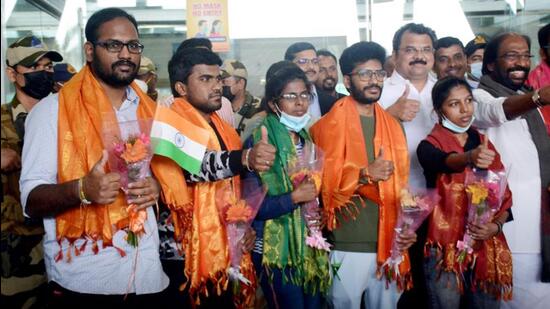
So in the effort to bring back students from the war zone, which was happening parallelly, volunteers, the NRI welfare wing and the state government began to organically reach out to one another until students were back home. “We were all in a loop,” says Dr Prem. Of the 1,921 medical students from Tamil Nadu studying in Ukraine, 1,890 have returned home. A batch of nine students who arrived in Chennai on Saturday were welcomed by chief minister M K Stalin, who had also announced that they would bear all the expenses of the students’ travel.
Before joining the CRPF in 2020, Dr Prem was the official representative for the Luhansk State Medical University from where he graduated in 2016. Prem too has a first-hand experience of fleeing a war. He was a fourth year student when Ukraine’s Revolution of Dignity began (between protestors and Ukraine’s security forces over Crimea culminating with the ouster of then President Viktor Yanukovych). “But, at that time the Indian embassy had arranged special trains for which took us to borders but we had to pay for our flight tickets,” he said. Prem returned to Tamil Nadu in June 2014 and went back in September the same year.
His role as official representative was to help Indian students in trouble. So when the war began, he assumed his former role. “My cousin is one of the contractors so he and I can both speak in Russian to taxi and bus drivers,” he said. Indian agents send students to contractors who are required to hold a company in their name in Ukraine as well as in India. Each contractor is responsible for their set of students from the time of admission until their graduation primarily because foregin students don’t know the language. “So I know a few contractors, I’ve been on the field and my friends are also Ukrainian residents. So it was a whole number of people who were helping at different points.” It was through family that one of the students in Kharkiv Medical University contacted Dr Prem. “I just told him to gather whoever you can and he brought in 80 students. I just wanted to get them to any place on the western side.” He adds that when they got a few students to Odessa (southwestern region) so they could cross over to Moldova, some were not keen and they wanted to go to Romania. The distance to Romania was twice that of Moldova. “I just wanted to be out of the Ukranian soil. So volunteers from Moldova State University, also there is no Indian embassy there so we approached the embassy in Vienna to help the students get to Romania.”
From Romanian borders and borders of Hungary and Poland, buses were arranged by Tamil Nadu residents besides by the union government, which helped join these students to locations of MEA’s evacuation. On March 4, Dr A P Vijayakumar (who graduated from Kharkiv) and hails from a remote district Ranipet in TN, through a contractor arranged a bus for 35 students stuck in Pisochyn who have now reached the state. The communication with students was on WhatsApp groups. The state government officials formed a Whatsapp group for each university in Ukraine to help them reach the borders. The students would send their live location to the alumni and the NRI wing workers who would guide them. “Once a group of students were waiting for five hours at the wrong check point in Slovakia. We could track using their location and we informed them to move to the right one,” said Yazhini. “We were coordinating with various embassies as the students had a very poor network. The state government also arranged transport for students from the Romanian border to Bucharest which was not limited to Tamil students.”
Those involved in the cycle of this evacuation say what was clearly lacking was communication and students just needed the right information and emotional support.
“We were on our own. We had to do everything by ourselves but the government guided us and they were very supportive,” says 21-year-old Devi Sesha Malini, a fourth-year medical student. Her initial experience is the commonly shared misery of every other student who had to run to bunkers every time they heard a siren and bombing, spend sleepless nights in metro stations, survive on limited and water.
“When the war broke out, we asked our University if we could go back but they were lethargic and told us that at the borders we will face problems...Three days later, they let us go.”
On February 26, two days after the war broke out, Malini along with a 100 Tamil students arranged a bus by themselves to go to Romania–a journey of 5 hours under normal circumstances and war-led traffic took them 14 hours. Malini left with a backpack of her most important documents and a few clothes. She ate biscuits and chips along the way.
“The buses stopped at a point. Then we had to walk another 20-kilometres to get to the border.” But the struggle wasn’t over. “We stood for more than a day from 9 am until the next afternoon at the border check post. It was snowing. We were standing in minus 7 degrees. We had no other choice.” After entering Romania, there were tents pitched where the students could sit and rest. They were buses arranged by both the state and central government which took Malini and the 100 students to a shelter (an indoor stadium which was converted) in the heart of the city until their flight.
After Malini reached Delhi, the state government’s team took her to the Tamil Nadu House where they would have a decent stay and food for the first time in days. She reached Chennai last week.
In Delhi
“There was a good connection between the state and the central government,” said the bureaucrat quoted above. “No one overstepped their roles and this coordination helped bring 700 students stuck in Sumi to Poland. The last batch of students from the eastern region really struggled, having travelled more than 1,000km by trains and buses.” Tamil Nadu had also arranged three special flights (akin to a chartered flight) on three different days to transport 482 students. “The top priority was to help them reach home at the earliest. We even booked flights for students to Trivandrum as they came from southern districts like Kanyakumari and Kerala was closer for them.”
What was challenging for the officials was that some students brought along their pets from rabbits to puppies to big dogs. “That was out of syllabus for us. Except Air India, most flights do not allow pets” says the bureaucrat. “But we ensured that none of the students were separated from their pets.”
The students’ next worry is the disruption in their education. On March 8, Malini and a few students met DMK MP Kanimozhi Karunanidhi in Chennai after their return. “I spoke to her about our uncertain future and she said that once everyone is back, they will take a collective call,” said Malini. Stalin has written to Prime Minister Narendra Modi urging him to find a solution for the Ukraine medical students to continue their education in India. “My University (in Ukraine) is starting classes from Monday,” said Malini.
DMK launched the NRI Wing only in January 2021 and Yazhini believes during crisis like this data is crucial.
"In Kerala, there is a systematic approach to maintain migrant data. They were available to provide near accurate information to MEA when required", says Yazhini. "Data collection is key. Steps must be taken to provide adequate orientation to students and working professionals during pre-migration as well as during crisis like this. There is a need for a policy and budget for creating a framework that supports migrants".


