E-Paper



How Kutch rebuilt itself after the 2001 tragedy
The district, which accounted for 88% of deaths in the 2001 disaster, saw a decades-long road to recovery

 Prefer HTon Google


Dr Gyaneshwar Rao was playing badminton when the ground beneath him convulsed violently. Within minutes, Bhuj laid in ruins. His home was damaged and Rao Hospital, his private facility, suffered severe structural harm. When he rushed there, patients were lying on the road. Not too far away, Bhuj General Hospital, a 281-bed government facility, had collapsed completely, killing an estimated 100 people trapped inside.
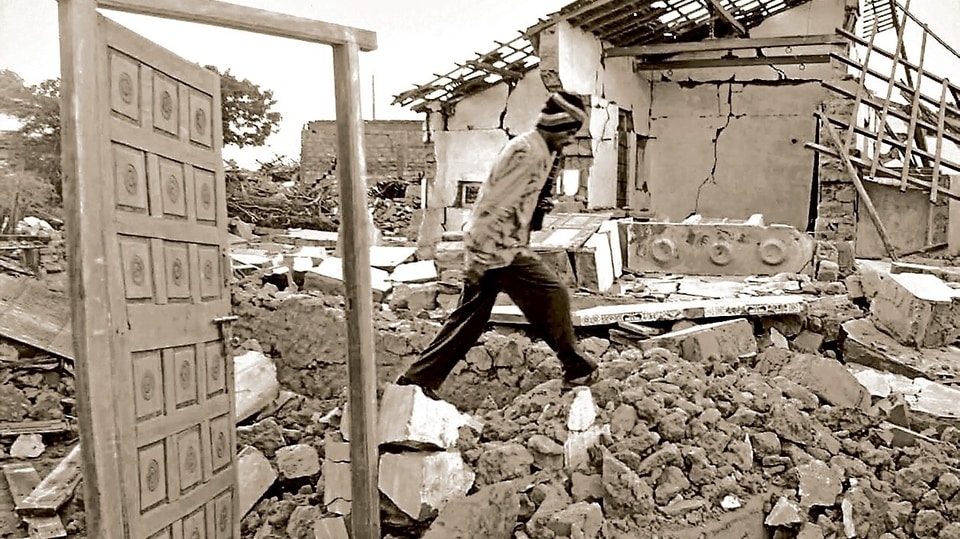
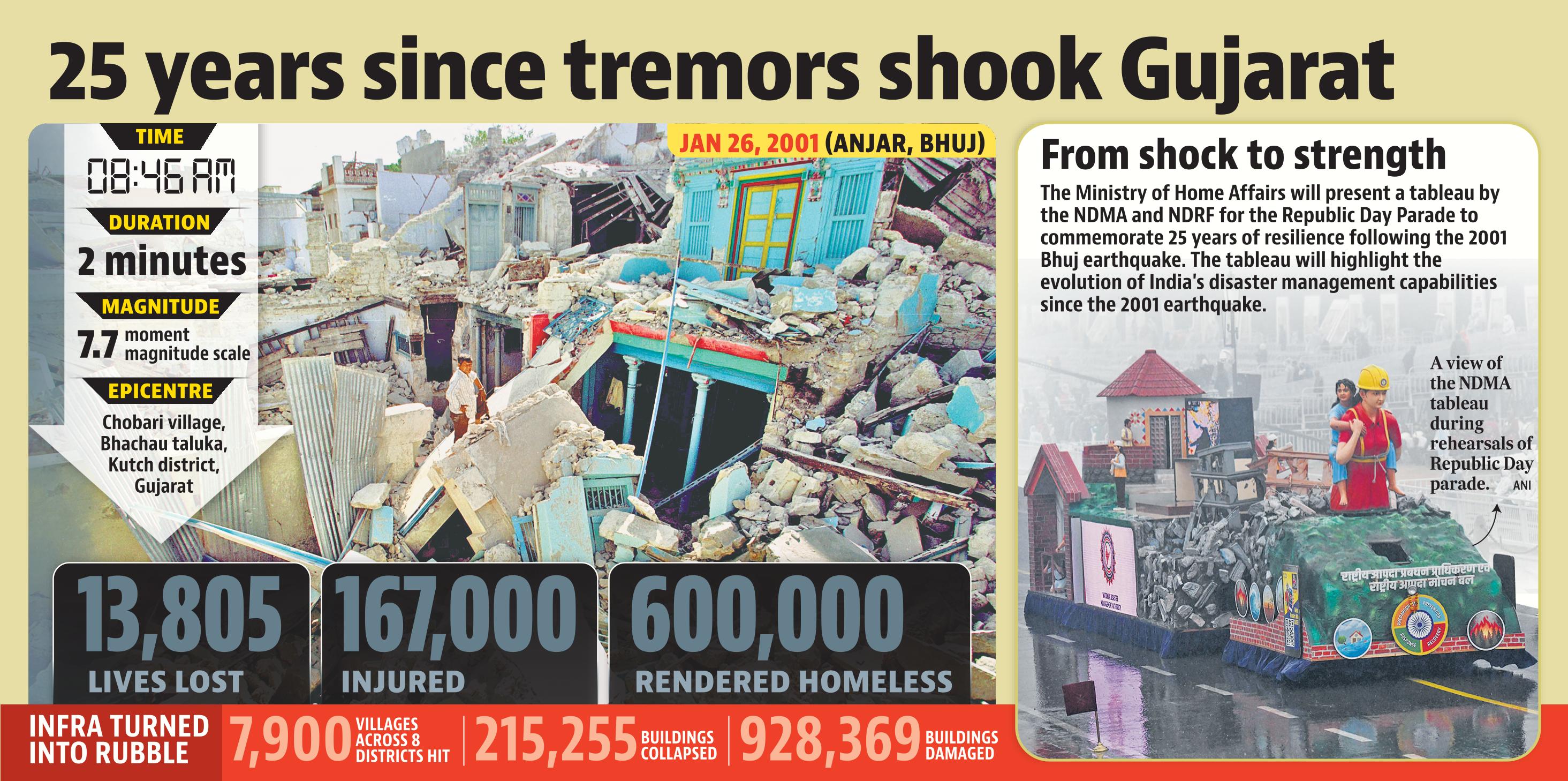
The devastation was caused by a powerful earthquake that struck Gujarat’s Kutch district around 8.46am on January 26, 2001. The epicentre of the earthquake of magnitude 7.7 was near Chaubari village, north of Bhachau in Kutch, around 250 km west of Ahmedabad.
By 9.30am, survivors began reaching Jubilee Ground, a cricket field that became an open-air emergency ward. “Patients poured in with devastating injuries — shattered limbs, deep lacerations, abdominal trauma,” Rao recalled. “By 10am, we had materials from my hospital and began treatment immediately.”
By 2pm, a tented operation theatre was erected and surgeries began, continuing for four days. Medical teams arrived from across Gujarat and neighbouring states. “We were treating 800 to 1,000 patients daily. Help poured in from all sides — whatever we needed materialised, though we often didn’t know from whom or how,” Rao said. The scale of long-term disability the quake left behind led to house-to-house physiotherapy visits, eventually resulting in the Kutch Comprehensive Rehabilitation Centre.
As rescue operations progressed, thousands of bodies had to be recovered and disposed of with dignity. Rasikbhai Thakar, then president of the Lohana Samaj, coordinated the task of tending to the dead at a Bhuj crematorium, where he oversaw mass cremations and maintained records, including symbolic consignments of ashes for later immersion. “My father performed the last rites of 932 people who died in the earthquake. He ensured the dead were treated with dignity,” said his son Ghanshyam Thakar, a former mayor. “The earthquake also became a turning point that saw Kutch transform into one of the most progressive regions of the country.” Rasikbhai, who worked through exhaustion in the days following the disaster, died in 2010.
Also Read: Scars fade, memories endure: Survivors recall chaotic ordeal
The scale of devastation was rooted in deep structural vulnerability, said Ravi Sannabhadti, senior assistant professor at the Faculty of Planning, CEPT University. Much of the built environment — housing, public buildings, infrastructure and transport systems — lacked seismic resilience, while earthquake risk had slipped from public consciousness after the long gap since the 1956 Anjar quake. “There was a clear capacity gap at the local level,” he said, noting that Gujarat’s seismic history made preparedness unavoidable.
Early estimates placed the death toll near 20,000, but a state government committee later verified the figures. According to PK Mishra’s The Kutch Earthquake 2001: Recollections, Lessons and Insights, published by the National Institute of Disaster Management (NIDM) in 2004, the official toll was 13,805 — 3,743 men, 5,184 women and 4,878 children. Kutch district accounted for 12,221, or 88%, of the total deaths. Mishra, who headed the Gujarat State Disaster Management Authority during the reconstruction phase, is now principal secretary to Prime Minister Narendra Modi.
Modi, who took over as Gujarat chief minister later in 2001, oversaw key phases of rehabilitation and reconstruction, backing institutional reforms, strengthening the GSDMA as a central coordinating body and supporting the owner-driven reconstruction model during the recovery phase.
Also Read: 2001 disaster set off chain of decisions that reshaped Gujarat’s political leadership
The NIDM publication estimated housing losses at about ₹5,166 crore and reconstruction costs at about ₹9,700 crore. The Gujarat government adopted an owner-driven reconstruction approach, placing affected families at the centre of rebuilding. Financial assistance was released directly to homeowners in stages linked to construction progress, supported by technical guidance from trained engineers and masons.
The shift from relief to recovery on the ground was overseen by Anil Mukim, then collector of Vadodara, who was appointed special collector of Bhuj and reached the town on January 29, 2001. “It was biting cold, the temperature was around 8 to 9 degrees Celsius. There was an immediate need for blankets and shelter. From food and drinking water to electricity, everything was shattered,” Mukim said. “There was no local workforce, they were victims too. We had to mobilise manpower from different parts of the country. We set up tents for the first month, after which we focused on building intermediate housing colonies.” He later retired as Gujarat’s chief secretary.
The Gujarat government announced a state disaster management policy in September 2002, formalising the transition from relief to structured recovery. Reconstruction gathered pace after then Prime Minister Atal Bihari Vajpayee announced a tax holiday and a special incentive package for Kutch to revive industry. A regulatory framework for safer buildings was enforced and funds were mobilised through the state and multilateral agencies, including the World Bank and the Asian Development Bank, with technical support from institutions such as IITs and CEPT.
Kutch’s recovery was reinforced by industrial investment. Kutchi entrepreneurs, long influential in trade and finance across India and abroad, expanded operations and capital flows into the region. Large investments by business groups led by Gautam Adani and plans, such as Reliance Industries’ proposed solar park, reshaped the economic landscape.
Improved highways, ports and logistics were matched by a renewed focus on tourism. The state’s Khushboo Gujarat Ki campaign, fronted by actor Amitabh Bachchan, brought national attention back to Kutch’s white desert, crafts and culture, adding another pillar to recovery.
A quarter of a century later, Kutch presents a different picture. Ports, industry, renewable energy and trade now define its economy. The recovery — driven by administrative decisions, institutional change, multilateral support and sustained investment by Kutchi enterprise — has turned the region into a reference point for post-disaster reconstruction in India.