
 E-Paper



How Odisha migrant workers in Kerala were chosen, brought home in special trains
Since the day the lockdown was announced and inter-state transport stopped, around 9000 migrants from different districts of Odisha working in Kerala’s Ernakulam district had been exploring ways to travel back to their homeland.

 Prefer HTon Google


Before the first batch of 1140 migrant workers from Odisha stranded in Kerala could take the special train home from Aluva, officials in the two states said their biggest difficulty was choosing who should travel first.
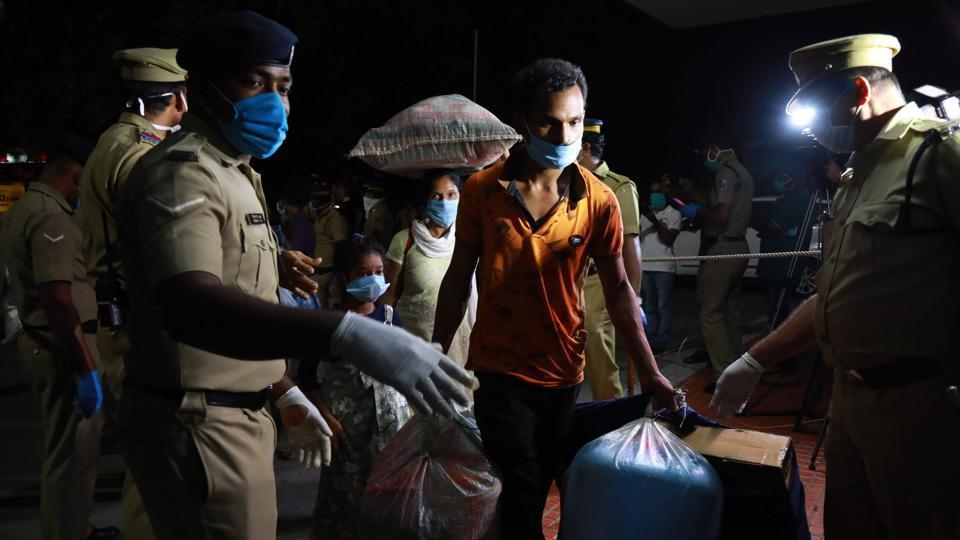
These migrant workers belong to 23 of the 30 districts with Kandhamal accounting for the maximum number at 382 followed by 283 from Kendrapara.
Since the day the lockdown was announced and inter-state transport stopped, around 9000 migrants from different districts of Odisha working in Kerala’s Ernakulam district had been exploring ways to travel back to their homeland.
While in neighbouring Tamil Nadu around 100 fishermen had taken the sea route to come back to Odisha, the migrants in Kerala did not take that risk.
Operation Subhayatra
The process to bring back the labourers started on April 30 after the Union ministry of home affairs (MHA) allowed the transportation of stranded people across the country.
Officials in Kerala’s Ernakulam district launched Operation Subhayatra and authorities held a meeting of officials of the police, transport and health departments, including the National Health Mission, as well as railway personnel.
“We already had the data of all the guest workers (migrant workers) police station wise and camp wise. The problem was how to stop more people from travelling as the train could take not more than 1140 passengers after adhering to the social distance guidelines,” Karthik Kannan, Ernakulam Rural district’s superintendent of police, said.
Kannan said they decided to pick people from a camp in Perumbavoor, a historic town in Ernakulam with 40000 workers from Bengal, Odisha and Assam, on May 1 but were confronted with the problem of possible agitation by other workers who may not be selected.
“To deal with the problem, we took nine BSF (Border Security Force) persons along with home guards with knowledge of Assamese, Odia and Bengali languages to the camps to persuade them that it is impossible to send everyone at one go. But we assured them that everyone will go in phases,” he said.
Choosing passengers
While a decision was taken to transport the 1140 migrant workers, the problem was to choose who will travel first.
“We decided to give priority to women and children and people with family. After that old people were given priority. We also gave priority to people who had some urgency at their home and needed travelling immediately,” the senior police official said.
Kannan said as only people with no Covid-19 symptoms could travel, a dozen team each comprising health, police and revenue officials screened the workers and registered for their onward journey to Odisha.
“Each of the people who were to board the train was given a medical certificate that they not showing any Covid symptoms,” he said.
In Bhubaneswar, officials at the Covid-19 control room then checked whether all of them have pre-registered themselves with the Covid-19 portal, a necessity for all migrant workers before they set foot in Odisha.
“When we cross-checked the details with our portal for registration of those who wanted to return, we found all of them had registered,” Manoj Mishra, Odisha’s IT secretary, said.
Journey home
Each of the returning migrant workers was stamped with indelible ink indicating their quarantine period on their inner side of the right forearm.
They were then taken in Kerala State Road Transport Corporation (KSRTC) buses to the Aluva railway station where each of the 23 coaches was allowed to be filled by 54 people as against capacity for 72 passengers following the social distancing norms. Each of them paid a base fare of Rs 530.
The revenue department then loaded 6000 litres of drinking water, 2400 food packets with chapati, biscuits and banana, which were picked up by each of the migrant workers.
The train also stopped at Duvvada in Andhra Pradesh for a few minutes for loading of cooked food.
The train carrying the migrant workers from Ernakulam district reached Khurda Road railway station near Bhubaneswar on Sunday morning and then Jagannathpur railway station in Ganjam a couple of hours later.
After they reached Odisha travelling a little more than 55 hours, the migrant workers were screened for any rise in body temperature before they were taken to their respective districts by waiting buses.


