E-Paper



HT This Day: Jan 23, 1986 - Sawant, two others sentenced to death
NEW DELHI- Special Judge Mahesh Chandra today convicted Satwant Singh, Kehar Singh and Balbir Singh on the charges of murder and conspiracy to murder late Prime Minister Indira Gandhi, and sentenced them to death. With this, Mr Mahesh Chandra, District and Sessions Judge, delivered the first death sentence of his career and brought the historic trial to an end.

 Prefer HTon Google


NEW DELHI- Special Judge Mahesh Chandra today convicted Satwant Singh, Kehar Singh and Balbir Singh on the charges of murder and conspiracy to murder late Prime Minister Indira Gandhi, and sentenced them to death.
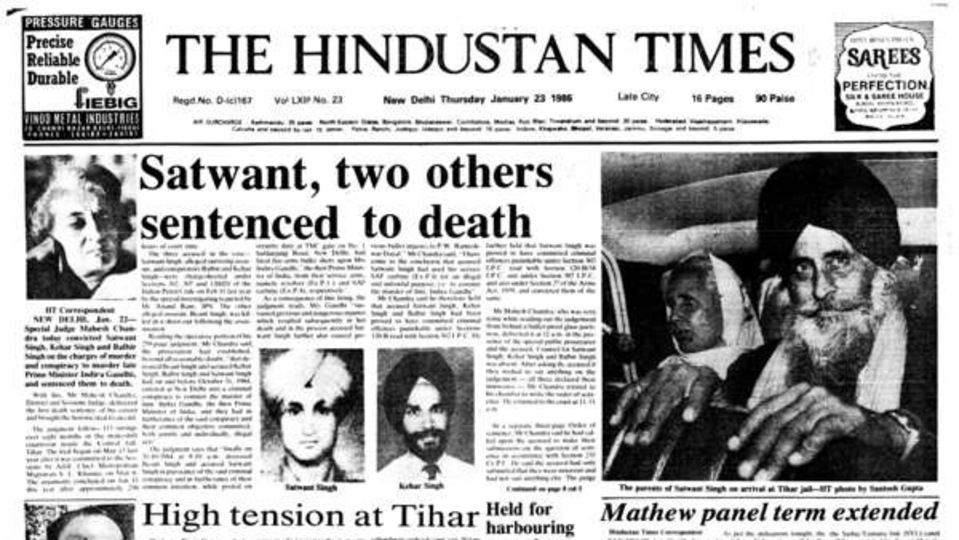
With this, Mr Mahesh Chandra, District and Sessions Judge, delivered the first death sentence of his career and brought the historic trial to an end.
The judgment follows 113 sittings over eight months in the makeshift courtroom inside the Central Jail, Tihar. The trial began on May 13 last year after it was committed to the Sessions by Addl Chief Metropolitan Magistrate S. L Khanna, on May 6. The arguments concluded on Jan 15 this year after approximately 250 hours of court time.
The three accused in the case-Satwant Singh, alleged surviving assassin and conspirators Balbir and Kehar Sing were chargesheeted under Sections 302. 307 and 120(D) of the Indian Penal Code on Feb 11 last year by the special investigating team led by Ms Anand Ram, IPS. The other alleged assassin, Beant Singh was killed in a shoot-out following the assassinated.
Reading the operative portion of his 259-page judgment, Mr Chandra said the prosecution had established, beyond all reasonable doubt, that deceased Beant Singh and accused Kehar Singh. Balbir Singh and Satwant Singh had on and before October 31. 1984, entered at New Delhi into a criminal conspiracy to commit the murder of Smt. Indira Gandhi, the then Prime Minister of India, and they had in furtherance of the said conspiracy and their common objective committed, both jointly and individually, illegal acts.
The judgment says that "finally on 31-10-1984 at 9.10 a.m. deceased Beant Singh and accused Satwant Singh in pursuance of the said criminal conspiracy and in furtherance of their common intention, while posted on security duty at TMC gate on No. I Saidarjung Road, New Delhi, had fired fire-arms bullet shots upon Mrs Indira Gandhi," the then Prime Minister of India, from their service arms namely revolver (Ex.P.L) and SAF carbine (Ex.P.4), respectively".
As a consequence of this firing, the judgment reads. Mrs Gandhi "sustained grievous and dangerous injuries which resulted subsequently in her death and in the process accused Satwant Singh further also caused grevious bullet injuries to P.W. Rameshwar Dayal." Mr Chandra said, "I have come to the conclusion that accused Satwant Singh had used his service SAF carbine (Ex.P.4) for an illegal and unlawful purpose, i.e. to commit the murder of Smt. Indira Gandhi."
Mr Chandra said he therefore held that accused Satwant Singh, Kehar Singh and Balbir Singh had been proved to have committed criminal offences punishable under Sections 12()-B read with Section 302 I P.C. He further held that Satwant Singh was proved to have committed criminal offences punishable under Section 302 I.P.C. read with Section 120-B/34 1.P.C. and under Section 307 I.P.C. and also under Section 27 of the Arms Act, 1959, and convicted them of the same.
Mr Mahesh Chandra, who was very tense while reading out the judgement from behind a bullet-proof glass partition, delivered it at 11 a.m. in the presence of the special public prosecutor and the accused. Counsel for Satwant Singh, Kehar Singh and Balbir Singh was absent. After asking the accused if they wished to say anything on the judgement - all three declared their innocence - Mr Chandra retired to his chamber to write the order of sentence. I le returned to the court at 11.51 a.m.
In a separate three-page Order of sentence, Mr Chandra said he had called upon the accused to make their submissions on the question of sentence in accordance with Section 235 Cr.P.C. He said the accused had only submitted that they were innocent and had not said anything else. The judge said he had given his considered thought to the question of sentence.
Briefly outlining the facts of the case, Mr Chandra said he had kept in view both the nature of the offence and the fact "that deceased Beant Singh and accused Satwant Singh were detailed for the security of the late Prime Minister Smt. Indira Gandhi and the service arms Ex.P.1 revolver and Ex.P.4 SAF carbine had been issued to deceased Beant Singh and accused Satwant Singh for her security and they committed her murder after entering into criminal conspiracy with other persons".
There was pin-drop silence in the courtroom as the Special Judge said he was of the opinion that the present case was one of "rarest of rare nature in which extreme penalty of death is called for".
Mr Chandra said, "I sentence accused Satwant Singh, Kehar Singh and Balbir Singh under Section 120-8 read with Section 302 I.P.C. to the sentence of death." He said, "I further sentence accused Satwant Singh under Section 302 read with Secton 120-B/34 I.P.C. to the sentence of death and further sentence him to undergo R.I. for seven years under Section 307 I.P.C. and to undergo R.I. k>r three years under Section 27 of the Arms Act and all the sentences shall run concurrently.
The 259-page judgment took note of Mr Pran Nath Lekhi's contention that the conspiracy lay somewhere else. But, it stated, the limited question before the court was whether deceased Beant Singh along with accused Satwant Singh. Kehar Singh and Balbir Singh had on or before Oct. 31. 1984, entered into a criminal conspiracy to murder Mrs Indira Gandhi, and whether in furtherance of such conspiracy Beant Singh and Satwant Singh did in fact murder her on Oct. 31, 1984. The judgement said that "any other question would he irrelevant as far as this court is concerned and, therefore, cannot be gone into and any reference to it would be even uncalled for here". It concluded that the prosecution had established the guilt of the accused persons beyond reasonable doubt.
Another aspect of the case considered in the judgment was the confessional statement made by accused Satwant Singh which was retracted later. The judgment noted that Mr S. L. Khanna, Additional Chief Metropolitan Magistrate, had warned Satwant Singh that be was not ix>und to make a statement and that if he made one it could be used against him during the trial. Mr Khanna had given Satwant two days to consider his decision, allowed him to consult a lawyer, Mr I. U. Khan, and only then sent him to Mr Bharat Bhushan Mr recording his statement. Satwant had also been medically examined by Dr Vijay Kumar, Medical Officer of Tihat Jail, and was declared fit to make a statement. Satwant had signed each page of the confession document.
The judgment dismissed defence counsels contention that there were irregularities in the appointment of Mr S. L. Khanna and Mr Bharat Bhusban. It said that the mere fact that the orders of appointment of Mr Bharat Bhusban had not reached him on Dec 1. 84 when he recorded the confessional statement did not materially affect his competence in this regard as the orders became effective from the moment they were passed. Further, the Supreme Court had ruled that a retracted confession could be used for conviction of the accused "if it receives some general corroboration from other independent sources", and can also be used against co-accused. The judgment held that such corroboration had been received.
Regarding the issue of conspiracy, the judgment held that the prosecution had established its case that Kehar Singh and Balbir Singh were associated with deceased Beant Singh, it had further established that on specific dates each conspirator was "doing something or the other at some place or the other", and that on those dates Kehar Singh had invariably been away from his job. The association of Balbir Singh with Beant and Satwant had also been proved. the main link between them being deceased Beant Singh.
The judgment said that under Section 10 of the Indian Evidence Act, the acts of each one could be used against the other and could be attributed to all of them. Though the prosecutioil had not produced direct evidence of conspiracy, it had produced sufficient circumstantial evidence to raise an inference of conspiracy, the judgment said. These included the recovery of a book entitled "Bhindranwale Sant' from the house of Beant and Balbir, the 'baaz' (falcon) incident and the exhortation of Kehar to Beant in a gurdwara. Even Bimla Khalsa's testimony corroborated the charge of conspiracy, the judgment said.
The 259-page judgment went through the entire evidence and arguments presented by both the prosecution and the defence counsel through its 113 sittings. It said that the statements of Head Constable Narain Singh and Assistant Sub-Inspector Rameshwar Dayal and Nathu Ram--the eye-witnesses to the occurrence--established that deceased Beant Singh and accused Satwant Singh had fired the shots at Mrs Gandhi. It had also established that they had deliberately manoeuvred their duty roster to do so.
The judgment took note of the testimony of prosecution witness Inderbir Singh regarding the gurdwara incident and Kehar Singh's exhortation to Beant Singh, "Ro mat badla le". It noted that Kehar was very close to Beant and even took him to Amritsar. The confession of Satwant Singh also affected Balbir and Kehar Singh, the judgment read.
After the judgment and the order of sentence were read in the open court, Mr Mahesh Chandra gave copies of the same to the three accused. He informed all three of them that they were entitled to file appeals against the judgment and sentence to the High Court within 30 days of the order.
Mr Mahesh Chandra was then escorted out of the courtroom under heavy security and did not come to his office in Patiala House in the afternoon.