
 E-Paper



HT This Day: January 2, 1955 -- First suburban train inaugurated in Delhi
The suburban railway service between New Delhi and Vinay Nagar was inaugurated on Saturday when a shuttle with three bogies left New Delhi station at 7-20 a.m, carrying, among others, Mr Brahm Perkash, Chief Minister, and Mr Gopi Nath Aman, Revenue Minister of Delhi State.


The suburban railway service between New Delhi and Vinay Nagar was inaugurated on Saturday when a shuttle with three bogies left New Delhi station at 7-20 a.m, carrying, among others, Mr Brahm Perkash, Chief Minister, and Mr Gopi Nath Aman, Revenue Minister of Delhi State.
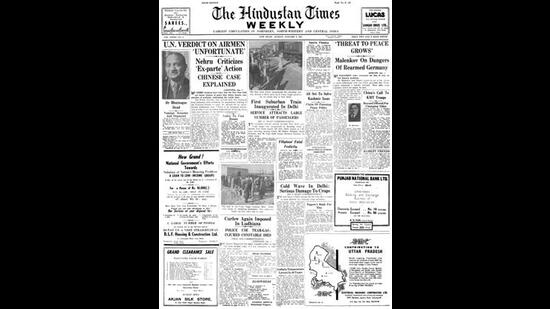
Mr M. K. Kaul, General Manager, Northern Railway, accompanied the Ministers.
Enthusiastic scenes were witnessed at every station from Lajpat Nagar onwards. The residents of the locality had collected at the platform to cheer the incoming train which is bound to ease their transport problems. The most to benefit from the service will be Lajpat Nager and Sewa Nagar as they will not only be satisfactorily connected with New Delhi but with two other important Government employees’ colonies Lodi Colony and Vinay Nagar.
More than 1,500 residents had gathered at Vinay Nagar platform to see that Delhi had come to have its first suburban railway. Children standing on the edge of the platform held by their parents screamed and shouted in delight as the train steamed in. The passengers could get down only with the utmost difficulty as the crowd virtually blocked the entrance to each carriage.
RUSH OF PASSENGERS
The lone booking clerk was hard pressed as there was a rush of passengers. As it was a holiday and the train was a novelty, there was a jam in front of the booking office which continued even after the train left Vinay Nagar for New Delhi on the return trip.
People were standing in groups to watch the engine taking water from the water column while the bogies were left far down the railway line. When the train was taken to the platform it was already full and there was little scope for passengers to board the train. There was a scramble and while women and children were still trying to find a foothold, the train whistled twice and steamed out with scores of persons standing on foot-boards. Those who were left behind complained to the station master that the train had moved without any signal being given.
The railway authorities had obviously not expected the rush of passengers; instead of four they had attached only three bogies which was capable of accommodating about 180 passengers at the most. But the number of tickets sold was 535, including 100 for Lodi Colony, 82 for Sewa Nagar, 26 for Lajpat Nagar, 39 for Nizamuddin and 146 for New Delhi. The large crowd which still stood before the booking window indicated that the railway authorities should attach more bogies as the maximum use would be made of the railway on Saturdays and Sundays.


