
 E-Paper



HT This Day: Nov 9, 1950 -- India willing to give asylum to Nepal ruler
New Delhi has apparently been taken by surprise by the ‘coup d’état’ staged in Nepal, though the existence of serious differences between the King of Nepal and his Prime Minister has been common knowledge for some time.

 Prefer HTon Google


New Delhi has apparently been taken by surprise by the ‘coup d’état’ staged in Nepal, though the existence of serious differences between the King of Nepal and his Prime Minister has been common knowledge for some time.
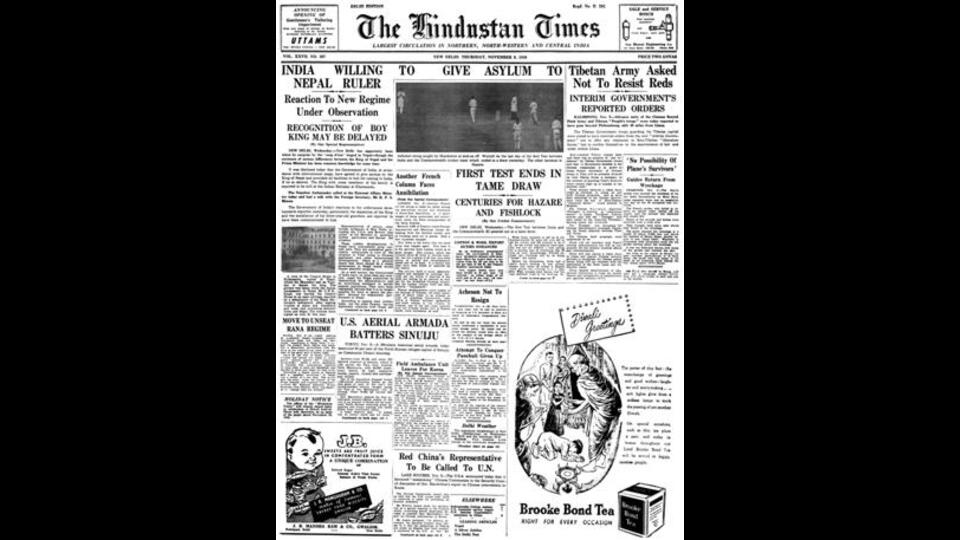
It was disclosed today that the Government of India, in accordance with international usage, have agreed to give asylum to the King of Nepal and provided all facilities to him for coming to India, if he so desired. The King with some members of his family is reported to be still at the Indian Embassy at Kathmandu.
The Nepalese Ambassador called at the External Affairs Ministry today and had a talk with the Foreign Secretary, Mr K P. S. Menon.
The Government of India’s reactions to the unfortunate developments reported yesterday, particularly the deposition of the King and the installation of his three-year-old grandson, are reported to have been communicated to him.
Representatives of certain other foreign embassies in New Delhi, including the U.S.A. and Britain, also called at the Ministry to ascertain further particulars and discuss the situation.
These sudden developments in Nepal have undoubtedly great concern here. They are considered particularly unfortunate in view of the situation in Tibet owing to Chinese aggression and other international developments. There is a general desire that there should be a stable government in Nepal which would ensure peaceful progress.
As is well known, the Government of India have, on more than one occasion, urged the Nepal authorities to democratize the administration and do everything necessary to satisfy popular aspirations. They have been I repeatedly advised that it is no longer possible for them to ignore the people’s demand for responsible government in Nepal.
According to reports here, neither India nor the other Powers having diplomatic relations with Nepal are likely to be in a hurry to recognize the new three-year-old King who is reported to have been instated. They are likely to watch the situation for the present and also carefully study international practices in regard to this matter. Several questions need clarification- for instance, how far the deposition of the King is constitutional and legally justified, to what extent it is supported by the people of the State, whether the installation of the three-year-old grandson of the King by the Prime Minister and the group behind him is constitutionally proper, and what - the attitude of the deposed King is going to be.
It has already been reported that the differences between the King and the Prime Minister were partly due to the former’s support to the progressive group in the State and his desire to introduce responsibl4 government without further delay. This fact further complicates the problem, for as there has already been serious political discontent in the State owing to the absence of responsible government, the removal of the King who is known to be sympathetic to the demand for responsible government is bound- to have an adverse effect on the public mind.
The constitutional position in Nepal, which is rather peculiar and out of date, is largely responsible for the political discontent. The Prime Minister is the virtual ruler-holding all political and administrative powers in his hands. According :0 an agreement of 1846, the then head of the Rana family obtained from the sovereign the perpetual right to the office of Prime Minister. This right is still enjoyed by the descendants of the Rana family. This has not only reduced the King to the position of a mere figure-head but also stood in the way of rapid constitutional development for the democratization of the State. Suen constitutional reforms as have been announced have been far too meagre to satisfy the public.


