
 E-Paper



HTLS 2022 Day 3: ‘Humans are wired for progress’, says Brooks
HTLS 2022 Day 3: Today, we had bestselling American author and professor Arthur C. Brooks and India’s external affairs minister S Jaishankar who shared their ideas on ‘Envisioning a New Tomorrow’.
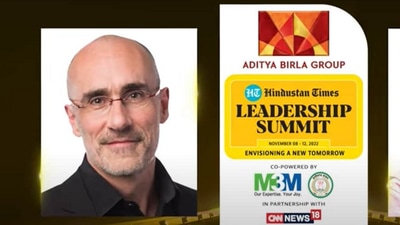
Welcome to the third day of Hindustan Times Leadership Summit 2022. Today, we had bestselling American author and Harvard professor Arthur C. Brooks and India’s external affairs minister S Jaishankar who shared their ideas on ‘Envisioning a New Tomorrow’. In the first session, Jaishankar spoke on the future of global order, the ongoing Ukraine conflict and climate change among others with R Sukumar, editor-in-chief, Hindustan Times....Read More
Jaishankar has helped India navigate a string of crisis since he took office in 2019, including the standoff with China on the LAC and the wide-ranging impacts of the Covid-19 pandemic and the Ukraine conflict.
In the second session, Brooks was in conversation with R Sukumar. Brooks speaks to audiences around the world about human happiness and works to raise well-being within private companies, universities, public agencies, and community organisations. As we stand at the cusp of a new tomorrow following a couple of tough years due to the Covid pandemic, Brooks is someone who can share ideas in line with our Summit theme, ‘Envisioning a New Tomorrow’.
Spend less time being public on social media: Brooks
"When you are being observed it's hard to change. For example, you have politicians, they can't change their opinions. They will be called hypercritical because if they change their opinions. Now, it's normal to change opinions. Every change their opinions... But if we stake our claim on social media, in public that this is what we believe, people will hold today for being hypercritical. It makes us rigid. One of the things that I recommend most people is to spend less time being public on social media," said Brooks
Family life in crisis in India and US: Brooks
Four big habits of happy people come down to:
1. Work which meaningful and serves others
2. Friendship outside the family.
3. Family life- which is in crisis in India and the USA because of urbanisation and work culture.
4. Faith and spirituality. People who are not religious can get the benefit of spirituality by reading the ancient masters.
‘Happier people are better workers': Brooks
“Happier people are better workers, they are better for societies. This is how we should mould our companies,” said Brooks
‘Humans are wired for progress’, says Brooks
"Humans are wired for progress. When they find that they are not getting more excellent, when things are not getting easier when they are not innovating more, that's the reason they start to burnout," said Brooks.
Brooks says due to advances in science, we can stay on the crystalised fluid intelligence curve longer
“The decline in life process is often misunderstood. In Indian thinking, we have the concept of ashrams that are quarters of an ideal life. It starts with brahmacharya - the student phase; grihasta - householders' life; vanaprastha - stepping back for spirituality; and finally the sannyasa - living in complete enlightenment in the last part of your life. This corresponds to 2 types of intelligence that we have to be able to identify through neuroscience and social science,” Brooks said.
Brooks said due to advances in science, we can stay on the crystalised fluid intelligence curve a bit longer. Fluid intelligence is your ability to process new information, learn, and solve problems. Crystallised intelligence is your stored knowledge, accumulated over the years. The two types work together and are equally important.
On instutionalisation of Quad
Jaishankar said he would not get overfocussed on institutionalising of Quad.
“Exactly what we are trying not to do.. idea is a comfortable consulation process, ability to work together, responding to needs of the day.”
‘I do calculations and sometimes when I do…’
Sukumar: Do you see a risk of escalation of tensions across the Taiwan strait?
Jaishankar: I don't do predictions. I do calculations and sometimes when I do calculations, I keep it myself.
Don't think current state can continue without damage to relationship: Jaishankar
Sukumar: What can we do that the realisation is there?
Jaishankar: We are doing a lot of things in terms of various policies and various pronouncements and the state of relations. I don't think there's any ambiguity about our signalling and our messaging. Naturally, they will weigh from their interest and from where they are, but it isn't just a matter of public sentiment. I think it's government policy, it is public sentiment and it is strategic calculation. I do not think that the current state can continue without damage to the relationship.
On relations with China and friction points
Jaishankar said that India and China have made some progress on some issues keeping in mind equal and mutual security but there are some which still need to be worked upon.
“So I think it's in the nature of what I do that you have to keep pushing. I do genuinely believe that there will be realisation, there should be a realisation that the present state of relations is not even in China's own interest.”
G20 not a forum to settle issues of international law, sovereignty: Jaishankar
Jaishankar said that some of issues in our part of the world like respect for international law and sovereignty will obviously influence G20. However, he added that G20 is not the forum to settle these issues.
“There are other sets of issues in our part of the world -- economic issues, respect for international law, for the rules, countries respecting each other sovereignty.”
“Some of these issues will obviously influence G20. But remember, G20 is not the forum to settle these issues or even to primarily debate these issues. There are other forums to do that. G20 has a mandate that is very much an economic and financial mandate.”
Important that G20 remains true to its agenda: Jaishankar
When asked how India intends to navigate the reality to achieve the goals of G20, the minister said that the grouping was envisaged as an economic forum and it it's important that it remains true to its mandate and agenda.
“From India's perspective, we need to reflect not just our viewpoint but a broader constituency that we represent. My sense is that when we sharply articulate what are the presidency priorities, I think we will do so with a sense of large responsibility. It is probably a bit early right now to say what exactly it would be but you can see the world's problems are pretty obvious today like energy security, food security, worries about fertilisers.”
‘This is pure politics’
“We speak today about democracy but I point out to you when democracy gives result which sometimes does not suit an elite in some part of the world, immediately you start attaching adjectives and caveats. Now this is completely ideological. It's like saying I didn't like the way this match produced a result so I'll now question the match. I will say there's something wrong with the pitch.”
“This is pure politics. One thing globalisation has done -- it has globalised politics.”
“When you cannot win inside a country, you export the debate outside. When you cannot get voices inside the country you will call back up from outside. These are all challenges in today's politics.”
On big-techs and their power to shape opinions
There should be awareness about the power of big technology companies because we are increasingly seeing that some of them have interests, agenda, and views, external affairs minister S Jaishankar said at the HT Leadership Summit 2022.
“You have around the world people with economic interest, with ideological viewpoints who believe today that it is their power, their right to certify, de-certify, criticise, support, legitimise, de-legitimise. This is an issue.”
'Atmanirbhar Bharat goal not primitive, all countries trying to de-risk, be self-reliant'
“There is a big economic churn which is today centred around more resilient reliable supply chains. There is also, I would argue, a digital churn.”
"When people today look at the government's goal of an Atmanirbhar Bharat, we should not think of it as primitive 'globalistaion [vs] protectionism'"
"This is a new era. We need, as a big polity with very large vulnerable sections in this country, to actually see how we safeguard ourselves in a difficult era. How do we build those capabilities in a difficult era. So it is a mindset change, it is a capability change, it is a strategic change."
What does it mean for foreign policy in particular?
“A common worry among all the major economies and polities of the world is...that we are going to go through difficult times, we should not think of it as incidents, we should think of it as complications after complications.”
Globalisation model increasingly challenged since 2008 crisis: Jaishankar
Speaking on medium- to long-term future, Jaishankar said he would be looking at a very unsettled world with a lot of turbulence and volatility.
He asserted that the globalisation model has been more and more challenged since 2008 global financial crisis.
“You had political manifestations of that -- Brexit was one manifestation, the election of Donald Trump was a manifestation. You had economic manifestations, which people were in denial about. There was kind of a globalisation mantra which a lot of people, including in our country, bought into without too much application of mind and too much thinking of our own interest there.”
S Jaishankar speaks on Day 3 of HT Leadership Summit 2022
Some changes in line-up today! First session with Dr Jaishankar.
HTLS 2022 Day 3: Author Arthur C. Brooks to speak shortly
In the first session, Brooks will be in conversation with R Sukumar, editor-in-chief, Hindustan Times.


