
 E-Paper



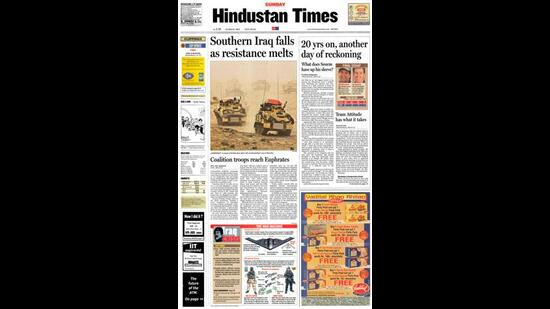
HT This Day: March 23, 2003 -- Southern Iraq falls as resistance melts
COALITION FORCES continued their sweep through southern Iraq capturing An Nasiriya on the bank of the Euphrates and encircling Basra. Preparations also began for airlifting US troops to open a second front in northern Iraq.


COALITION FORCES continued their sweep through southern Iraq capturing An Nasiriya on the bank of the Euphrates and encircling Basra. Preparations also began for airlifting US troops to open a second front in northern Iraq.
Trenches full of oil were set on fire to provide Baghdad a smokescreen as missiles continued to rock the Iraqi capital throughout the day. Another round of the “shock and awe” blitz of 1,000 missiles and bombs that hit Baghdad on Friday night was predicted for Saturday.
General Tommy Franks, head of the allied operations, holding a press conference on Saturday evening in Qatar promised a military campaign that would be “unlike any other in history”. Coalition war plans, he said, allowed commanders to “attack the enemy on our terms”.
He said, “We gave Saddam Hussein the choice to give up weapons of mass destruction or lose power He chose unwisely and now he will lose both.” Military experts said a logical time for Iraq to fire chemical weapons would be as coalition forces concentrated at bridgeheads along the Euphrates.
Franks said thousands of Iraqi troops were surrendering and even more had “laid down their weapons” and “gone home”. The UK chief of staff, Admiral Michael Boyce, had earlier said the 9.000strong Iraqi 51st Infantry Division had surrendered en masse near Basra. This claim was denied by Iraqi Information Minister Muhammad Saeed al Sahhaf.
The allies faced pockets of resistance as they moved forward. But for the most part their troops found empty bunkers and white flags.
With the fall of An Nasiriya, the US 1st Marines were ready to cross the Euphrates and drive towards Baghdad. The US 7th Cavalry were already just 160 miles south of Baghdad. They were stopped for a few hours by a small Iraqi detachment.
There were conflicting reports regarding Basra. Coalition forces captured its airport and most of its defenders gave up. US and UK troops were attempting to negotiate with the remaining Iraqi soldiers rather than storm the city But military officials indicated the coalition would probably just skip the city and press forward to Baghdad.
The expectation was that coalition troops would reach Baghdad early next week.
Friday night’s missile blitz on Baghdad seemed concentrated against Hussein’s palaces and government buildings, striking targets more symbolic than military.
Al Saffah said three Iraqis were killed and 207 wounded in the attack. Analysts said these relatively low casualties were testimony to the precision of the latest generation of smart weapons.
Hussein and his aides were believed to have shifted to bunkers and tunnels. US Defence Secretary Donald Rumsfeld claimed Hussein “was starting to lose control”. Franks only said “there is certain confusion within the regime.” But he confirmed the US had opened a dialogue with senior Iraqi military officers.


