
 E-Paper



HT THIS DAY: August 25, 1946 — Interim national government formed: Cabinet of 14, 2 Muslim seats to be filled later
The announcement is the culmination of the past five month’s negotiations. The new members are not described as members of the Governor-General’s Executive Council but as “the Interim Government.”


New Delhi- “His Majesty the King,” says a communique issued from the Viceroy’s House today, “has accepted the resignations of the present members of the Governor-General’s Executive Council.
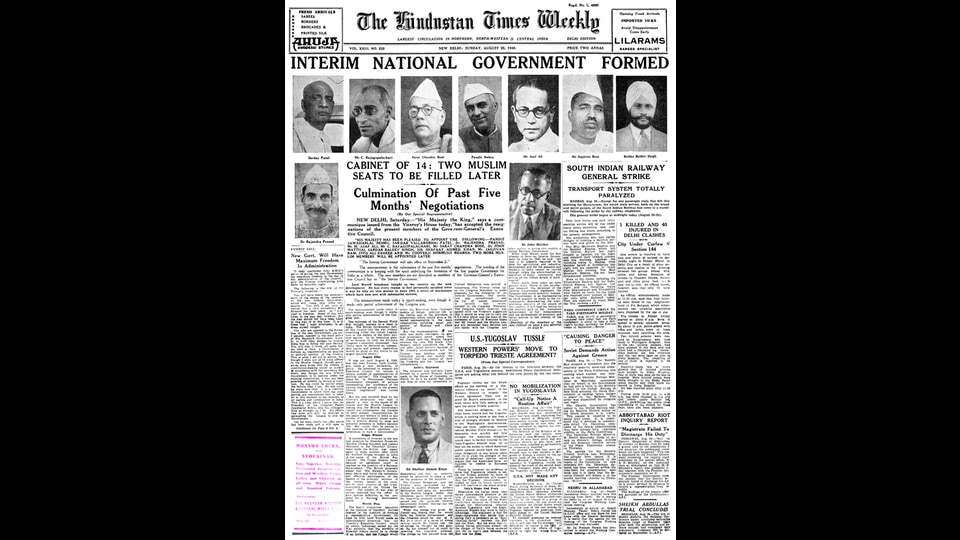
”His Majesty has been pleased to appoint the following:-Pandit Jawaharlal Nehru, Sardar Vallabhbhai Patel, Dr. Rajendra Prasad, Mr. M. Asaf Ali, Mr. C. Rajagopalachari, Mr. Sarat Chandra Bose, Dr John Matthai, Sardar Baldev Singh, sir Shafaat Ahmed khan, Mr. Jagjivan ram, Syed Ali Zaheer and Mr. Cooverji Hormusji Bhabha, two more muslim members will be appointed later.
The Interim Government will take office on September 2.”
The announcement is the culmination of the past five month’s negotiations. The wording of the communique is in keeping with the spirit underlying the formation of the first popular Government for India as a whole. The new members are not described as members of the Governor-General’s Executive Council but as “the Interim Government.”
Lord Wavell broadcast tonight to the country on the new development. He has every reason to feel personally satisfied since it was he who set into motion in June 1945 a series of discussions which have now met with substantial success.
The announcement made today is epoch-making, even though it marks only partial achievement of the Congress aim.
The outbreak of the Second World War brought matters to a head in India. The British Government forced this country into the war without consulting either the Indian Legislature or the leaders of the main political parties. In its resolution passed on October 10, 1939, the All-India Congress Committee demanded that “India must be declared an independent nation and present application should be given to this status to the largest possible extent.”
August Offer
It was not until August 8, 1940, that the then Viceroy, Lord Linlithgow, made a new declaration of policy. He promised to expand his Executive Council “to include a certain number of representatives of political parties.” The Congress demand for “a Provisional National Government composed of persons commanding the confidence of the various elected groups in the present Central Legislature” - was turned down.
But the real mischief done by the Viceroy’s declaration was that it placed a veto in the hands of Mr. Jinnah and the Muslim League by stating that the British Government “could not contemplate the transfer of their present responsibilities for the peace and welfare of India to any system of Government whose authority is directly denied by large and powerful elements in India’s national life. Nor could they be parties to the coercion of such elements into submission to such a Government.”
Cripps Mission
A succession of reverses in the war and pressure by President Roosevelt, Marshal Chiang Kai-shek and Labour Ministers in the Churchill Government made the British war leader agree to make another offer which Sir Stafford Cripps brought to India in the name of the British War Cabinet. The Cripps Mission failed because no agreement could be reached on the question of a National Government. The British proposals stated that “His Majesty’s Government desire and invite the immediate I and effective participation of the leaders of the principal sections of the Indian people in the counsels of their country, of the Commonwealth and of the United Nations.” The subject of war was, of course, reserved but the effort to give precise definition to the proposal for a National Government failed.
Wavell Plan
The Sapru Committee appointed at the instance of Gandhiji revived interest in the question of forming a representative Government. On June 14, 1945. Lord Wavell made an announcement proposing that the Viceroy’s Executive Council would be wholly Indianized except for the War portfolio that the portfolio of External Affairs would be in charge of an Indian, that the Viceroy would select his Executive from “amongst leaders of Indian political life at the Centre and in the provinces in proportions which would give a balanced representation to the main communities, including equal proportion of Muslims and Caste Hindus.”
But the implementation of the plan was made contingent on general acceptance, which meant that Mr. Jinnah and the Muslim League retained the veto. The Simla Conference, which considered the Wavell offer failed entirely because of Mr Jinnah’s intransigence but the Viceroy, was helpless since Mr. Churchill would not modify the condition that the consent of both the Congress and the League was indispensable.
Attlee’s Statement
The situation was radically transformed by a speech Premier Attlee made in the House of Commons on March 15. In it he stated that India was free to vote for immediate in- dependence and that no minority would be permitted to place a veto on the progress of the majority.
The Cabinet Delegation and the Viceroy were persuaded by Mr Jinnah to modify Premier Attlee’s declaration and gave an assurance to the Muslim League leader that whichever party declined to accept the long-term proposal would be by passed and the proposed Interim Government formed leaving out the intransigent party.
When this pledge was given Mr Jinnah was hoping that he would form the Interim Government and the Congress would be out of it. , But as a result of a series of wrong tactical moves Mr Jinnah lost the advantage he thought he had gained. He put himself out of court by, rejecting the long-term proposal. The pledge he had secured from the Cabinet Delegation now proved a boomerang. The Viceroy called upon the Congress President to make proposals for the formation of an Interim Government. The invitation was unconditional and the list of names announced is entirely that recommended by the Congress President. The Congress leader, however, has agreed with the Viceroy’s suggestion that it would be wise not to vary the 6:5:3 ratios which was the basis of the statement of June 16. Everyone hopes that Mr Jinnah and the Muslim League will reconsider their decision and join hands with the Congress and other parties in giving this country a strong National Government.
When Lord Wavell made his first attempt to form an Interim Government on June 14, 1945, he said: “All that is so urgently required to be done for agricultural and industrial development and for the peasants and workers of India cannot be carried through unless the whole-hearted cooperation of every community and section of the Indian people is forthcoming.”
These words have today an even greater force. There is one satisfaction, however. The personnel of the Interim Government represents the Congress and every minority interest. The Government is as representative as could possibly be made in the circumstances. Representing the overwhelming majority of the people of this country, it will lead the nation by the shortest path to the immediate I achievement of full independence and the development of economic and social policies in the interest of the masses.


