E-Paper



Human race years away from artificial general intelligence: AI pioneer Yann LeCun at AI Impact Summit
Yann LeCun is a leading AI voice whose pathbreaking work in neural networks became the foundation for modern computers and deep learning.

 Prefer HTon Google


The human race is still years away from artificial general intelligence and large language models are a dead end on that path, French-American scientist and deep learning pioneer Yann LeCun said on Wednesday, adding that AGI remains a misnomer in the current context.
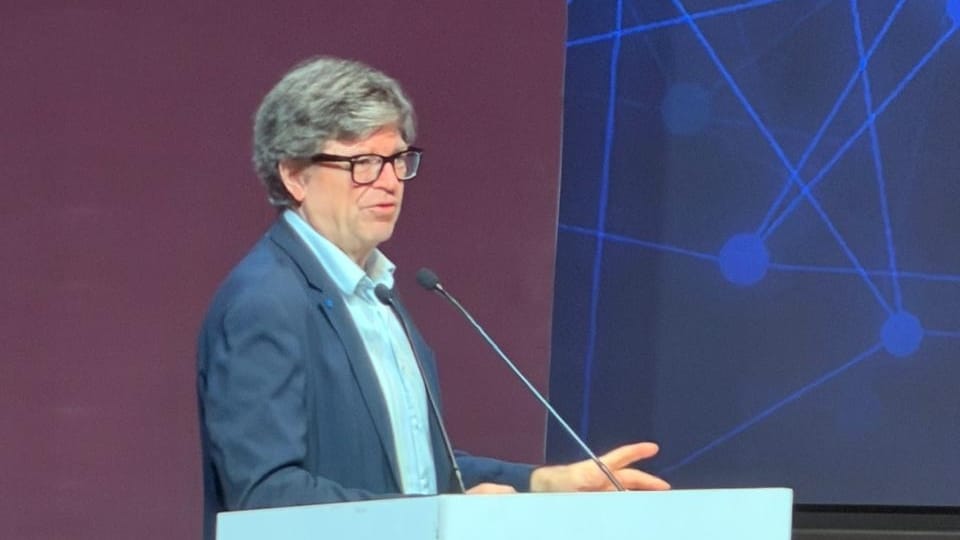
LeCun, who quit Meta last year, has launched a startup that aims to build a “new breed” of AI systems which understand the “real world”, have persistent memory, can reason and plan, and are controllable.
“I’m going to tell you about something that is not yet a buzzword in AI: world models… If we want AI systems to understand the real world and approach human-level intelligence -- not just in language, coding, or mathematics, but in everything -- we need systems that truly understand the world at an intuitive level, like babies learning how the world works,” the 65-year-old French-American scientist said in his keynote address at the India AI Impact Summit.
Also Read: PM Modi to speak at opening ceremony of India AI Impact Summit at 10:25am tomorrow
And these characteristics, he added, can’t be observed in current systems built on LLMs. “You can see this clearly… We still don’t have a robot that can do what a cat can do. We’re not talking about high-level reasoning -- just basic physical understanding and control.”
LeCun is a leading AI voice whose pathbreaking work in neural networks became the foundation for modern computers and deep learning. After having worked at Bell Labs on learning algorithms, he joined New York University’s Courant Institute as a professor. In 2013, he was instrumental in creating Meta’s FAIR research lab and served as the big tech firm’s Chief AI Scientist, promoting research-driven AI applications.
“Public internet text is about 10¹⁴ bytes, which is roughly the visual information a child receives in the first four years of life, or about 30 minutes of YouTube uploads. In video terms, that’s tiny. So we cannot reach human-level intelligence by training only on text,” LeCun said.
Also Read: Quote of the day: ‘India can be full-stack player in AI,’ Sundar Pichai says at AI Impact Summit
So, what is LeCun’s plan behind his upstart, Advanced Machine Intelligence Labs? According to him, human-level intelligence will be the real breakthrough.
“Agentic systems cannot exist without predicting consequences of actions, and LLMs cannot do this. So we need world models. I see no alternative.” Such models build a simulation of reality by working on dynamics that include physics, sensory data and spatial properties.
“Generative approaches should be abandoned for real-world understanding. They work for language because it’s discrete. But they fail for continuous, noisy data,” LeCun said.
When asked to elaborate on his repeated displeasure with the term AGI, LeCun said: “We don’t have general intelligence at all. Humans are extremely specialised… We think we’re general because we can only imagine problems we ourselves can understand. But computer science shows humans are terrible at many things computers excel at -- route planning, chess, equation solving, etc.”
Also Read: AI Impact Summit’s expo in Delhi extended to Feb 21, summit closed to public on Feb 19
LeCun left Meta after differences with Mark Zuckerberg over the direction AI or superintelligence research was taking at the tech company. The French scientist has long emphasised that LLMs have a very limited application and future.
“Intelligence isn’t just accumulated knowledge, which is what LLMs largely are. They store vast human-digested knowledge. They’re strong in domains where language supports reasoning -- code, math, law -- but not in understanding… Adaptability is the hallmark of true intelligence.”