
 E-Paper



IAF chief calls for rapid capability enhancement of military
The Chief of the Air Staff, Air Chief Marshal AP Singh urged the officers to embrace change, critically assess evolving threats, and design adaptive strategies for future conflicts


NEW DELHI: The Chief of the Air Staff, Air Chief Marshal AP Singh, has called for a rapid capability enhancement of the armed forces to address emerging security challenges in light of the evolving geo-strategic landscape, the defence ministry said in a statement on Wednesday, at a time when the world’s fourth largest air force is grappling with a shortage of fighter planes and seeking to fill critical gaps.
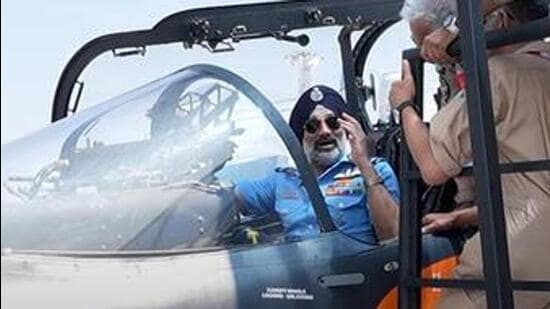
Singh was addressing student officers from the Indian armed forces and faculty at the prestigious Defence Services Staff College at Wellington in Tamil Nadu.
The comments, made on Tuesday, came days after a top government committee recommended a raft of short and long-term measures to boost the capabilities of the IAF, pointing out that it was critical to enhance self-reliance in the aerospace sector through increased participation of the private sector.
Singh urged the officers to embrace change, critically assess evolving threats, and design adaptive strategies for future conflicts. Touching upon jointmanship, he highlighted the need for integrated training and operational synergy among the three services to enhance combat effectiveness.
The setting up of integrated theatre commands for the best use of the military’s resources to fight future wars, new domains such as cyber and space, and simpler weapons buying procedures are in sharp focus as the defence ministry has declared 2025 as the “year of reforms” aimed at modernising the armed forces to tackle new challenges.
These fields are among the nine areas identified by the defence ministry for focussed intervention. Defence minister Rajnath Singh will conduct a quarterly review of critical defence reforms being driven by the government to boost the armed forces’ combat readiness.
The theaterisation drive, a long-awaited military reform, is expected to gather pace. Jointness among the three services is an essential prerequisite to the creation of theatre commands. The theaterisation model being pursued involves raising the China-centric northern theatre command in Lucknow, the Pakistan-centric western theatre command in Jaipur, and the maritime theatre command in Thiruvananthapuram.
“The visit reaffirmed the IAF’s commitment to enhancing joint operational capabilities and strengthening inter-service cooperation, ensuring a well-prepared leadership for the challenges of tomorrow,” the defence ministry statement added.
The IAF chief also spoke about the air force’s ongoing capability development initiatives and the importance of unified operations in modern warfare.
The government committee submitted its report (classified “secret”) on capability enhancement of the IAF to the defence minister on March 3. It was presented at a time when the IAF chief has publicly flagged concerns about a worrying erosion of capabilities and called for urgent measures to address it.
The IAF chief recently admitted that the air force was “very badly off in numbers”, adding that it must induct 35-40 fighter jets every year to stay combat ready. An in-house study by the IAF showed that it must induct two fighter squadrons every year to cater to the numbers needed, the existing shortfall and to replace the aircraft that will be phased out soon, he had earlier said.


