NEW DELHI: India on Friday avoided any mention of the “one-China” policy as it opposed unilateral actions to change the status quo in the Taiwan Strait in its first official response to tensions triggered by China’s military drills following US House Speaker Nancy Pelosi’s visit to Taiwan.
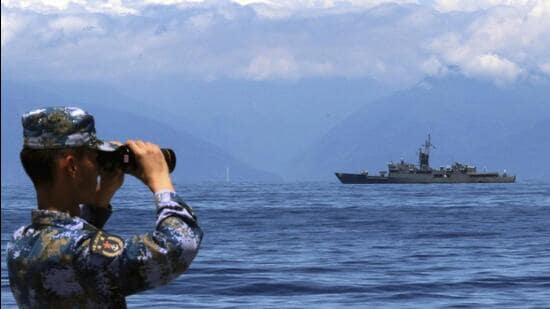
The Indian side, locked in a military standoff with China in the Ladakh sector of the Line of Actual Control (LAC) for more than two years, so far maintained a studied silence on last week’s Pelosi visit to the self-governed island that China sees as a breakaway province, and the air and sea drills conducted by the People’s Liberation Army (PLA).
External affairs ministry spokesperson Arindam Bagchi, without naming either China or Taiwan, outlined India’s position on the issue in response to several questions at a weekly media briefing.
Also Read: India must strengthen its ties with Taiwan | Opinion
“Like many other countries, India too is concerned at recent developments. We urge the exercise of restraint, avoidance of unilateral actions to change status quo, de-escalation of tensions and efforts to maintain peace and stability in the region,” Bagchi said.
A reporter from China’s state-run Xinhua news agency pointedly mentioned Pelosi’s visit to “China’s Taiwan region” and the support received by Beijing from some 170 countries on the “one-China” principle, and asked about India’s position on this matter but the spokesperson was not drawn out on the issue.
{{/usCountry}}A reporter from China’s state-run Xinhua news agency pointedly mentioned Pelosi’s visit to “China’s Taiwan region” and the support received by Beijing from some 170 countries on the “one-China” principle, and asked about India’s position on this matter but the spokesperson was not drawn out on the issue.
{{/usCountry}}“India’s relevant policies are well-known and consistent. They do not require reiteration,” Bagchi replied.
Also Read: The fallout of China’s actions | HT Editorial
In response to another question, Bagchi said India has no plans as of now to evacuate the 10,000-odd Indians living in Taiwan. He noted that all Indian missions around the world have contingency plans in place for expatriate Indians but said that no advisory has been issued so far in the case of Taiwan.
Almost all other countries that criticised China’s military drills in the Taiwan Strait have also acknowledged the “one-China” policy regarding their relations with Beijing. India is among the very few countries that have not made a reference to the policy in their response to the tensions in the Taiwan Strait.
People familiar with the matter said the “one-China” principle hasn’t found mention even in India-China joint statements since at least 2005. The last time the Chinese side made a push for the principle to be included in a joint statement was during the Chinese president’s visit to India in 2014.
At the time, the Indian side was non-committal due to widespread anger over China’s policy of issuing “stapled visas” to residents of Jammu and Kashmir and Arunachal Pradesh, parts of which are claimed by China.
A report on India-China relations issued by the parliamentary committee on external affairs in 2018 noted that India is “overtly cautious about China’s sensitivities while dealing with Taiwan and Tibet”, whereas “China does not exhibit the same deference while dealing with India’s sovereignty concerns, be it in the case of Arunachal Pradesh or that of the China-Pakistan Economic Corridor (CPEC) in Pakistan-Occupied Kashmir (PoK)”.
Since the beginning of the military standoff on the LAC in May 2020, the Indian leadership has accused Chinese troops of making several attempts to alter the status quo in border areas and of violating agreements and protocols for border management. India’s opposition to such unilateral changes to the status quo has been supported by key partners such as Australia and several European nations.
Though there are no diplomatic relations between India and Taiwan, both sides have maintained representative offices in each other’s capitals since the mid-1990s to look after economic, trade, investment, cultural and science and technology issues.