
 E-Paper



In a first, Quad foreign ministers hold meeting on UNGA sidelines
The foreign ministers of India, United States, Japan and Australia met on Friday in their first meeting as the Quad partners on the sidelines of the United Nations General Assembly (UNGA), a meeting during which they reaffirmed their partnership, especially in the Indo-Pacific theatre.


New York
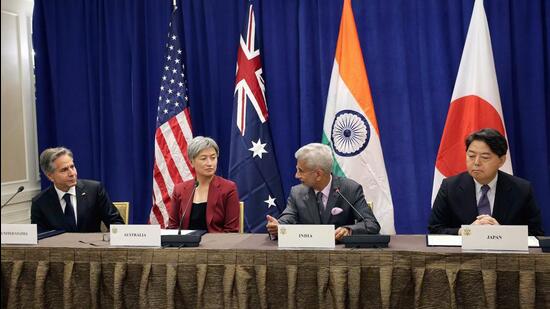
The foreign ministers of India, United States, Japan and Australia met on Friday in their first meeting as the Quad partners, after the grouping got formally institutionalised with leader level summits, on the sidelines of the United Nations General Assembly (UNGA), a meeting during which they reaffirmed their partnership, especially in the Indo-Pacific theatre.
The ministers, India’s S Jaishankar, US’s Anthony Blinken, Australia’s Penny Wong and Japan’s Yoshimasa Hayashi, signed a set of guidelines on Quad’s partnership on humanitarian assistance and disaster response (HADR).
Jaishankar said it was important for the grouping to continue working on its “constructive agenda” and “delivery of public goods”.
This is the fifth high-level political engagement, including those between top leaders and foreign ministers, among Quad countries in just the past year.
US Secretary of State Blinken, who lost his father late on Thursday but still made it a point to host the meeting, said the gathering and the HADR partnership was evidence that Quad “is strong and getting stronger” and the fact that no one country alone can deal with the current challenges and seize opportunities is the inspiration behind the grouping.
He hoped that Quad meetings on UNGA sidelines would become a regular feature.
Australia and Japan focused on the strategic subtext of the grouping, with Australian foreign minister Wong saying that no one in the room wanted an Indo-Pacific region where countries were not able to make sovereign choices and “one country and one perspective dominates”, in what appeared to be a clear reference to China.
Japan’s foreign minister Hayashi said it was extremely significant to show the grouping’s commitment to the UN charter and a free and open Indo-Pacific when these principles were under threat, and highlighted the need to work with countries in the region to do so.
The HADR agreement represents a full circle for Quad countries for in its most original avatar, the four nations had first come together to cooperate in the domain of disaster response and relief in the wake of the 2004 tsunami.
On Friday, India kept the focus on tangible and constructive items on the Quad agenda in its public comments. Jaishankar said that it was particularly timely that they were meeting, for the world had gone through a few years of Covid, global repercussions of the Ukraine war were playing out, and there were “climate events and emergencies of an unprecedented scale”.
“Given the turbulent times, it is particularly important that we, the Quad, go further in the constructive agenda that we have set for ourselves, that we work together on delivery of public goods. And particularly what we are signing today — the HADR partnership which we discussed and finalised in Tokyo — is extremely timely.”
The minister said the grouping had got other initiatives in the making, some a little further in the pipeline such as the STEM fellowship that provides an opportunity to scholars from all four countries. “We are working on the economic framework though we have many other partners beyond Quad, on maritime domain awareness. It is a great idea that we meet regularly on sidelines of UNGA… This is also an opportunity for us to discuss how to strengthen the UN-led multilateral system,” Jaishankar added, in an apparent reference to UN reforms that India has long advocated.
Exactly a year ago, on September 24, 2021, President Joe Biden hosted the first in-person Quad leaders’ summit. In February this year, Quad foreign ministers met in Melbourne. In March, Quad leaders held a virtual summit in wake of Russia’s invasion of Ukraine, and in May, the second in-person Quad summit took place in Tokyo where HADR cooperation was discussed and formalised.
Quad foreign ministers had also met in 2019 in New York, but this was before leader-level summits began and Quad got more formally institutionalised.
Through each of these meetings, the scope of Quad’s agenda has expanded, and differences such as the one on Ukraine where India’s stand differed from that of the others in the early months of the war have not halted the deepening of ties.
In his comments before the leaders signed the HADR partnership guidelines, Blinken said: “Our meeting today and document we are about to sign is evidence that Quad is strong and getting stronger. It is strengthening our multilateral cooperation. Our four countries know very well that the significant challenges we face as well opportunities before we have demand more than ever that we work together. No one of us alone can do as necessary to meet these challenges and seize these opportunities. That is the inspiration behind Quad.”
Wong recalled that the new Australian government, just hours after it was sworn in, had renewed its commitment in Tokyo “to a free and open Indo-Pacific that is inclusive and resilient and to a Quad which is a force for good, a Quad which is committed to bringing tangible benefits to the region and ensuring a region which is peaceful, stable, prosperous and in which sovereignty is respected and where countries are free to make their own choices”.
The Australian foreign minister, in the sharpest comments among the four ministers about the strategic big picture underlying Quad, added: “None of us in this room want to see a region in which countries are not able to make those sovereign choices and any one country and one perspective dominates. We do know our region is being reshaped economically and strategically and we are here because we want to work with countries here to better navigate this period of change better. This is the heart of the Quad.”
In brief remarks to HT after the meeting about the key takeaways and engagement with India, Wong said: “It is extremely important for our four countries to work together in a demonstration of our collective focus on a region that is prosperous, secure and where sovereignty is respected. We appreciate India’s engagement”.
Japan underlined both the strains in the international order, but also the need to work together with countries in the region to ensure a free and open Indo-Pacific. While Quad has consistently referred to the centrality of ASEAN in the region, many countries in Southeast Asia are keen not to be forced into a position to make choices between the US and China. Quad’s focus on tangible goods is seen as a way of allaying those apprehensions.
In his public remarks, Hayashi said: “Today the world is witnessing direct attempts to unilaterally change the status quo by force. The free and open international order based on rule of law is under threat. So, it is extremely significant for us to demonstrate together to the international community our firm commitment to the UN charter and free and open Indo Pacific.”
But, he added, this cannot be achieved “without working together with countries in the region”. “I am confident that the guidelines for Quad partnership on HADR here will further strengthen our collaboration to effectively respond to disasters in the Indo-Pacific region.”


