
 E-Paper



In India’s wildlife debate, the battle between the cheetah and lion
The introduction of cheetahs in MP’s Kuno Palpur wildlife reserve and cyclone Tauktae hitting Gujarat’s Gir National Park, the country’s only wild home for lions, has triggered a ferocious debate among conservation experts on whether Kuno should get cheetahs from Africa or lions from Gir


The introduction of cheetahs in Madhya Pradesh’s Kuno Palpur wildlife reserve and cyclone Tauktae hitting Gujarat’s Gir National Park, the country’s only wild home for lions, has triggered a ferocious debate among conservation experts on whether Kuno should get cheetahs from Africa or lions from Gir.
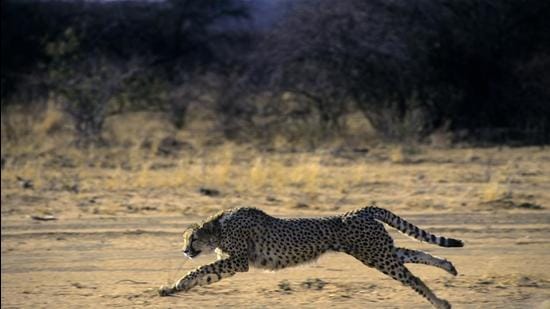
Most wildlife experts say that Kuno should get lions from Gir as the habitat was originally developed for translocation of the big cats so that they could get a second home outside Gujarat, more so after the devastating Tauktae, which caused felling of about 2.5 million trees in Gir.
Although the Gujarat forest department claimed that no lion died because of the cyclone, wildlife experts said the cyclone was a warning to governments that India needs a second home for lions.
“You can relocate people to safer places before the cyclone comes. Not wildlife. You need a second home for them to ensure Asiatic lion species from wild is not wiped out,” said a scientist from the Wildlife Institute of India, who was not willing to be quoted as he was not authorised to speak to media.
For the lion
The idea to find a second home for lions was mooted in early 1990s and the Madhya Pradesh government started developing Kuno Palpur as second home for Asiatic lions. The Gujarat government refused to share lions with Madhya Pradesh saying they were pride of Gujarat.
Environmental activists filed a petition in the Supreme Court seeking directions to Gujarat government to provide lions from Gir to Kuno to develop a second wild home for Asiatic lions. The Gujarat government categorically refused to give lions to Madhya Pradesh, arguing that lions were safe in Gir and the state would create a second home for them, if needed, within Gujarat.
Also Read | Experts fear biodiversity loss in Andaman, Nicobar Islands
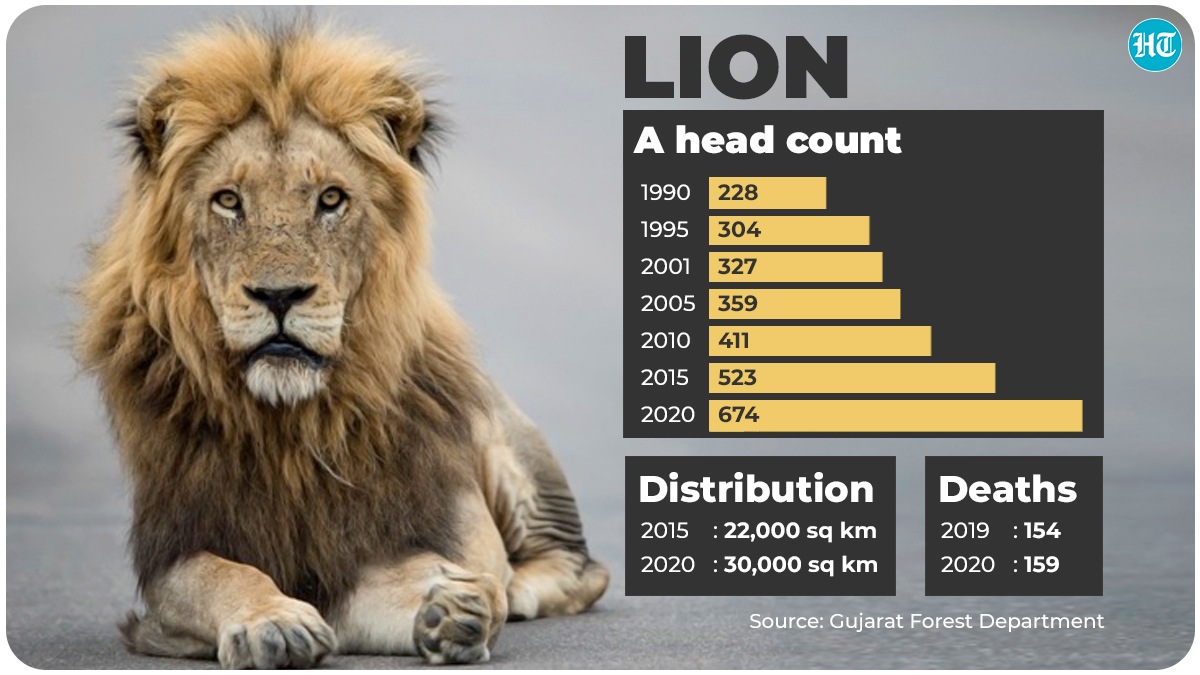
Lions did not get a second home even eight years after the Gujarat government told the Supreme Court it would create one, despite almost 40% of the lion population in Gujarat living outside the notified wildlife areas and being vulnerable to diseases from livestock. According to wildlife experts, 1,400 square km of Gir National Park has a carrying capacity of about 250 or so lions and the park has attained that level more than two decades ago. So, now lions are moving close to people and their livestock.
“It (over-populated Gir) has two fold implications,” said a wildlife biologist Meena Venkatraman, who has worked in Gir for more than two decades. “First, for the animal himself, and second, for people living around them.”
The signs of these implications are visible.
In September 2018, 27 lions in Gir died because of canine distemper virus (CDV) while 37 others had to be quarantined. The incident brought back memories of 1994 incident in Serengeti National Park in Tanzania where one-third of 3,000 lions died due to CDV in a few weeks.
Between January to May 2020, a central government expert committee pointed out that some lions had again caught CDV while it was investigating death of 20 lions because of babesiosis, a disease caused by babesia protozoa which spreads through tick parasite.
Dogs are said to be carriers of CDV which has high mortality rate among cats and a study done by National Institute of Virology concluded that Gir lions got CDV from dogs. “Reintegration of the existing lion population from the Gir region to different sanctuaries can ensure the protection and conservation of the species,” the institute said in its report.
The Gujarat forest department data shows that lion deaths because of conflict with people are on the rise. As per information provided to the state assembly, 159 lions died in 2020 as compared to 154 in 2019 in and around Gir and about one-third of them were probably because of conflict with humans. The state forest department officials have rejected the claims of rising conflict with people to relocate lions saying there were just stray cases and lions were safe in Gir.
With lions in Hyderabad zoo getting Covid-19, and the impact of cyclone Tauktae, the debate on lions needing another home has got reignited. Wildlife biologist and conservation scientist Ravi Chellam, who has been involved in research and conservation of felines since 1985, said that the possibility of lions population getting wiped out because of a natural disaster such as cyclone is high even though the cats living in wild contracting the virus in a free-ranging condition from humans is “close to zero.”
Also Read | High chance of hitting 1.5°C tipping point during next five years, warns WMO
Weather scientists such as Mathew Roxy Koll of Indian Institute of Tropical Meteorology have repeatedly said that with warning of sea surfaces because of the climate crisis, the intensity and frequency of cyclones would rise. “The number of cyclones witnessed in Arabian Sea in the past decade is highest since 1901 and the intensity of them is also increasing,” Koll said.
Tauktae gusted the Saurashtra coast, where Gir is situated, with a wind speed of about 185 kilometer per hour and caused huge ecological devastation in Gir, even though no loss of lions was reported. “Our initial estimate shows that 2.5 to 3 million trees were damaged badly,” said a Gujarat forest department official. Gujarat chief conservator of forest, Shyamlal Tikadar, said assessment of ecological loss was being done. Climate studies show that intensity of cyclones across the world including in Arabian Sea will rise in coming years, posting a grave danger to Gir lions.
The cheetah question
In the present circumstances, Kuno appears to be viable for translocation of lions as it was developed for them. But it may not be available as a second home for Asiatic lions. The reason is a Supreme Court appointed expert committee, which has decided to import Cheetahs from South Africa in MP’s green habitat, bordering Rajasthan’s Ranthambore tiger reserve. The Centre, earlier this month, informed the Madhya Pradesh forest department that it could import eight cheetahs from South Africa by November this year.
“Since the beginning, Kuno was developed to receive Asiatic Lions and was never seen from the Cheetah perspective,” said Faiyaz Khudsar, a wildlife biologist, who has carried out a long term research in Kuno National Park. The grasslands and the prey population in Kuno was groomed to sustain lion population. “Most of the evacuated crop fields are now taken over by many woody plant species such as Ziziphus nummularia and Acacia leucophloea and other woody shrubs and non-palatable grasses such as Desmostachya bipinnata etc. It led to slow ecological elimination of probably the most preferred catchable prey for cheetah i.e. chinkara and now chinkara can be rarely sighted in Kuno,” he said.
Khudsar said small population of Blackbuck reported from Poh ki Nimai and Manak Chowk area of Kuno have already been eliminated in ecological succession. “Once seen in large group size, Chital is now seen in small groups due to the continuous loss of open large grassland. Therefore, Kuno is not a site to see successful introduction of Cheetah,” Khudsar said.
Those in favour of introduction of cheetah, such as MK Ranjitsinh, said the project would help India in protecting some of its lost grasslands and create new wildlife habitats. Cheetahs were last spotted in India in 1950s and Ranjitsinh first tried relocation of cheetahs from Iran in 1970s. He was able to convince environment minister Jairam Ramesh in 2010 to get cheetahs and an expert committee headed by him was formed. They selected three locations in India for introduction of Cheetah. The Supreme Court, however, put a stay on the project after some wildlife conservationists approached the apex court.
Also Read | Researchers at IISER document new species of African Violet in Mizoram
“The opposition to the project is misconceived. If the tigers can adapt to new habitats within the country, the cheetah can also. Conservation of cheetahs can help in conserving grasslands and protect grassland species like Great Indian Bustard, who are now less than 200 in India. Kuno may not be perfect but it is a good option,” Ranjitsinh had told this correspondent in 2019 when the Supreme Court gave the go-ahead to the project.
Debunking claims against Kuno, Madhya Pradesh’ principal chief conservator of forest (wildlife), Alok Kumar, said, “Cheetah translocation is an ambitious project. We are leaving no stone unturned to develop Kuno as one of the best habitats for cheetah. We have started construction work of boundary wall and also cutting thorny bushes.”
Wildlife biologist and conservation scientist Ravi Chellam questioned the need to introduce cheetahs in India when there is not a robust policy framework for conservation and protection of so many species and grasslands. “A robust policy to conserve these last remaining grassland fragments must precede the cheetah, not depend on its arrival being the catalyst of preservation,” said Chellam, CEO, Metastring Foundation and member of the Biodiversity Collaborative.
In 2011, the central government had estimated that project cheetah would cost ₹300 crore, even though most of national parks, other than tiger reserve, get ₹12 lakh annual from the central kitty, according to one study on the allocation for wildlife made in financial year 2018-19. Ranjitsinh said the “ecological benefits” of the project cannot be measured in money terms. For the project, the environment ministry has allocated ₹14 crore in May 2021.
Khudsar said that the possibility of lion surviving in Kuno is much higher than cheetahs and Kuno should be kept for shifting lions in case of an epidemic or a natural disaster. Chellam backed him saying the SC’s 2013 order had disallowed the introduction of cheetahs calling it “arbitrary and illegal”, in part due to the lopsided idea of flying in an exotic species, while undermining its own native species, like the endangered Asiatic lion. Kumar added that there is no end of road for lion translocation as two cat species can co-exist in Kuno. Tigers and cheetahs lived close to each other in Madhya Pradesh, about 100 years ago. M
 ABOUT THE AUTHORChetan Chauhan
Chetan Chauhan is the National Affairs Editor looking into all aspects of news and features from across India. A Chevening scholar with over three decades of experience in reporting and news management, Chetan has extensively covered all important aspects of the social sector, political economy, environment and climate change nationally and internationally. He did a journalism course at the Reuters Institute of Journalism in Oxford and Digital Media training at Nanyang Technological University in Singapore. He started as a reporter with The Statesman in 1996 and joined the Hindustan Times in 2000 in the metro bureau covering environment, crime and Delhi politics. He covered hot local news, from the Jessica Lal murder case to the rebellion of Delhi Congress MLAs against then Chief Minister Sheila Dikshit, to the replacement of toxic vehicle fuel with cleaner compressed natural gas (CNG) in the national capital. Some of his stories on air pollution became part of the Supreme Court’s landmark MC Mehta versus Government of India case in the National Capital Region (NCR), forcing the government to take corrective measures. As part of the national political bureau since 2004, he covered important central sectors such as environment, education, social justice, labour, rural development, water resources, renewable energy, agriculture, broadcasting and the Planning Commission for more than a decade producing several exclusive and investigative breaking stories. His specialisation is the environment, having covered at least a dozen United Nations global conferences on climate change, biodiversity and wildlife including climate summits in Paris, Copenhagen and Bali. He also covered India’s two five-year plans ---11th and 12th and reported on drafting and execution of right based laws such as Right to Education, Right to Information and rural job guarantee law, MG-NREGA, now being introduced in new format as VG-RAM-G Act. He has in-depth knowledge of social sector issues. He was one of the first to report on tigers vanishing from Sariska and Panna wildlife reserves in 2004 and 2008, respectively, leading to the setting up of the National Tiger Conservation Authority (NTCA) and the introduction of stringent penal provisions for poaching. He has written extensively on the rising human-animal conflict in India and the degradation of India’s biodiversity hotspots because of mining and other activities. Since 2004, Chetan has covered Parliament comprehensively and participated in training on the nuanced coverage of Parliament proceedings. He has travelled extensively across India to cover national and provincial elections since 1998, especially in the Hindi heartland states, considered India’s road to power. He writes a regular column for Hindustan Times, Ecostani, on important national politics, economy, Himalayan ecology and environmental issues. His other responsibilities include providing inputs for edits and edit page articles for the publication, apart from managing news flow from across India.Read More


