On the sidelines of India’s heady barnstormer performances at the Chess Olympiad, there appeared other familiar pieces of news. The All India Tennis Association (AITA) had been taken to court by two former senior pros. The treasurer of the Indian Olympic Association (IOA) was threatening to do so against its president if allegations against the treasurer were not withdrawn.
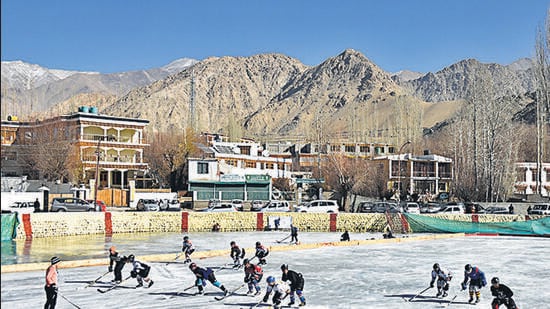
Ladakh has a chance like few others — to adopt distinctly clean sports governance habits. (Sanchit Khanna/HT PHOTO)
It is possible when this news reached Ladakh, a shiver ran up the spines of its sports officials. This had nothing to do with dipping temperatures, but instead with the wish to be spared such mud and its never-ending slinging. Not only is Ladakh geographically distant from such tawdriness, the Union territory (UT) has a chance like few others -- to adopt distinctly clean sports governance habits.
Previously tied in with state of Jammu & Kashmir, the granting of UT status in 2019 has given Ladakh’s sport fresh oxygen. “Well, we’re trying to keep it apolitical -- as much as possible,” says a UT Ladakh sports ministry official. It means applying the national sports code, “all its rules and regulations” making it one of “very few states” aiming to put the code into real-time practice. On a new canvas.
Earlier this year, when Vikram Malik first took over his posting as secretary power, tourism and sport, UT Ladakh, what he saw around him was heartening. There was ice-hockey and skating on frozen lakes, football on mud flats, archery and endurance running. Malik, who is from Haryana, said: “This region has a great sports culture, plus the physical fitness and endurance levels of people are very good because of living at 10,000 feet.”
With Ladakh’s budget rocketing from ₹300 crore to ₹6,000 crore, Malik says “investment in sport has also increased tremendously”. There are funds to create new play spaces and put fresh policies in place, fielding people who according to an official, “have played sport some time or have first-hand knowledge of their sport itself, who, you know, will contribute; who are not dummies.”
Ladakh has just established its own Sports Council, an umbrella body of its 20 registered sports organisations and associations. As first-time governors of sport, said the sports ministry official, “Everyone has seen what is going on in the national organisations in the rest of the country - we tell them the whole story. Keep it simple as possible, transparency, accountability, those things.”
The winter season will hopefully bring the completion of a world standard ice hockey rink costing round between ₹60-70 crore in the centre of Leh, ready to host next February’s ice hockey nationals. “Winter sport is the niche here, our of the 20-odd players on the national team, 16 are from this region,” Malik said. That the national federation is still run out of Delhi makes little sense, but well…
Ladakh, sparsely populated with around 300,000 people, is divided into two districts -- Leh and Kargil -- and further divided into six subdivisions. This year’s plans, says Malik “is to saturate the subdivisions with three basic things - an astro turf for football, an ice hockey rink, an athletic running track”. Plus, as part of Ladakh’s sport-tourism double-team, there’s a ski slope being set up in Kargil and academies for winter sport in Dras and Zanskar.
Along with this hardware, the software gaps that Ladakh must bring at speed are qualified people to train, to officiate, and to run sport. “One of the parts that was missing was coaching,” Malik said. “So we are sending our coaches to batches in different parts of the country, for some sports like ice hockey and skating to places in central Asia.” There are some rumblings about an ice-hockey league as well but that will need the rink to be up and running.
Earlier, in September, Ladakh staged its biggest football event for the second year in a row -- the Climate Cup, a zero-carbon event to highlight the impact of the climate crisis on the region. I-League team Gokulam Kerala came through a feat of skill and endurance at 11,000 feet above sea level, winning the title and the handmade wooden trophy.
The Ladakh Football Association is pushing to add to its annual calendar, and has already conducted a D-licence coaching course. When the course was announced, Tsering Angmo, general secretary of the Ladakh Football Association, said that people came from everywhere -- “from borders areas, some driving ten hours. We tried to subsidise the ₹16,000-course by paying for half”. The LFA, she says, has now written to the administration to try and get one coach and one referee from every village to do these basic required courses. Higher level courses, making space for 11-a-side matches along with futsal which is very popular are next on the list.
Sports ministry officials would like greater notice to be taken of Ladakh, its topography, and its people. The region’s altitude, they point out, could also be the base for setting up high altitude training centres at 8000ft (Kargil) and 11,000 feet above sea level.
“Creating infrastructure is not a problem at all - it is the easiest thing to do, you need people to use it,” said one of them. The 300-bed sports hostel coming up at the Spituk Open Stadium which hosted the Climate Cup will the need qualified professional man power to run it and ensure it doesn’t turn into a “ghost hall”.
Locals remain rankled that there has been no scouting of the UT’s athletic potential from any of the large corporates — they reel off Reliance, Tata, JSW — who have invested in talent-development over the last few decades.
Ladakhis know that they will excel at winter sport, endurance and combat sport, but they need to be seen. Fortunately, unlike the majority of their compatriots elsewhere, their sporting ecosystem is an opportunity to nurture a generation of officials whose primary focus is will be to champion the cause of athletes over their own.
Get the latest India News, breaking headlines and real-time updates from across the country. Stay informed about politics, government policies, crime, weather and major national developments.
Home/India News/In Ladakh’s Clean Slate, A Rare Chance For Sport Administrators To Learn Lessons

 E-Paper