E-Paper



Video footage shows last moments of 8 Nanda Devi climbers
The ITBP rescue team recovered the bodies of seven climbers after a very tough climb through steep gradient, heavy snow and high-velocity wind in one of the most difficult high-altitude operations in the Himalayas

 Prefer HTon Google


Indo-Tibetan Border Police (ITBP) on Monday released video footage of eight mountaineers heading for the Nanda Devi East summit before they changed course for an unnamed peak in Uttarakhand’s Pithoragarh shortly ahead of an avalanche on May 26 which killed them.
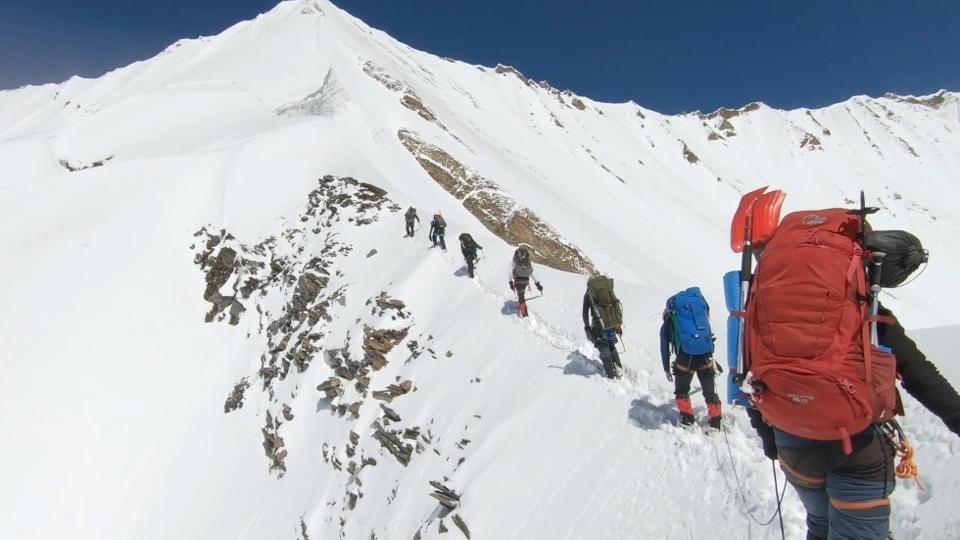
Bodies of seven of the eight mountaineers were retrieved almost a month later on June 23 by an ITBP search team.
The one-minute 55-second video had likely been shot by one of the mountaineers on the early morning on May 26 while heading for the summit on the unnamed peak when the avalanche swept them away. It depicts mountaineers during their ascent in a line towards the unnamed peak.
The video footage was released in Delhi by ITBP during a function to felicitate the 11 member rescue team which retrieved the bodies on June 23 near after a 500-hour high altitude retrieval mission code name ‘Daredevils’
According to Vivek Kumar Pandey, public relations officer (PRO) ITBP, SS Deswal, DG ITBP on Monday felicitated the 11 member of the search team who had successfully retrieved the bodies of the seven mountaineers from an altitude of almost 20000 feet.
Congratulating the team, Deswal said that the ITBP was proud of them. “The operation was conducted in most difficult, inhospitable and trying conditions. ITBP is in a process to raise five high altitude rescue teams comprising of mountaineers of the force in five states- Jammu and Kashmir, Himachal Pradesh, Uttarakhand, Sikkim and Arunachal Pradesh. ITBP is the first responder in such situations in the Himalayas,” he said.
Twelve mountaineers on their attempt to climb Mount Nanda Devi East were on an expedition in Pithoragarh District since May 13, onwards.
On May 30, 2019, the Pithoragarh district administration received a distress call about the missing mountaineers. The ITBP was requested to search for eight mountaineers who were reported missing since May 26 while attempting to summit an unnamed peak near Nanda Devi East.
Four of the 12 mountaineers were rescued alive and airlifted from Nanda Devi base camp on June 2. The four, Mark Thomas, Ian Wade, Kate Armstrong, and Zachary Quain from Britain who had split from the main group, told local officials on May 31 that eight other team members had not returned as planned and that they had been in touch with them until 26 May, a day before an avalanche hit the mountain, the ITBP said in a statement.
On June 3, two of the rescued mountaineers were taken back to the area from where the climbers had gone missing. They succeed in getting photographs in which they spotted five bodies. Helicopter operations were attempted with the help of Indian Air Force on June 5, but due to terrain, weather and wind conditions, the bodies could not be retrieved.
After this, ITBP with the help of Pithoragarh district administration started a search operation from June 14 onwards by establishing base camps near the site of the avalanche. The eight missing mountaineers included expedition leader Martin Moran, John Mclaren, Rupert Whewell and Richard Payne (all from UK), Anthony Sudekum and Ronald Beimel (from the US), Ruth McCance from Australia, and Chetan Pandey of the Indian Mountaineering Foundation, who was the Indian Liaison Officer
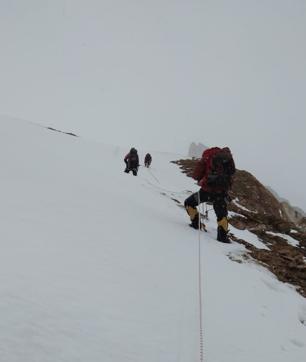
The ITBP rescue team eventually reached the site after a very tough climb through steep gradient, heavy snow and high-velocity wind in one of the most difficult high-altitude search operations in the Himalayas. The team retrieved seven bodies on June 23. The eighth body – that of Martin Moran could not be found.
These bodies were found at an altitude of 18000 feet in the bowl below the peak they were attempting to climb. The bodies were then taken to a nearby safe site later that day but efforts to airlift them failed due to attitude.
After a reconnaissance on June 29 and 30 by Indian Air Force helicopters, it was decided to take the bodies to a lower altitude first by ITBP search team so that they could be airlifted from there.
On July 1, ITBP mountaineers managed to take four bodies to the highest point of the ridge (18,800 feet) before they were brought down to Base Camp 1 helipad (15,250 feet).
The remaining three bodies were carried the next day to the same point first. All bodies were taken to Base Camp 1 temporary helipad on the evening of July 2. Then the bodies then airlifted to Munsyari and further to Pithoragarh on July 3 and handed over to the Pithoragarh district administration. The search operation was conducted under the supervision of APS Nimbadia,,Deputy Inspector General (DIG) ITBP.
Nanda Devi is India’s second highest mountain, is a two-peaked massif, forming a two-kilometre-long high ridge, oriented east-west. It is the 23rd-highest peak in the world.
The western summit is higher, while eastern summit, called Nanda Devi East, is the lower one.
It was first climbed in 1936 by a British-American expedition, becoming the highest peak climbed by man until the 1950 ascent of Annapurna.