
 E-Paper



In Ludhiana, tailors respond by switching from kurtas to masks
Since April 2, the tailors of at least three small towns, three towns of Payal, Doraha and Malout have been stitching at least 450 to 500 cotton masks a day, for which they are being paid Rs 15 a mask by the district administration.


Till last month, the tailor shops in Ludhiana’s small towns were busy making ladies’ blouses and kurta-pajamas on order. In the past six days, their brief has undergone a swift revision.
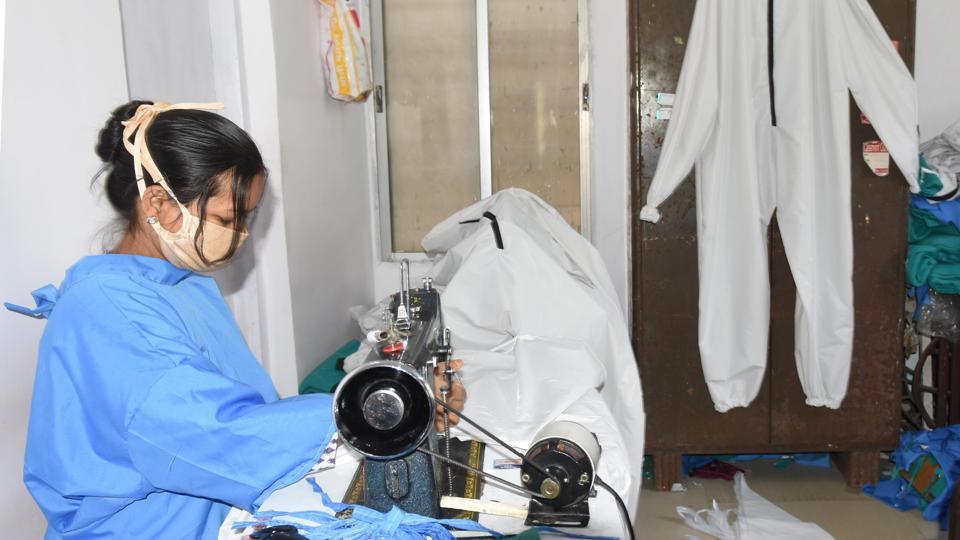
Since April 2, the tailors of at least three small towns, three towns of Payal, Doraha and Malout have been stitching at least 450 to 500 cotton masks a day, for which they are being paid Rs 15 a mask by the district administration. The authorities are funding the project through two agencies — the District Red Cross Society and the Local Bodies Department. Till date, an amount of Rs 1 lakh has been incurred by the administration for the project.
Several individuals and even a gurudwara in Payal have offered donations to the project — money, fabric and elastic bands.
“There was an acute shortage of masks in the market and so we decided to make best use of our talent. It takes us about 20 minutes to make a mask which can be washed and re-worn many times,” said 36-year-old Nihal Ahmad, one of the tailors in Payal, a nondescript town located close to the National Highway 44 that runs through the middle of Punjab and outskirts of Ludhiana city. The tailors themselves are taking precautions like using sanitiser and sitting at a distance from each other inside a shop, Ahmad said.
The administration has sourced the fabric from suppliers in the city. One of the suppliers, Rajiv Grover of Ram Pal and Company in Payal, said he supplied five metres of cotton fabric to the tailors last week but it was a struggle as the shops are closed due to the lockdown. “We are getting in touch with traders and manufacturers who are donating, so that the work doesn’t stop,” he said.
An advisory issued by the ministry of health and family affairs last week stated that homemade protective masks helped maintain “personal hygiene” and could be used by those who weren’t suffering from any medical condition or didn’t have any breathing difficulty, especially while stepping out. However, such masks were not recommended for Covid-19 patients or those involved in their care including healthcare workers and medical professionals.
“The supply of fabric is not an issue,” sub divisional magistrate Sagar Setia said, adding that the district authorities have supplied the cloth required to make these masks — all of them are being made using three layers of cloth, covering the nose and mouth of a wearer.
The authorities have given these masks to village authorities to distribute in villages.
“We put the masks in the kits meant to supply ration to poor people so that these can reach all homes. At other places we are doing door to door distribution. At some places we are seeking help of the police who also supply it to the villagers and those in need of masks,” Pradeep Kumar Bains, tehsildaar of Payal sub division, said. Around 900 ration kits with these cotton masks in them have already been distributed.
Across villages, it is usually the men who wear these masks.
“These masks are of considerable benefit to the women who usually use a dupatta to cover their face. But a dupatta usually requires frequent handling which is not good,” said Sunita Kumari, one of the tailors making these cotton masks.
“I got a mask with the ration kit but wore it only once. My son then took it and plays with it,” said Chanda, a 35-yearold resident of Doraha and the wife of a farm labourer.


