
 E-Paper



Relief for migrant workers: ‘One nation, one ration card’ expands to 32 states
The one nation, one ration card system will come as a boon for migrant workers, who could not access their share of cheap foodgrains when they relocated from their native places for work in cities because the system did not allow for it.


The Modi government’s “one nation, one ration card” programme, a digital system aimed at enabling countrywide access to subsidized foodgrains for 80 million migrant workers, is now operational in all 32 states, while four states are in the process of digitizing their networks, data from the food ministry shows.
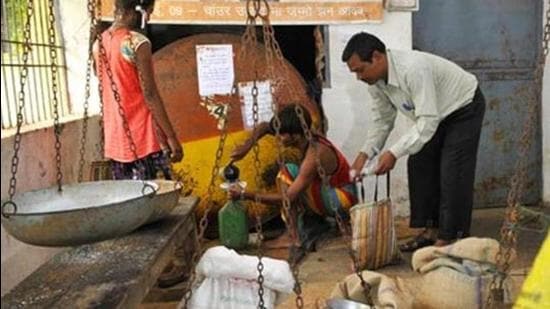
Between August and February, there were 230 million transactions through the digitized system, the data show.
The government has also rolled out “Mera Ration”, a mobile app, available to 67% of the population or over 800 million beneficiaries of subsidized grains under the National Food Security Act 2013, food secretary Sudhanshu Pandey told HT. The app will show beneficiaries real-time data of ration stocks, their share and nearest fair-price shops from where they can procure cheap grains.
The one nation, one ration card system will come as a boon for migrant workers, who could not access their share of cheap foodgrains when they relocated from their native places for work in cities because the system did not allow for it.
A migrant worker just needs to present his ration card, which is now seeded with the 12-digit biometric Aadhaar, in digitized ration shops to withdraw subsidised foodgrains, a lifeline for 67% of Indians deemed food-insure.
The new digital network does away with the need for a migrant to make a fresh ration card, a cumbersome task, while shifting to faraway cities or another district for work to be able to withdraw grains from the public distribution system (PDS).
During the peak pandemic months, the plight of thousands of workers fleeing cities, facing hunger and distress in the aftermath of the coronavirus lockdown, could have been eased had the programme to make subsidized rations portable for migrants been fully operational. The programme hadn’t gained the scale and reach to be a mitigating factor then.
According to data from the ministry, West Bengal, Delhi, Chhattisgarh and Assam are yet to operationalize the system or at an advanced stage of implementing it. “The problem with Assam is that Aadhaar penetration is low. Delhi and West Bengal are almost ready with the digital infrastructure,” Pandey said.
In 32 states, the scheme is now fully geared for seamless inter-state and even intra-state transactions. Inter-state portability, whereby a migrant draws subsidised food in a state other than his own, ensures in-kind subsidies move with migrants wherever they go.
The Economic Survey 2016-17 used some new metrics to give updated data on migration. It suggested an annual inter-state migration flow of close to 9 million from 2011 to 2016 in a “circular” fashion based on data from railways.
The first portability trials were done by September 2018 in clusters in six states. By January 2020, 12 states -- Andhra Pradesh, Telangana, Gujarat, Maharasthra, Haryana, Rajasthan, Karnataka, Kerala, Madhya Pradesh, Goa, Jharkhand and Tripura – were in.
The system essentially allowed for “state-level portability”, meaning ration-card holders could draw rations from any electronically linked fair price shops within their “district or state”.
A novel cohort-based migration metric, a statistical tool developed by former chief economic adviser Arvind Subramanian, revealed an annual “inter-state migrant population of about 60 million and an inter-district migration as high as 80 million” between 2001 and 2011. Subramanian had called for full portability of all welfare doles.


