E-Paper



Sullivan, Doval unveil cooperation road map
India and the US have launched a new initiative to drive cooperation in hi-tech across seven areas, with a focus on removing barriers and export controls standing in the way of enhanced collaboration. The move is part of the initiative on Critical and Emerging Technologies (iCET) and envisages closer cooperation between private industry, researchers and academia of the two sides. It is also part of efforts to focus on deliverables for Prime Minister Narendra Modi?s state visit to the US next week. The partnership spanning several fields will be crucial for New Delhi?s plans to counter China?s aggression.

 Prefer HTon Google


India and the US on Tuesday unveiled a major initiative to drive cooperation in hi-tech across seven areas, ranging from artificial intelligence to semiconductors and defence, with the focus on removing barriers and export controls standing in the way of enhanced collaboration.
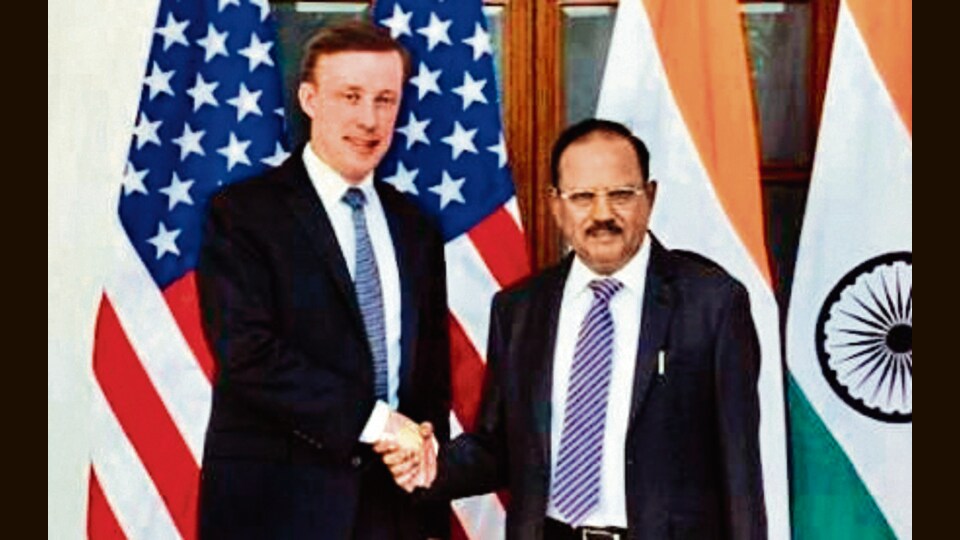
The move, spelled out by national security adviser (NSA) Ajit Doval and his visiting US counterpart Jake Sullivan, is part of the initiative on Critical and Emerging Technologies (iCET) launched in January and envisages closer cooperation between private industry, researchers and academia of the two sides. It is also part of efforts to focus on deliverables for Prime Minister Narendra Modi’s state visit to the US next week.
Sullivan also met PM Modi and briefed him on progress in various areas of cooperation. He said US President Joe Biden looked forward to welcoming Modi on his state visit.
Modi expressed satisfaction at the deepening of the comprehensive global strategic partnership with the US, and said he looked forward to a “productive visit and an engaging conversation with President Biden on bilateral, regional and global issues”, according to a readout from the external affairs ministry.
Addressing a roundtable on the theme “Advancing India-US iCET” organised by the Confederation of Indian Industry (CII), Doval highlighted the speed at which things had moved. “I was very excited, but I was also sceptical. I wasn’t very sure whether the idea would be able to take off. Today, I am much more confident and hopeful. And it is because of not what has happened between the governments,” he said.
“It’s more because of the response [from] industry, business, scientists, research scholars [and] institutions. They took the battle, and they took the battle much faster, at much greater speed than I had anticipated.”
Sullivan said the cooperation was about much more than technology. “It’s about our people-to-people relationships. It’s about building the skills of our populations. It’s about building habits of trust and confidence between every element of our societies and governments, it’s about deepening our defence cooperation in ways that will serve us strategically as well as economically,” he said.
The visit again underlines the deepening ties between India and the US, which will be further bolstered when Prime Minister Narendra Modi visits Washington DC. The partnership spanning several fields will be crucial for New Delhi’s plans to counter China’s aggression.
Apart from restricted discussions between Doval and Sullivan on Tuesday, separate groups held discussions on seven specific areas of cooperation – AI and quantum computing, advanced materials, defence, semiconductors, next generation telecommunications, bio-tech, and space.
People familiar with the matter said the focus is on concrete deliverables ahead of Modi’s visit to the US, removing barriers, and aligning export control regulations of the two countries. “This is a work in progress though we have made significant progress in just six months. The export controls are more on the US side,” one of the people cited above said.
Doval noted that the two sides have put in place the Quantum Coordination Mechanism, signed an MoU on semiconductors and launched a public-private dialogue on telecommunications to drive collaboration in Open RAN, 5G and 6G. There have also been important exchanges on AI and “positive momentum” on the defence and space pillars, he said.
Sullivan noted the two sides are seeking to address issues that have stood in the way of maximising the full potential of cooperation. The deliverables for Modi’s visit “are not just bullet points on a page”, he said.
“They are fundamentally designed to remove those obstacles in defence trading, in hi-tech trade, in investment in each of our countries, in taking away obstacles that have stood in the way of better collaboration among our scientists and researchers, in stimulating greater access for our students going both ways, for Americans coming to India, for Indians coming to the US,” he added.
Sullivan described recent contacts between key institutions and departments of the two sides as unprecedented and designed to remove barriers “keeping us from being able to drive forward in ways that all of us want to see”. This includes research and development on 5G, 6G, defence cooperation and removing barriers to strategic trade. “Fundamentally, our aim is to catalyse and encourage as much, if not more, momentum between our businesses, our think tanks and research chambers,” he said.
Key recommendations from Tuesday’s discussions include signing a “security of supply agreement” in the realm of defence and listing India among the qualifying countries for the Defence Federal Acquisition Regulation Supplement (DFARS), while also easing regulatory mechanisms to facilitate co-design and co-development of critical technologies.
In the field of semiconductors, there were recommendations to decentralise supply chains to create an alternate eco-system for de-risking and for developing a talent corridor between India and the US. In the field of advanced materials, there was a recommendation to simplify export control guidelines and speed up clearances for manufacturing licensing agreements and joint technology development agreements.
There was also a recommendation in the realm of space cooperation for joint satellite missions to co-develop core technologies and to create a white list for technology transfers between India and the US. In telecommunications, the recommendations included the development of an innovation corridor for joint research and chip innovations and creating a trusted and structured framework for supply chains, cyber-security and technology access.
Sullivan’s visit to India comes on the heels of trips to New Delhi by other key US officials such as treasury secretary Janet Yellen (in February), secretary of state Antony Blinken (in March), under secretary of state for political affairs Victoria Nuland (in March) and defense secretary Lloyd Austin (in May).
The iCET is being seen as a major new initiative that builds on framework agreements signed by the two sides for collaboration and sharing of sensitive technologies, including the Communications Compatibility and Security Agreement (COMCASA) that was inked in 2018 and Basic Exchange and Cooperation Agreement (BECA) signed in 2020.