E-Paper



India hopes Myanmar elections will be fair and inclusive: Modi to junta chief
The unrest in Myanmar since the military ousted the elected government of Aung San Suu Kyi in a 2021 coup has triggered concern in India

 Prefer HTon Google


India hopes the upcoming elections in Myanmar will be fair and inclusive with the involvement of all stakeholders, Prime Minister Narendra Modi told the head of Myanmar’s ruling junta, Senior General Min Aung Hlaing, when they met on the margins of the Shanghai Cooperation Organisation (SCO) Summit in China on Sunday.
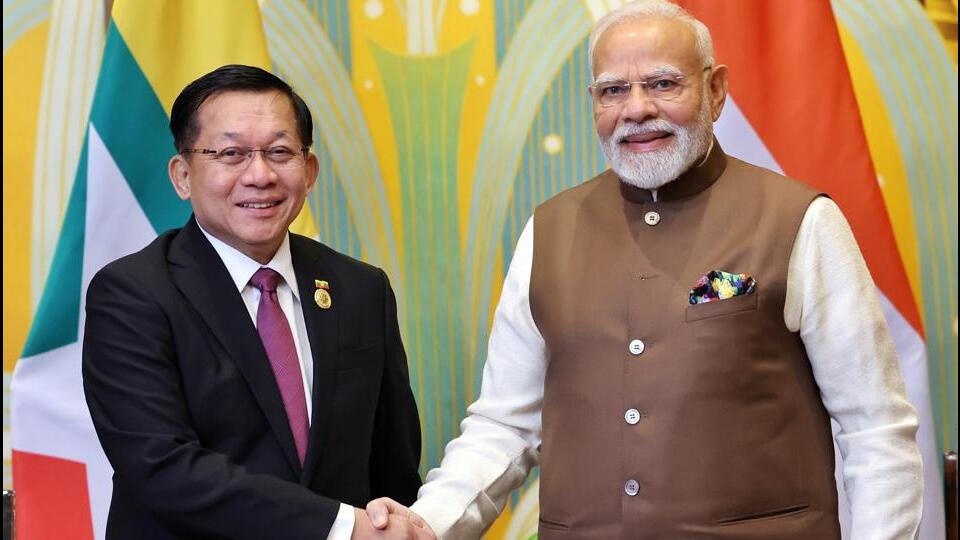
Hlaing, chairman of the State Security and Peace Commission of Myanmar, is among leaders invited as special guests to the summit by China. The unrest in Myanmar since the military ousted the elected government of Aung San Suu Kyi in a 2021 coup has triggered concern in India, especially in view of security implications for the country’s northeastern region.
Modi told Hlaing that India attaches importance to its relations with Myanmar as part of its Neighbourhood First, Act East and Indo-Pacific policies. He expressed the hope that the “forthcoming elections in Myanmar will be held in a fair and inclusive manner involving all stakeholders”, the external affairs ministry said in a readout.
India supports a “Myanmar-led and Myanmar-owned peace process”, for which peaceful dialogue and consultation is the only way forward, Modi said.
Myanmar’s military government announced this month that multi-phase elections will begin on December 28. Scepticism remains that the junta will allow a free and fair vote and opposition groups have said they will boycott the elections.
Armed resistance groups launched a coordinated operation against the junta in October 2023, leading to a civil war that has engulfed wide swathes of Myanmar. The anti-junta resistance forces have captured all border trade points and key territories located along the frontier with India’s northeastern states. The Indian side has been concerned by thousands of Myanmarese nationals taking refuge in Mizoram and the links between armed groups on both sides of the border.
Modi and Hlaing also reviewed bilateral ties and discussed the way forward in several aspects of cooperation, including development partnership, defence and security, border management and border trade issues. Modi said progress in ongoing connectivity projects will foster greater interaction between the people of the two countries and promote regional cooperation and integration as envisioned in India’s Act East policy.
Modi reiterated India’s readiness to support the developmental needs of Myanmar, the readout said.
The PM posted on social media about several informal engagements with other leaders attending the SCO Summit in the Chinese city of Tianjin, including Maldivian President Mohamed Muizzu and Nepal’s Prime Minister KP Sharma Oli.
“Interacted with President Muizzu of Maldives on the sidelines of the SCO Summit in Tianjin. India’s developmental cooperation with Maldives is greatly beneficial for our people,” he said. In a separate post after meeting Oli, Modi said India’s relations with Nepal are “deep-rooted and very special”.
Modi also interacted with Kazakhstan President Kassym-Jomart Tokayev, Kyrgyz President Sadyr Japarov, Tajikistan President Emomali Rahmon, Turkmenistan President Serdar Berdimuhamedow, Uzbek President Shavkat Mirziyoyev, Armenian Prime Minister Nikol Pashinyan, Belarus President Alexander Lukashenko, Lao President Thongloun Sisoulith, Vietnam’s Prime Minister Phạm Minh Chính and Egyptian Prime Minister Mostafa Madbouly.
Bilateral relations and cooperation in areas ranging from trade and energy to security and health care figured in these interactions.